 Visualization
Silverware Tray With Long Fork Lane SVG, Four Pocket Utensil Drawer Organizer Laser Cut File, Knife and Spoon Insert DXF
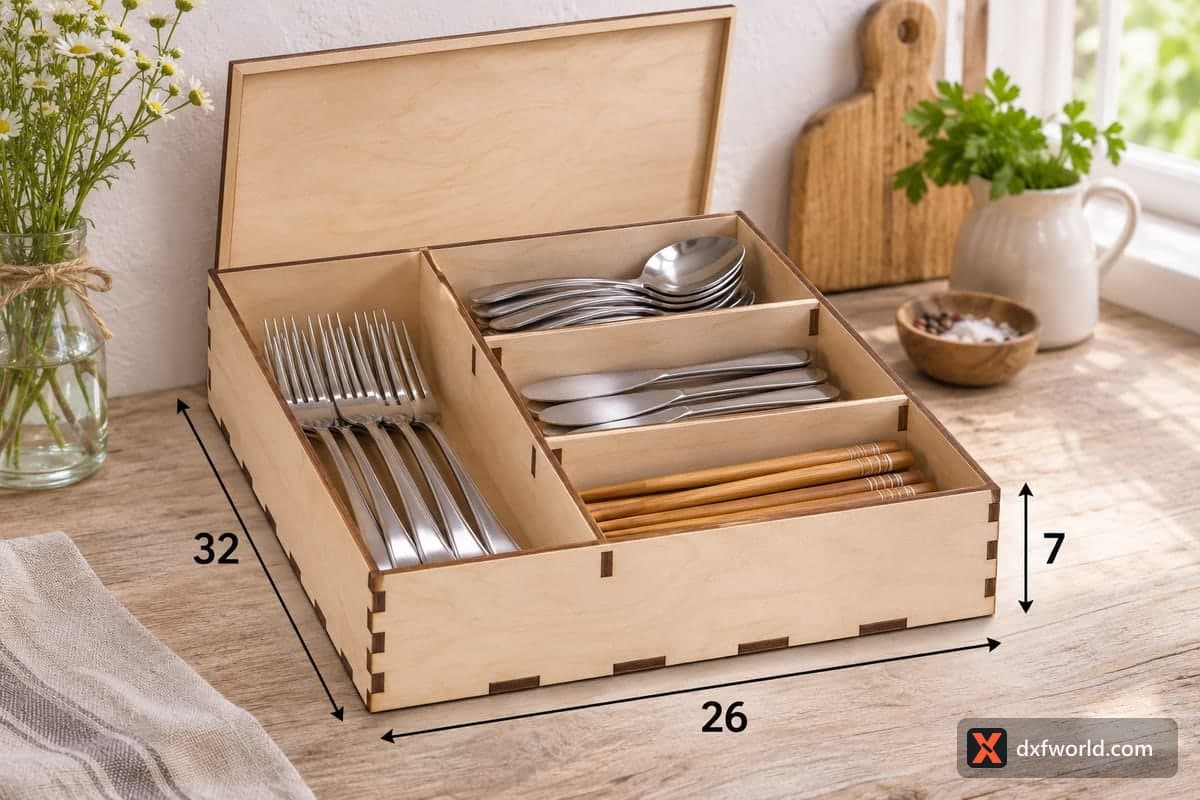
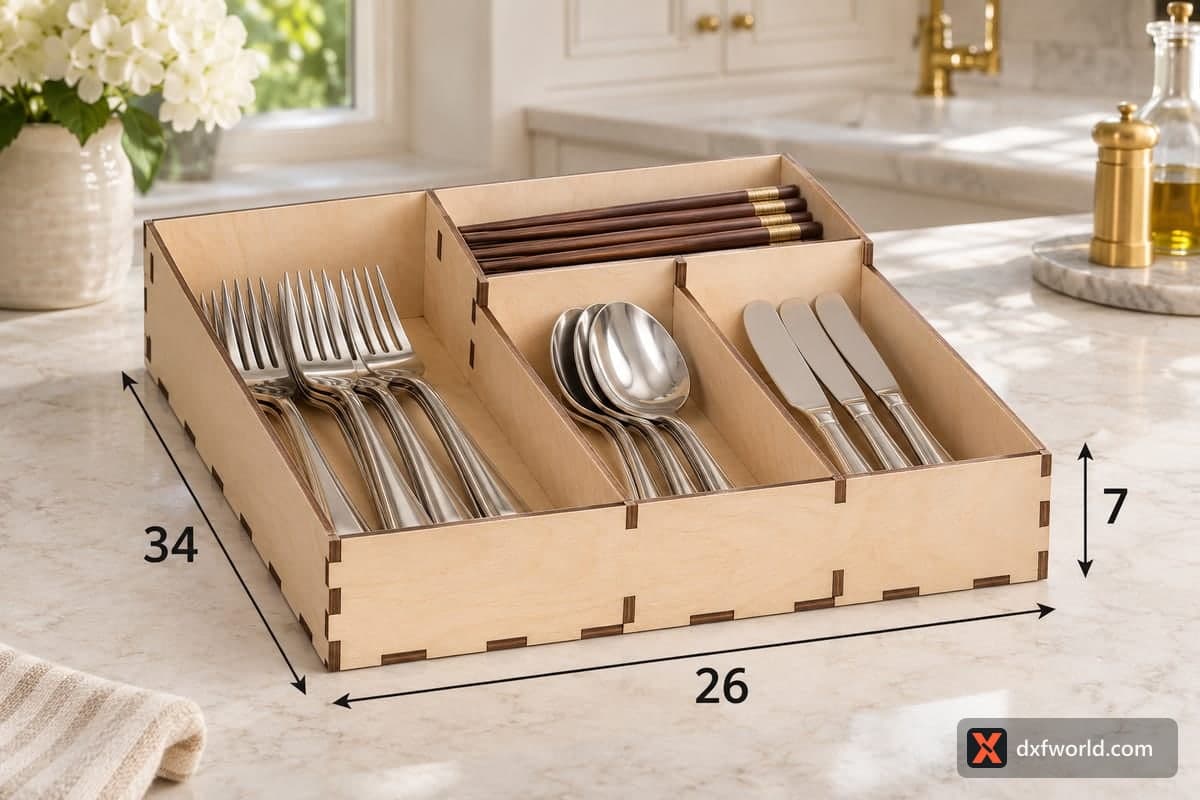
A free laser cut file for an open silverware tray with one long lane on the left and three pockets stacked front to back on the right, 260 × 340 × 70 mm (10.24 × 13.39 × 2.76 in) outside. The download has SVG and DXF for 3, 4, 5 and 6 mm plywood; its 8 pieces, including one long divider and two cross dividers, fit together with tabs and slots.
- Formats
- SVG, DXF
- Outer size (W × D × H)
- 260 × 340 × 70 mm (10.24 × 13.39 × 2.76 in)
- Parts
- 8
- Material thickness
- 3, 4, 5 or 6 mm plywood (a file for each)
- Layout size (3 mm file)
- 1,220 × 422 mm
- Cut length
- 6.79 m
- Est. time, 10 W diode (3 mm)
- 22 min 38 s
- Est. time, 40 W CO2 (3 mm)
- 9 min 26 s
- Layers
- CUT only, no engraving
Free account required to download
How to make it
- 01Pick the file that matches your plywood and test one cross divider slot on scrap before cutting the full sheet.
- 02Cut the 8 pieces, with the base on its own sheet if your laser bed is smaller than the layout.
- 03Fit the long divider into the base, add the two cross dividers on the right side, then close the four walls around them.
- 04Sand the pocket edges smooth, seal with lacquer or oil, and sort long pieces into the lane and small ones into the pockets.
One long lane, three short pockets
Most cutlery trays force you to choose between long lanes and small boxes. This one mixes the two. A divider running the full 34 cm depth sets off a narrower lane on the left, about 9.5 cm wide, which takes dinner forks, table knives or a pair of chopsticks lying lengthwise. The wider right column, about 15 cm across, is split by two cross dividers into three pockets roughly 11 cm deep.
Those pockets are where the small, easily lost pieces go: teaspoons and coffee spoons laid crosswise, cake forks, butter spreaders, bottle openers or chopstick rests. In the photo the back pocket holds dark chopsticks, with spoons and knives in front of it. Standard 23 cm chopsticks are longer than the pockets are wide, so for those the left lane is the better home.
Cut, build and finish
The 3 mm file takes about 22 min 38 s on a 10 W diode, about 9 min 26 s on a 40 W CO2 and about 4 min 32 s on a 100 W CO2. The layout is 1220 × 422 mm; on a small bed, cut the 260 × 340 mm base on its own sheet and the walls and dividers on a second. All walls are 70 mm tall and the front is straight, so the tray suits a standard drawer.
Put the long divider in first, then slide the two cross dividers between it and the right wall before the walls close around them. Glue is optional. Sand the edges and seal with oil or lacquer.
Ideas for sellers
- Add a few simple chopstick rests cut from the offcuts
- Offer it as a starter kit for a first apartment
- Bundle it with a teaspoon set as a coffee lover gift
Questions about this file
Where do long knives go?
In the left lane, which runs the full depth of the tray. The right pockets are about 11 cm deep and suit teaspoons and small tools.
Can I move the cross dividers?
Their slots are fixed in the file. To change the spacing, move the slots in your editor and keep them as wide as your plywood.
Will 3 mm plywood hold up in a busy drawer?
Yes for home use. A drop of glue in the corners helps if the drawer is opened and shut hard many times a day.
Can I engrave labels on the pockets?
You can add small engraved words or icons to the divider faces before cutting. Nothing is engraved in the download, so labels are your own addition.
Is MDF safe for a cutlery tray?
Sealed MDF is fine for dry cutlery. Plywood copes better with the odd damp spoon, so it is the safer pick for a kitchen.
Similar files