 Visualization
Spice Tray SVG, Low Sloped Spice Jar Organizer Laser Cut File, Six Section Seasoning Box DXF
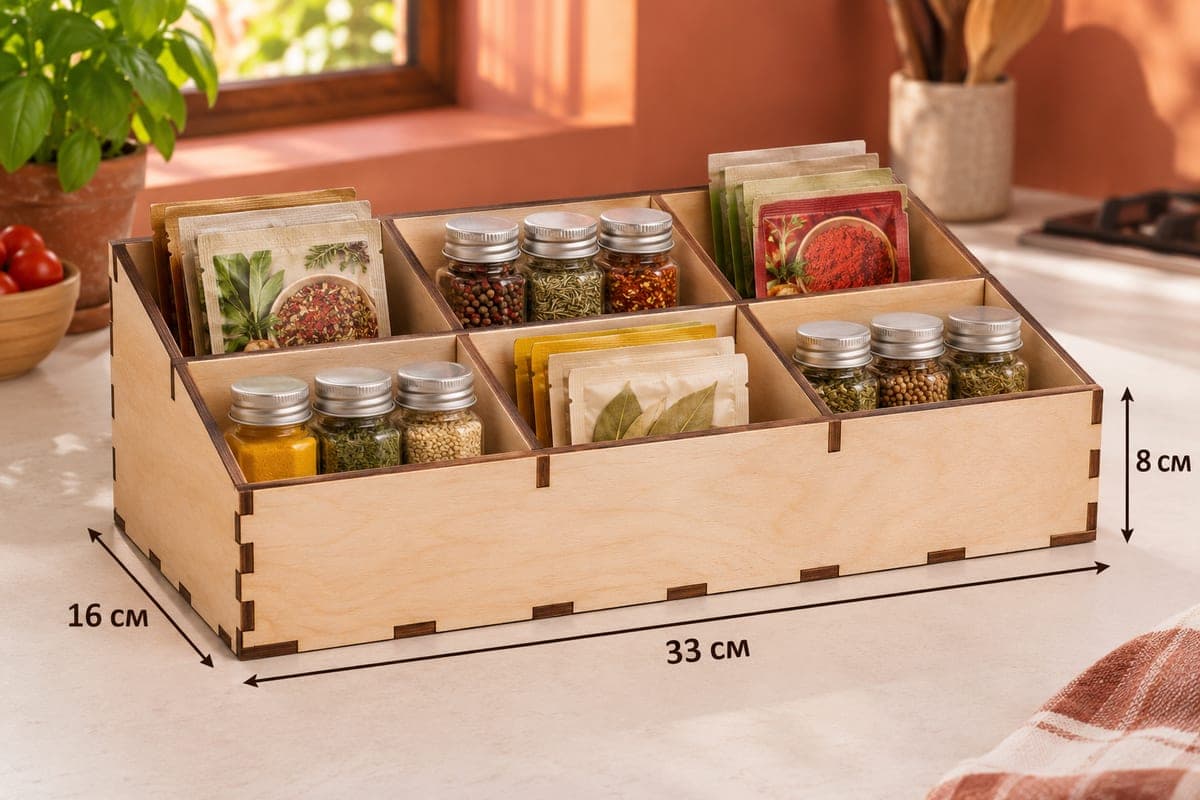
A free laser cut file for a long, low spice tray with six sections in two rows of three, where the front wall drops to 40 mm and the sides slope down from an 80 mm back. Included are SVG and DXF files for 3, 4, 5 and 6 mm plywood; the tray measures 330 × 160 × 80 mm (12.99 × 6.30 × 3.15 in) and is made of 10 pieces that fit together with tabs and slots. It fits inside a shallow cabinet or on an open shelf.
- Formats
- SVG, DXF
- Outer size (W × D × H)
- 330 × 160 × 80 mm (12.99 × 6.30 × 3.15 in)
- Parts
- 10
- Material thickness
- 3, 4, 5 or 6 mm plywood (a file for each)
- Layout size (3 mm file)
- 1,334 × 252 mm
- Cut length
- 6.29 m
- Est. time, 10 W diode (3 mm)
- 20 min 59 s
- Est. time, 40 W CO2 (3 mm)
- 8 min 44 s
- Layers
- CUT only, no engraving
Free account required to download
How to make it
- 01Select the file for your plywood thickness, then cut one small divider and check it slides into its slot without forcing.
- 02Cut the 10 parts, splitting the 1334 mm strip into shorter groups for a smaller laser bed.
- 03Place the long cross divider in the base, add the two taller back dividers and the two lower front dividers, then close it with the back, sloped sides and 40 mm front.
- 04Sand the front edge, finish with oil or lacquer, and arrange jars and packets across the six sections.
A wide, shallow layout
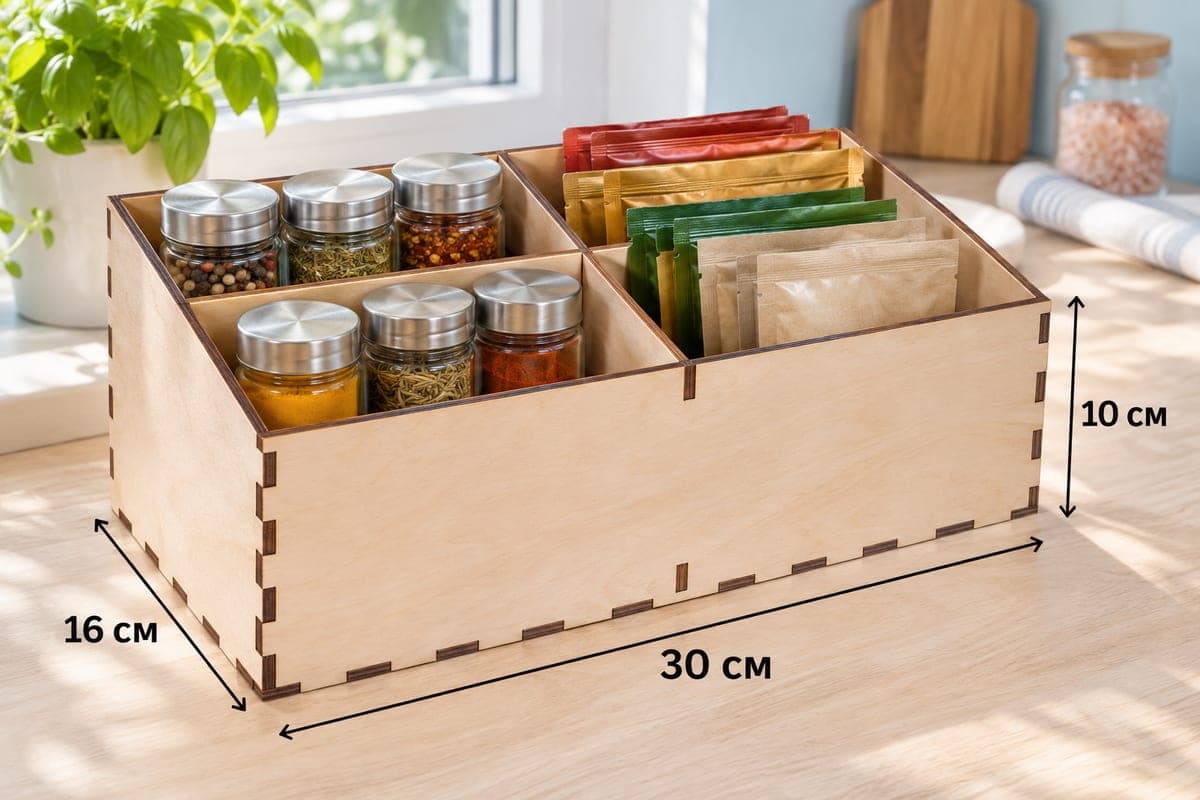
At only 80 mm tall and 330 mm long, this tray suits low cupboard shelves and the space under wall cabinets. A long cross divider splits it into a back row and a front row, and each row has two short dividers, so you get six sections of similar size. The dividers in the two rows are slightly offset rather than lined up, which you can see in the photo; it gives the tray a staggered look and makes each section easy to reach.
The photo mixes contents on purpose: the back row holds herb packets, three jars and a stack of chili blends, while the front row has three jars on each end and bay leaf sachets in the middle. Because the front wall is just 40 mm, half the back height, jar labels stay visible from above.
Thickness and machine notes
All 10 parts nest in a strip 1334 × 252 mm long, which is narrow but longer than most hobby beds. Split the parts into two or three groups and cut them on separate sheets. Cutting time for the 3 mm file is about 20 min 59 s on a 10 W diode, about 8 min 44 s on a 40 W CO2 and about 4 min 12 s on a 100 W CO2.
3 mm birch keeps the tray light and is plenty for small jars. Choose 4 mm for a firmer feel, and leave 5–6 mm for a CO2 laser unless you are happy to run several diode passes.
Finishing
Round the top edges of the low front with fine sandpaper, since that is where fingers touch most. A hardwax oil or water-based lacquer protects it from spills; let it cure fully before adding food packets. Paired with a jar label set, it sells well as a kitchen starter gift.
Questions about this file
What fits in each of the six sections?
Each section is about 80 mm wide, which takes three slim spice jars in a row or a stack of flat seasoning packets standing on edge.
Why are the front and back dividers not in line?
The two rows are planned separately, so their dividers sit at slightly different positions. It does not affect strength, and the cross divider holds both rows.
Is the low tray short enough to go inside a drawer?
At 80 mm tall it fits many deeper drawers; measure the inside height first. The sloped front also makes it easy to see into from above.
Could this spice tray be cut from MDF instead of birch?
Yes, use the file that matches the MDF thickness and seal it well, because raw MDF swells if it gets wet near the sink or stove.
Can I resize the tray for a longer shelf?
You can stretch the length, but keep the slot width equal to your sheet thickness, otherwise the dividers will be loose or will not go in.
Similar files