 Visualization
Low Front Utensil Organizer SVG, Sloped Side Cutlery Caddy Laser Cut File, Five Bay Flatware Tray DXF
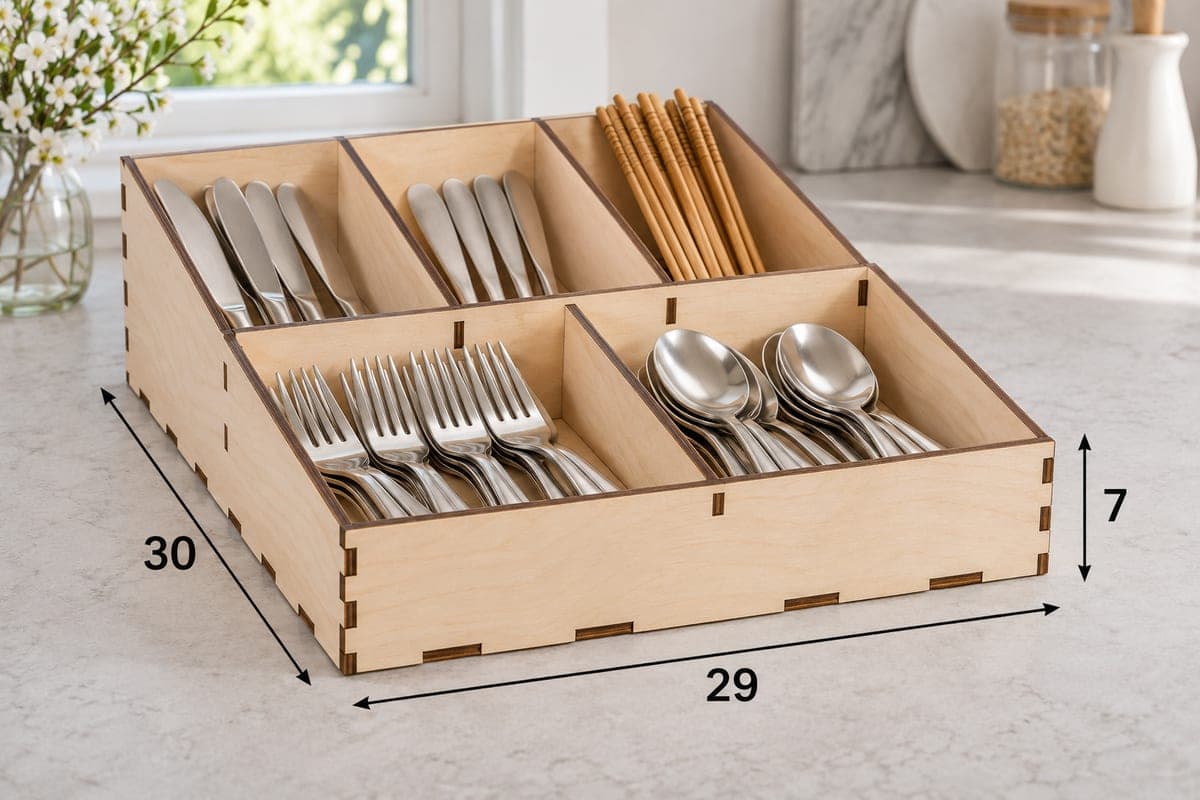
An open utensil organizer with a 42 mm front wall, sides that slope up to a 70 mm back, and five bays: three tall ones along the back and two wide, low ones at the front. It measures 290 × 300 × 70 mm (11.42 × 11.81 × 2.76 in), is made of 9 plywood pieces that assemble with tabs and slots, and is a free SVG and DXF download with separate files for 3, 4, 5 and 6 mm plywood.
- Formats
- SVG, DXF
- Outer size (W × D × H)
- 290 × 300 × 70 mm (11.42 × 11.81 × 2.76 in)
- Parts
- 9
- Material thickness
- 3, 4, 5 or 6 mm plywood (a file for each)
- Layout size (3 mm file)
- 1,200 × 382 mm
- Cut length
- 7.09 m
- Est. time, 10 W diode (3 mm)
- 23 min 38 s
- Est. time, 40 W CO2 (3 mm)
- 9 min 51 s
- Layers
- CUT only, no engraving
Free account required to download
How to make it
- 01Select the thickness folder that matches your sheet and cut one corner joint to check that the tabs seat fully.
- 02Cut the base, the 42 mm front, the 70 mm back, both sloped sides, the cross divider and the three dividers.
- 03Join the sides to the base, add front and back, slide in the cross divider, then fit the two tall back dividers and the short front one.
- 04Round over the sloped edges with sandpaper, finish with a food-safe oil and load knives at the back, forks and spoons in front.
Two rows, two heights
The front wall is only 42 mm tall, 60% of the back wall, and the side panels slope down to meet it. Inside, a cross divider separates a front row from a back row. The back row has three narrow bays between full-height 166 mm dividers; in the photo they hold dinner knives, butter spreaders and a bundle of bamboo chopsticks standing tall. The front row is lower and split into two wide bays by one short 137 mm divider, where forks and spoons lie in easy reach.
That split suits how most people set a table: the long, thin items wait at the back, and the pieces you grab by the handful sit in front, where the low wall lets you see the full count at a glance.
Cutting notes
The 3 mm layout comes to 1200 × 382 mm with 7092 mm of cut line. It takes about 23 min 38 s on a 10 W diode, about 9 min 51 s on a 40 W CO2 or about 4 min 44 s on a 100 W CO2 for the 3 mm file. The two sloped side panels and the 290 × 300 mm base are the longest parts; on a 400 mm bed move the dividers onto a second sheet. Sand the sloped top edges of the sides with a block so the angle stays crisp.
Make it a set
- Cut a second one for the cooking drawer and fill the back bays with spatulas and tongs.
- Sell it together with a matching napkin holder as a dinner table set.
- Stain the inside a darker shade than the outside so the bays read clearly.
Questions about this file
What goes in the back row and what goes in the front?
The three back bays are full height and suit items that stand or lie long, like knives, spreaders and chopsticks. The two front bays are wider and lower, good for forks and spoons you grab often.
Does the low front make it less stable?
No, the base is a full 290 × 300 mm panel. The low front only changes how easy it is to reach in.
Can this five bay organizer be cut from acrylic?
Clear or frosted acrylic works with the 3 mm file, as long as your sheet is really 3 mm thick. Measure it first, because acrylic sheets often vary by a few tenths.
Is it low enough to go inside a kitchen drawer?
It needs about 75 mm of clear height and 300 mm of depth. In a shallower drawer, scale it down and keep slot widths equal to the plywood.
How do I protect it near a sink?
Use a water-based polyurethane on all faces, including the base underside. Let the cutlery dry before putting it back so no water sits in the bays.
Similar files