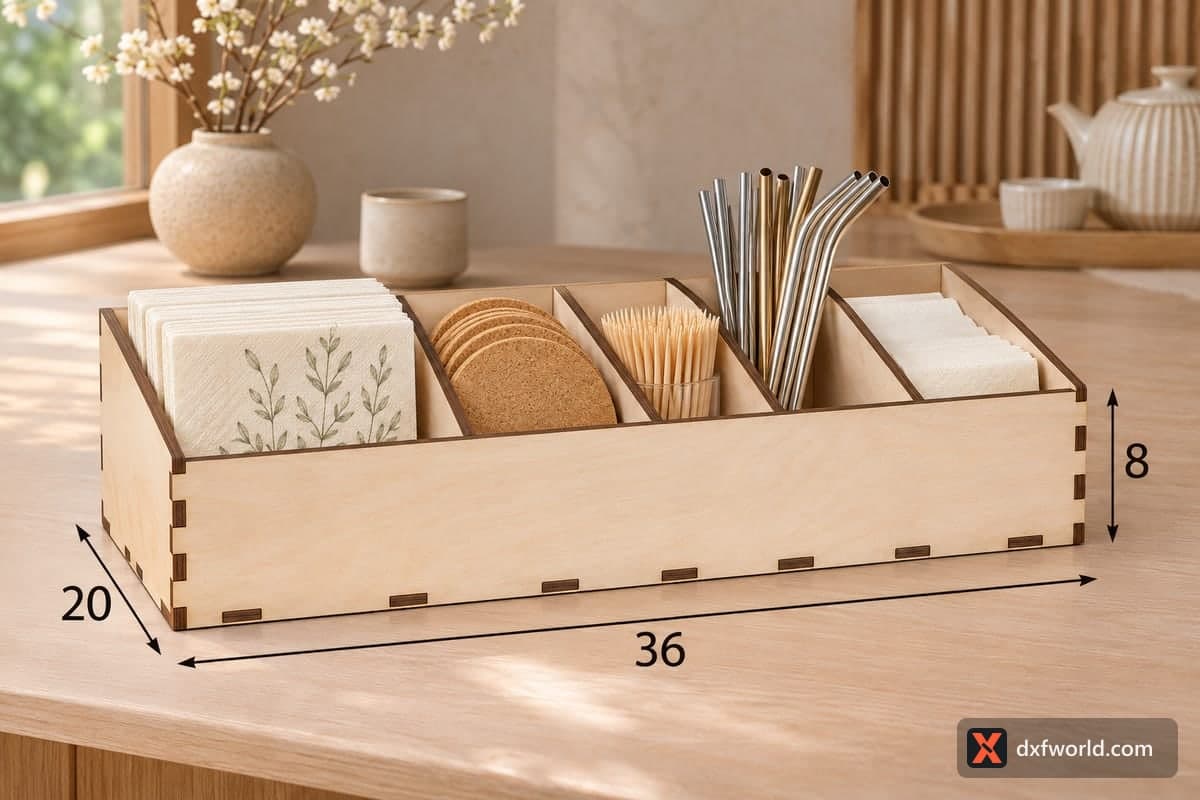
 Visualization
Sloped Napkin Caddy SVG, Five Section Table Organizer Laser Cut File, Long Coaster and Straw Tray DXF
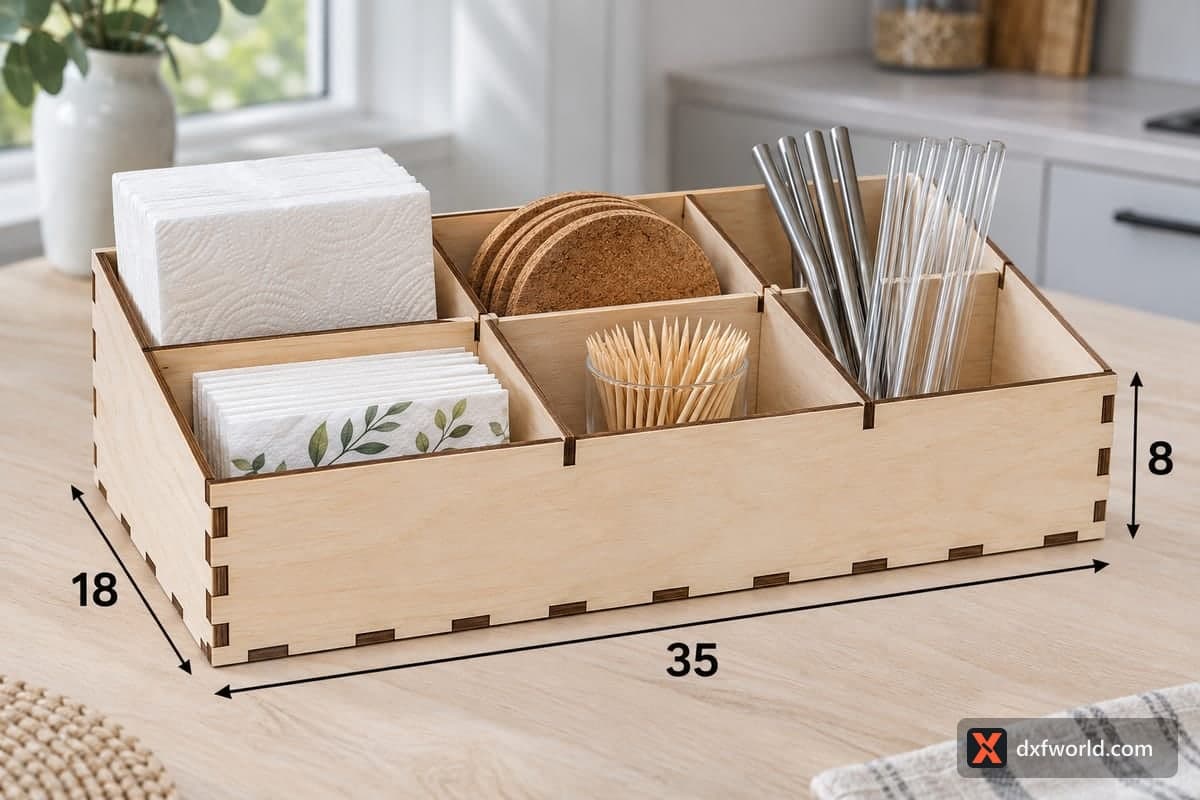
A free long napkin caddy with five sections in a row and a sloped front: the front wall is 48 mm high and the sides slope up to the 80 mm back, so napkins, coasters, toothpicks and straws are easy to see and grab. The download has SVG and DXF files for 3, 4, 5 and 6 mm plywood; the caddy measures 360 × 200 × 80 mm (14.17 × 7.87 × 3.15 in) and is built from 9 pieces that join with tabs and slots.
- Formats
- SVG, DXF
- Outer size (W × D × H)
- 360 × 200 × 80 mm (14.17 × 7.87 × 3.15 in)
- Parts
- 9
- Material thickness
- 3, 4, 5 or 6 mm plywood (a file for each)
- Layout size (3 mm file)
- 1,184 × 292 mm
- Cut length
- 6.97 m
- Est. time, 10 W diode (3 mm)
- 23 min 13 s
- Est. time, 40 W CO2 (3 mm)
- 9 min 41 s
- Layers
- CUT only, no engraving
Free account required to download
How to make it
- 01Pick the SVG or DXF for your plywood thickness and cut one divider slot on scrap to check the fit.
- 02Cut the 9 pieces, splitting the 1184 mm layout over two runs if your bed is shorter.
- 03Set the back and the low front into the base, add the two sloped sides, then slide the four dividers in from above.
- 04Sand, oil or lacquer the caddy, and load the five sections with napkins, coasters, toothpicks and straws.
Five sections in one row
Four full-depth dividers split the 360 mm length into five sections running from front to back. In the photo the first one holds a stack of leaf-print paper napkins, the next carries cork coasters standing on edge, then come a glass of toothpicks, a bundle of steel and gold straws, and a pile of plain white napkins at the far end. Because the front wall is only 48 mm tall, every section stays visible from across the table, while the 80 mm back stops tall straws from tipping over. The caddy is long enough to run along the centre of a dining table or the back edge of a kitchen island.
Cutting it
The 3 mm layout is 1184 × 292 mm, longer than most diode and desktop beds, so split the job: base and long walls in one run, the two sloped sides and four dividers in another. The estimated time for the 3 mm file is about 23 min 13 s on a 10 W diode, about 9 min 41 s on a 40 W CO2 and about 4 min 39 s on a 100 W CO2. A 10 W diode handles 3 mm plywood in one or two passes; for 5 or 6 mm sheets expect several passes or switch to a CO2 tube. Nothing on the pieces gets engraved, it is cut lines throughout.
Finish and selling ideas
Tabs and slots hold the caddy together without glue, though a little wood glue along the base makes it sturdier for daily use. Sand the edges, then wipe on food-safe oil or clear lacquer so spilled drinks bead up instead of soaking in. Ideas: a set of matching caddies in one stain for a small restaurant, a housewarming gift filled with napkins and reusable straws, or a craft-fair piece with a family name engraved on the front.
Questions about this file
How wide is each of the five sections?
With four dividers across the 360 mm length, each section is roughly 65 to 68 mm wide inside, depending on the plywood thickness. That takes folded cocktail napkins, coasters standing on edge or a toothpick glass.
Can I make it shorter for a small table?
You can scale the drawing, but then redraw the slots and tabs to your real material thickness, because scaling shrinks them too and the joints come out loose.
Is 3 mm plywood stiff enough at 360 mm long?
Yes for napkins and coasters at home. For a restaurant caddy that gets lifted full many times a day, the 4 or 5 mm file gives a firmer base and walls.
How do I protect it from wet glasses?
Raw plywood stains quickly, so seal every face with oil, hard wax or clear lacquer and let it cure before the first use.
Is clear acrylic an option for this long caddy?
Use the 3 mm file for 3 mm cast acrylic and test one joint first. Acrylic does not give like wood, so a tight slot can crack it; a drop of acrylic cement fixes a loose one.
Similar files