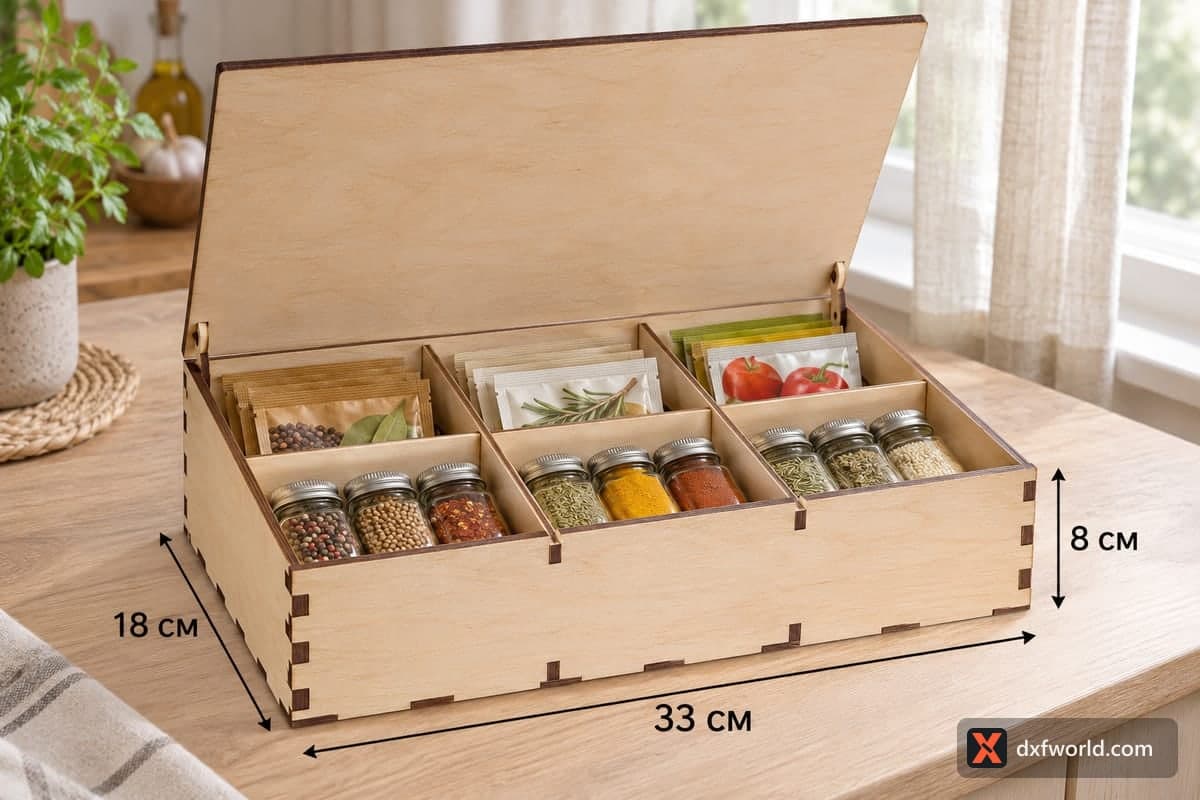
 Visualization
Hinged Spice Box SVG, Six Compartment Wooden Spice Chest Laser Cut File, Seasoning Box With Lid DXF
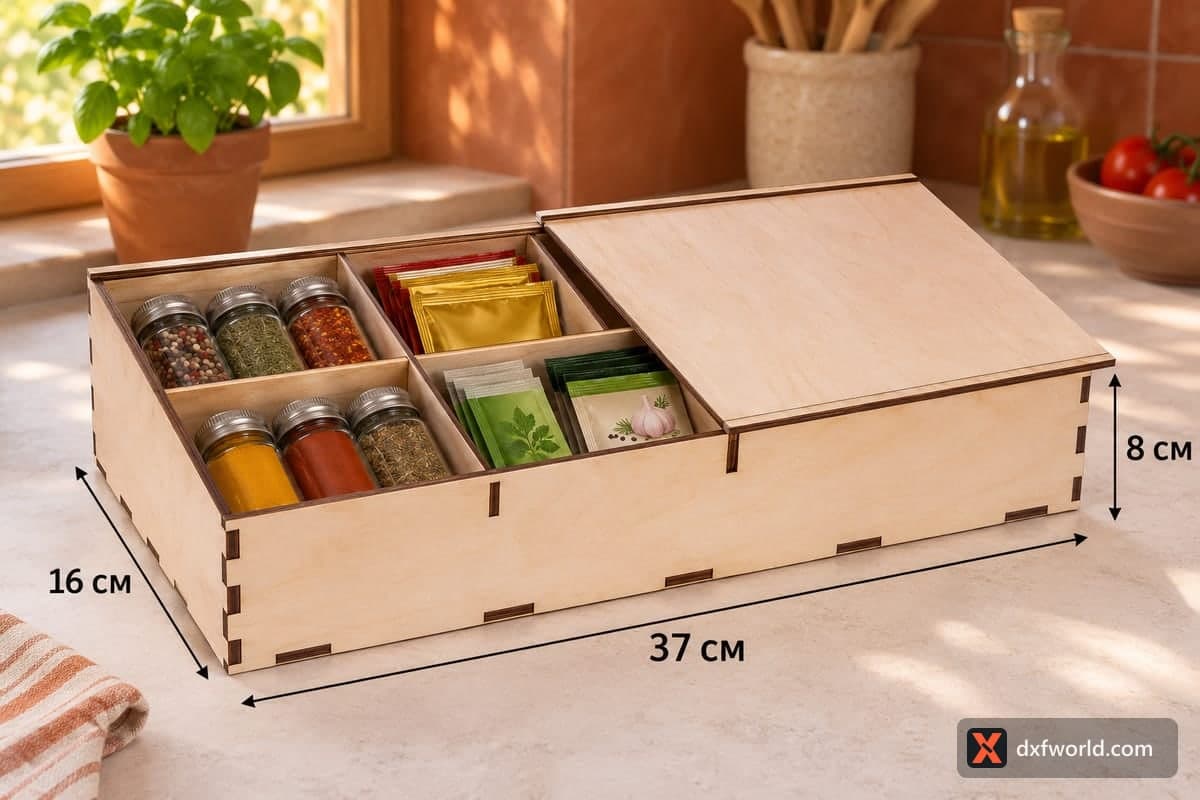
A free laser cut file for a hinged spice box with six compartments in two rows of three, under a lid that pivots open at the back on pins cut into the plywood. It includes SVG and DXF for 3, 4, 5 and 6 mm plywood; the box is 330 × 180 × 80 mm (12.99 × 7.09 × 3.15 in) and goes together from 9 pieces with tabs and slots, without metal hinges or screws.
- Formats
- SVG, DXF
- Outer size (W × D × H)
- 330 × 180 × 80 mm (12.99 × 7.09 × 3.15 in)
- Parts
- 9
- Material thickness
- 3, 4, 5 or 6 mm plywood (a file for each)
- Layout size (3 mm file)
- 1,040 × 457 mm
- Cut length
- 8.63 m
- Est. time, 10 W diode (3 mm)
- 28 min 46 s
- Est. time, 40 W CO2 (3 mm)
- 11 min 59 s
- Layers
- CUT only, no engraving
Free account required to download
How to make it
- 01Select the SVG or DXF for your plywood thickness and cut a side panel from scrap to check the tab and slot fit before the full job.
- 02Cut all nine pieces from the 1040 × 457 mm layout, or move the lid and base onto a second sheet.
- 03Join the base, front, back and one side panel, seat the lid's pivot pins, close with the second side, then slot the long divider and two short dividers together inside.
- 04Sand the lid until it swings without catching, oil the outside and fill the back row with sachets and the front with jars.
Back row for sachets, front row for jars
One long divider splits the box into a front and a back row, and two short dividers cross it to make three columns, so you get six compartments of about 10 cm wide each. The photo shows a sensible way to fill them: the back row keeps paper and foil sachets upright (peppercorns with bay leaves, rosemary, tomato seasoning), and the front row holds three short jars per compartment, among them mixed pepper, coriander seed, chilli, dried herbs, turmeric and paprika.
How the wooden pivot works
The 330 × 176.3 mm lid pivots at the back on pins cut into the plywood, which sit in the two side panels. Those side panels are slightly taller than the front and back (84.2 mm), so the pivot sits above the walls and the lid can swing up and lean back on its own, as in the photo. The front wall is 77 mm and the back 80 mm. No metal parts are involved, so the whole chest stays wood.
Cutting and finishing
Everything fits on a 1040 × 457 mm layout. Cutting time for the 3 mm file is about 28 min 46 s with a 10 W diode, about 11 min 59 s with a 40 W CO2 and about 5 min 45 s with a 100 W CO2. A diode cuts 3 mm in one or two passes; for 5–6 mm, use more passes or a CO2 tube. On a 400 mm bed, cut the lid and base separately from the walls.
Keep glue well away from the pivot. Sand the lid edges until it opens without rubbing, then seal the box with oil. As a gift, fill it with six jars and six sachets of your own blends; a spice merchant can engrave a logo on the lid and keep it on the counter as a sample chest.
Questions about this file
Do I have to buy hinges for this box?
No. The lid pivots on pins that are part of the plywood layout, held by the side panels, so the box needs no hardware at all.
How many spice jars fit inside?
The photo shows three small jars in each front compartment. Fill all six compartments with jars instead of sachets and you get eighteen small jars in total.
What plywood thickness should I choose for the hinged lid?
3 or 4 mm birch keeps the lid light so it opens with one finger. 5 and 6 mm make a heavier chest that feels solid but needs a stronger laser.
Can I engrave the lid?
Yes. The file has cut lines only, so add your own text, herbs or logo to the lid in your laser software before cutting.
Is it suitable for a humid kitchen?
Seal all faces with lacquer or oil and keep it away from kettle steam. Dry the lid if it gets wet so the plywood does not warp.
Similar files