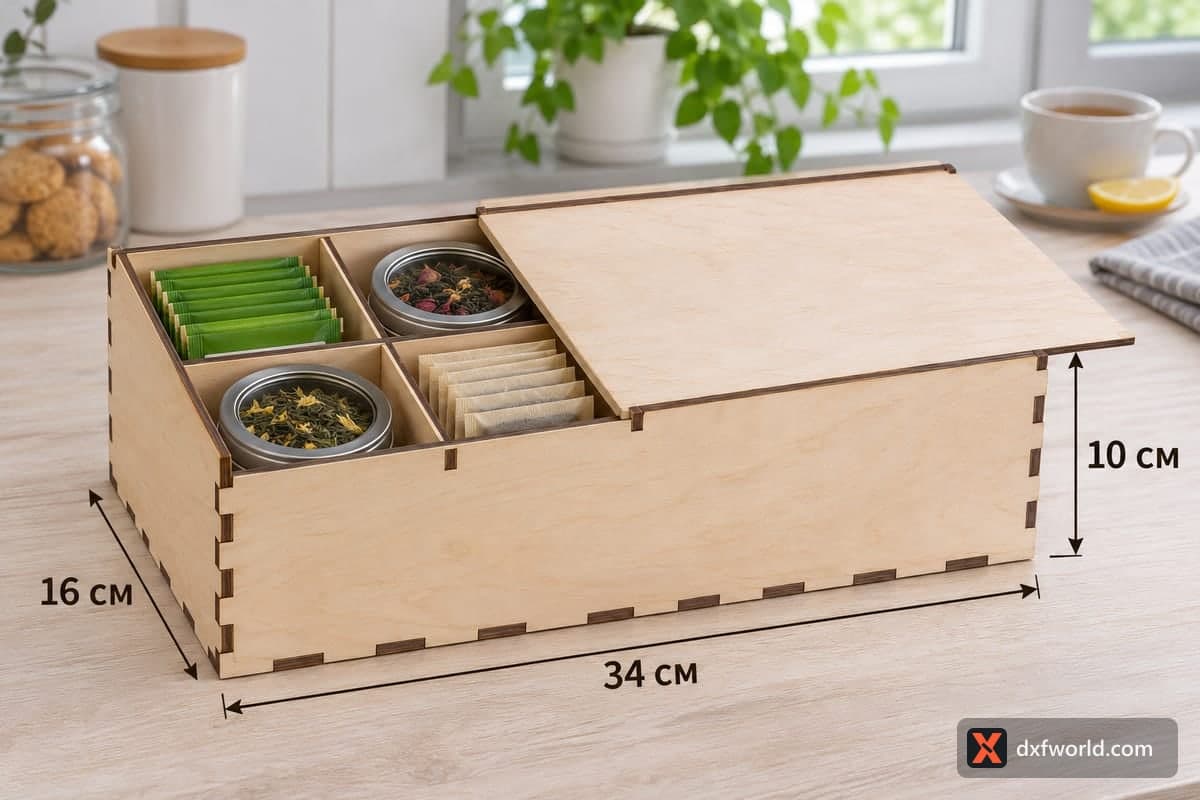
 Visualization
Sliding Lid Tea Box SVG, Four Compartment Tea Chest Laser Cut File, Wooden Tea Storage DXF
A tea chest with a sliding lid that runs on two rails, covering four equal compartments laid out two by two. The free download has SVG and DXF files for 3, 4, 5 and 6 mm plywood; the box measures 340 × 160 × 100 mm (13.39 × 6.30 × 3.94 in) and is cut as 10 pieces that fit together with tabs and slots.
- Formats
- SVG, DXF
- Outer size (W × D × H)
- 340 × 160 × 100 mm (13.39 × 6.30 × 3.94 in)
- Parts
- 10
- Material thickness
- 3, 4, 5 or 6 mm plywood (a file for each)
- Layout size (3 mm file)
- 1,364 × 332 mm
- Cut length
- 8.58 m
- Est. time, 10 W diode (3 mm)
- 28 min 36 s
- Est. time, 40 W CO2 (3 mm)
- 11 min 55 s
- Layers
- CUT only, no engraving
Free account required to download
How to make it
- 01Select the SVG or DXF for your plywood and test-cut one rail and a short wall section to check the fit before the full job.
- 02Cut the 10 pieces, moving the lid and base onto a second sheet if the 1364 mm layout is too long for your bed.
- 03Assemble the walls on the base, fix both rails level inside the side walls, then cross the two dividers and set them in the box.
- 04Slide the lid in to test, sand any tight edge, wax the rails and fill the four sections.
Four bays under one lid
One long divider and one cross divider split the inside into four equal sections, each about 16 cm wide and 7.5 cm deep. The dividers stop a little below the rim, at about 82 mm, so the lid passes over them without catching. In the photo the back row holds green wrapped sachets and a round tin of rose-petal blend, while the front row has a tin of loose green tea and a stack of paper-wrapped bags. Keeping the lid closed keeps dust and kitchen steam off the tea.
How the lid works
The lid is a flat panel that slides in on two thin rails fixed inside the side walls. There is no hinge and no lock, so the box opens with one finger and the lid can be pulled all the way out when you refill. Push it halfway, as in the photo, to show off the contents on a table without taking it off.
Cutting and assembly tips
The 10 pieces are a front, back, two sides, base, two dividers, two rails and the lid. The layout is 1364 × 332 mm; on a 400 mm bed move the lid and base onto their own sheet. For the 3 mm file a 10 W diode needs about 28 min 36 s, a 40 W CO2 about 11 min 55 s and a 100 W CO2 about 5 min 43 s. Thicker sheets mean slower speed or more passes on a diode.
Build the walls around the base, fix the two rails level on the inside of the sides with a little glue, then slot the dividers together and lower them in. Try the lid before the glue sets and sand its edges lightly if it drags. A coat of wax on the rails keeps the slide smooth.
It makes a tidy hostess gift filled with four teas, and engraved lids sell well as personalised tea chests.
Questions about this file
Does the lid lock or click shut?
No, it simply slides along the rails and stays put by friction, so there is nothing to break or adjust.
Will standard tea bags fit standing up?
Yes, the dividers are about 82 mm tall and each section is around 7.5 cm deep, enough for most wrapped tea bags on edge.
Which thickness slides best?
3 or 4 mm birch gives the lightest lid and the smoothest slide; 6 mm works but the lid gets heavy and the rails need more sanding.
Can I seal it against moisture?
A coat of food-safe oil or clear lacquer inside and out keeps steam from swelling the wood; avoid finishing the rail grooves too thickly.
Can I engrave the lid?
The file is cut lines only, but the 333 × 160 mm lid is a large flat panel ideal for a name, monogram or tea leaf design you add yourself.
Similar files