 Visualization
Condiment Caddy SVG, Deep Oil and Vinegar Organizer Laser Cut File, Wooden Pantry Bin With Divider DXF
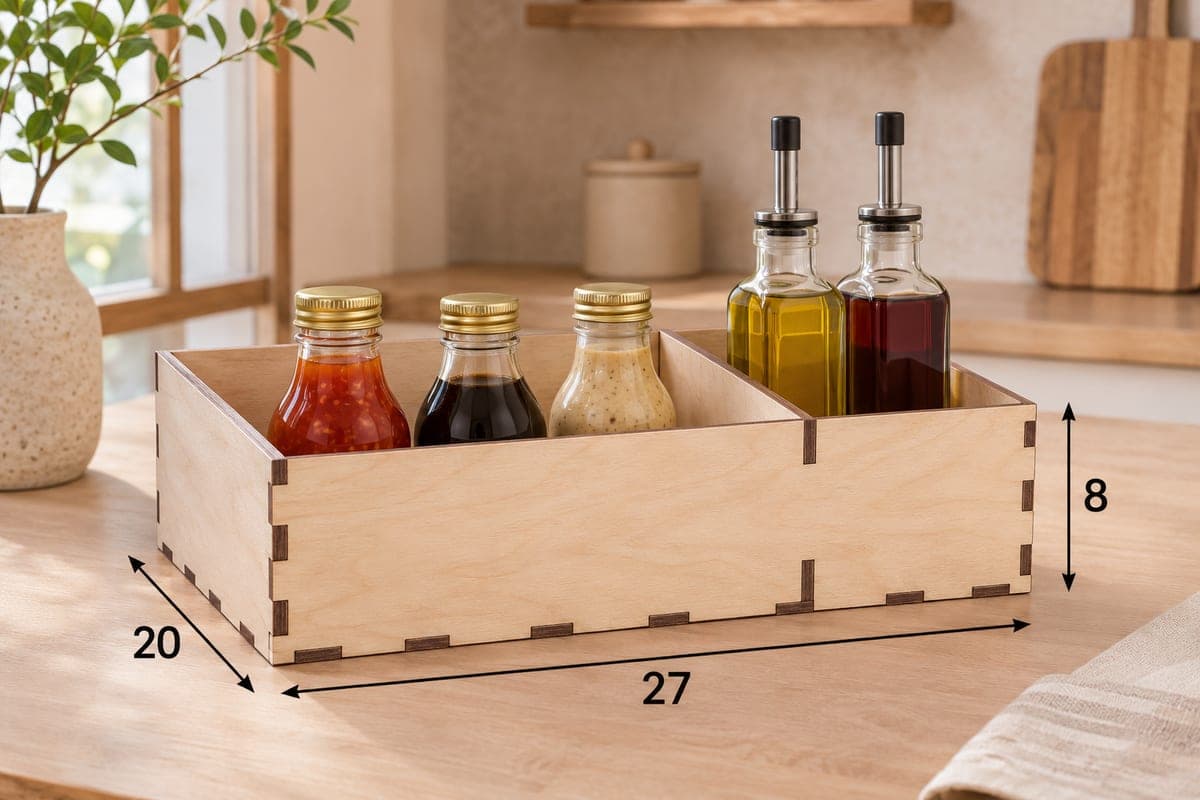
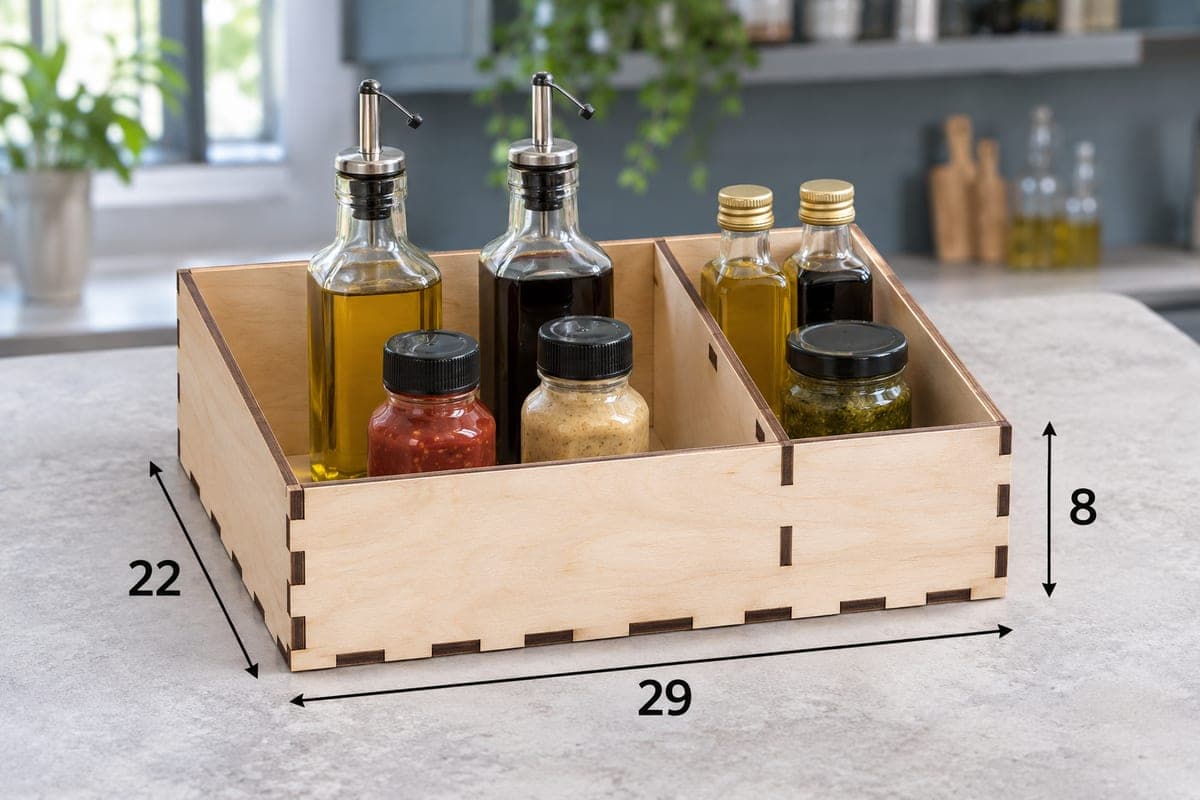
A deep open caddy with two bays, sized so each bay holds a back row of oil pourers and a front row of jars. The free download has SVG and DXF files for 3, 4, 5 and 6 mm plywood; the caddy measures 290 × 220 × 80 mm (11.42 × 8.66 × 3.15 in), is made of 6 pieces and is held together by tabs and slots, with a slotted divider between the bays.
- Formats
- SVG, DXF
- Outer size (W × D × H)
- 290 × 220 × 80 mm (11.42 × 8.66 × 3.15 in)
- Parts
- 6
- Material thickness
- 3, 4, 5 or 6 mm plywood (a file for each)
- Layout size (3 mm file)
- 1,040 × 312 mm
- Cut length
- 5.56 m
- Est. time, 10 W diode (3 mm)
- 18 min 31 s
- Est. time, 40 W CO2 (3 mm)
- 7 min 43 s
- Layers
- CUT only, no engraving
Free account required to download
How to make it
- 01Select the SVG or DXF for your plywood thickness and test one divider slot on an offcut.
- 02Cut the six parts, sending the base as a separate job if the 1040 mm layout does not fit your bed.
- 03Fit the back and both sides to the base, set the divider into the back wall, then close the box with the front wall.
- 04Sand, seal the base against oil drips and load tall bottles at the back with jars in front of them.
Room for two rows in each bay
At 220 mm front to back this is one of the deeper caddies in the condiment range, and that depth is the point: in each bay a tall bottle stands at the back with a squat jar in front of it. The photo shows the larger bay with two pump-spout oil and balsamic bottles behind jars of tomato salsa and grainy mustard, and the smaller bay with two short oil bottles behind a jar of pesto. Walls are a straight 80 mm all round, so nothing slides out on a busy counter.
The divider is a full-height slotted panel, 220 × 80 mm, that locks into the front and back walls.
Sheet size and laser time
The six parts sit on a 1040 × 312 mm layout. On a 600 mm bed, cut the base on its own and the walls with the divider in a second job. A 40 W CO2 cuts the 3 mm file in about 7 min 43 s; a 10 W diode needs about 18 min 31 s and may want a second pass on denser plywood. With 5 or 6 mm sheets the joints get stiffer and the caddy feels heavier, which is nice for a pantry bin, but plan for slower diode cutting.
Where it works best
The deep footprint suits a pantry shelf or the corner next to the stove where bottles tend to multiply. Group daily oils in one bay and the jars you open less often in the other. Several caddies of the same size line up neatly on a shelf, and a matching pair makes a good wedding or housewarming gift with two oils and two preserves inside. Seal the base with lacquer or a food-safe oil before the first bottle goes in.
Questions about this file
How much fits in each bay?
In the photo the bigger bay holds two pourer bottles and two jars, the smaller one two short bottles and a jar. Bottles of any height work since the top is open.
Is 3 mm plywood strong enough for this caddy, or should I go thicker?
3 mm keeps it light and quick to cut on a diode. Choose 5 or 6 mm if the caddy will carry heavy glass bottles every day and you have a CO2 laser.
Could this caddy be cut from acrylic instead of wood?
Yes, if you choose the file that matches the acrylic thickness. Clear or frosted acrylic wipes clean easily, which helps with sticky jars.
Is it suitable for a fridge door or shelf?
At 220 mm deep it suits most fridge shelves but not door racks. Lacquer it well, because a cold fridge collects condensation.
Should I glue the divider?
It is held at both ends by the front and back walls, so it stays put dry. Glue it only if the joints feel loose in your plywood.
Similar files