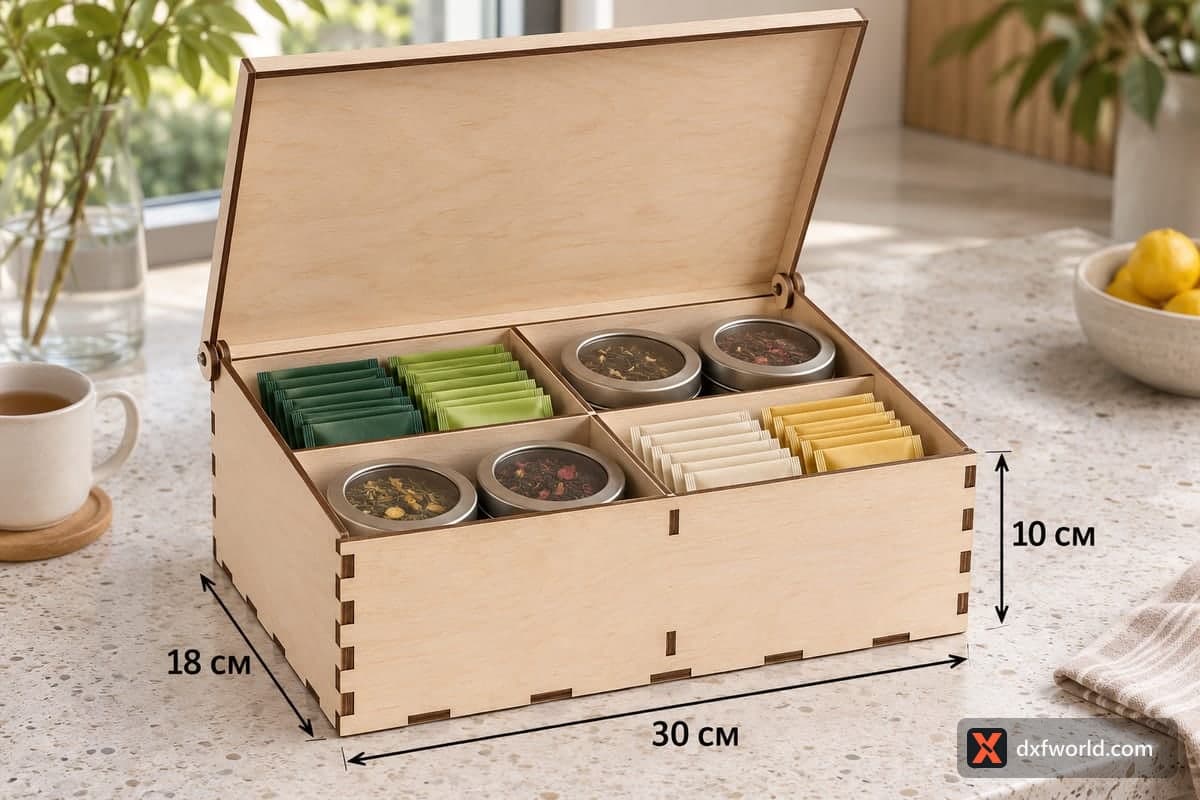
 Visualization
Hinged Tea Box SVG, Wooden Tea Chest With Lid Laser Cut File, Four Compartment Tea Organizer DXF
A tea chest with a lid that flips open at the back, pivoting on pins cut into the plywood side panels, and four compartments in a two-by-two grid. The free download has SVG and DXF files for 3, 4, 5 and 6 mm plywood; the box measures 300 × 180 × 100 mm (11.81 × 7.09 × 3.94 in) and is cut as 8 pieces joined with tabs and slots.
- Formats
- SVG, DXF
- Outer size (W × D × H)
- 300 × 180 × 100 mm (11.81 × 7.09 × 3.94 in)
- Parts
- 8
- Material thickness
- 3, 4, 5 or 6 mm plywood (a file for each)
- Layout size (3 mm file)
- 1,100 × 296 mm
- Cut length
- 7.62 m
- Est. time, 10 W diode (3 mm)
- 25 min 24 s
- Est. time, 40 W CO2 (3 mm)
- 10 min 35 s
- Layers
- CUT only, no engraving
Free account required to download
How to make it
- 01Choose the file that matches your plywood and test-cut a corner joint and one pivot to make sure the lid will turn without binding.
- 02Cut all 8 pieces, placing the lid and base on a separate sheet if the 1100 mm layout is too long.
- 03Assemble the base, front and back, then fit the lid between both side panels and attach the sides together, finishing with the two crossed dividers.
- 04Sand the lid's back edge until it opens smoothly, apply wax or oil and fill the four sections.
A tea chest that opens like a jewellery box
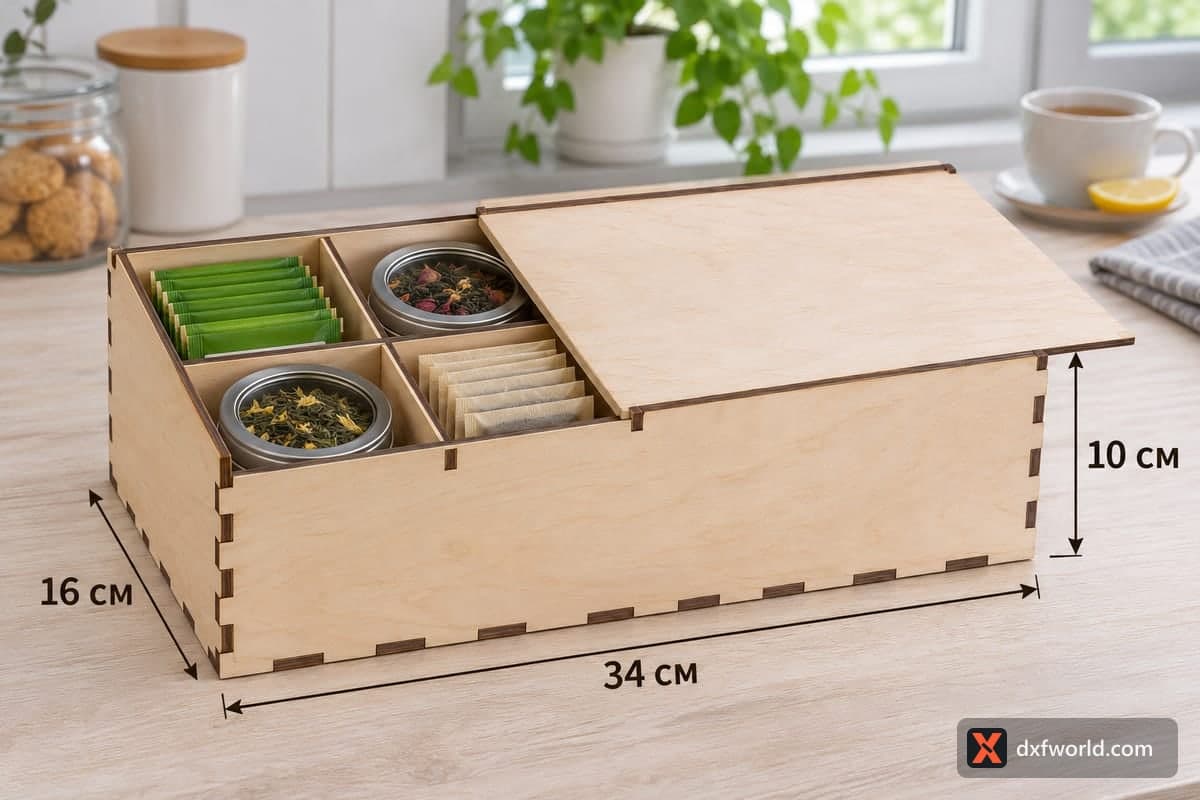
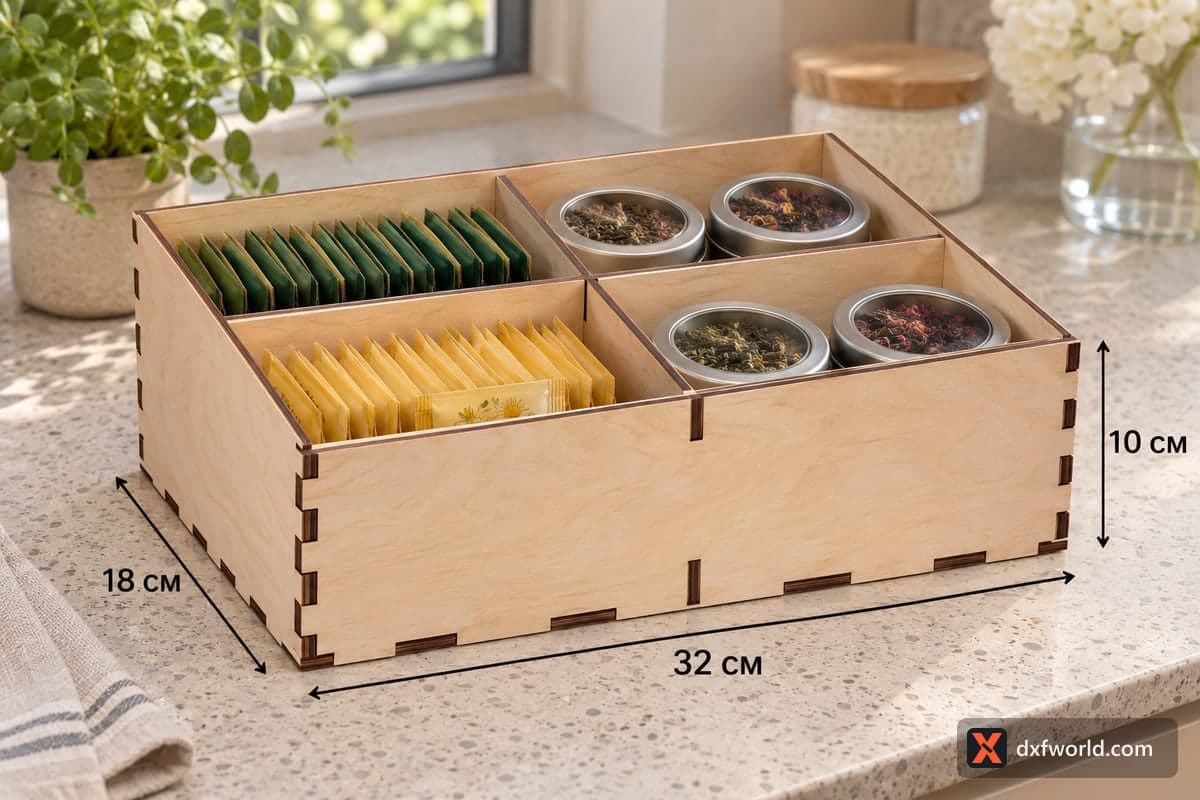
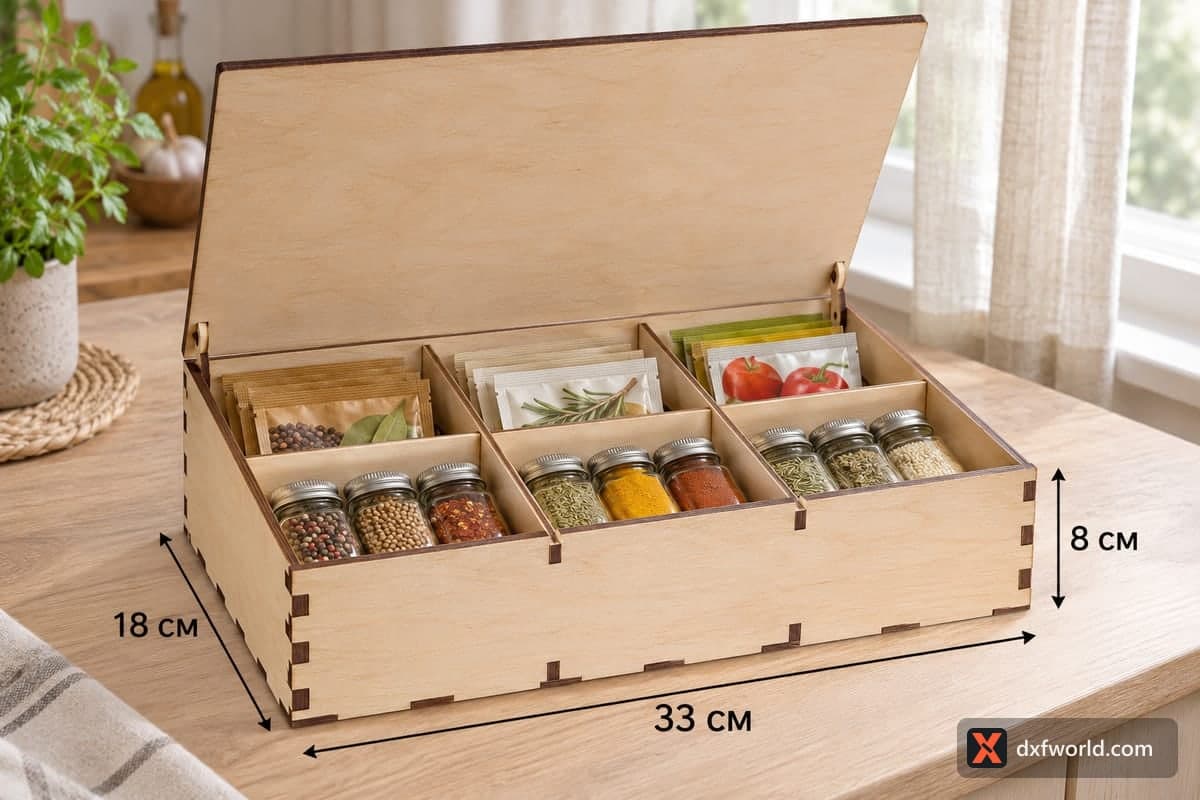
The lid lifts from the front and swings back on two pivot points formed by the side panels themselves, so the whole chest is plywood with no metal parts. Inside, a long and a short divider cross to make four sections of about 15 × 9 cm. The photo shows green tea sachets and two tins of loose leaf in the back, two more tins and a mix of white and yellow wrapped bags in the front. The dividers are cut to about 86 mm, lower than the walls, so the lid closes flat over them.
At 30 cm long it is the most compact of the lidded tea boxes here, a good size for a shelf or a kitchen windowsill.
Cut list and timing
There are 8 pieces: front, back, two taller side panels that carry the pivots, the base, two dividers and the lid. The layout is 1100 × 296 mm, which fits a large CO2 bed in one go; on a smaller machine put the lid and base on a second sheet. Cutting the 3 mm file takes about 25 min 24 s on a 10 W diode, about 10 min 35 s on a 40 W CO2 and about 5 min 05 s on a 100 W CO2. Diode users cutting 5 or 6 mm should plan on extra passes.
Assembly order
Build the base, front and back first. Fit the lid between the two side panels so the pivots engage, then press the sides onto the box together with the lid. Add the crossed dividers last. Glue the walls if you like, but keep glue well away from the pivots. Sand the back edge of the lid until it swings freely, then wax or oil.
Gift ideas: a tea lover's birthday box with four blends, a wedding favour chest with the couple's names engraved on top, or a Christmas market product sold in two wood tones.
Questions about this file
Do I need metal hinges?
No, the lid turns on pins cut into the plywood itself, so the whole box is made from the 8 laser cut pieces.
Why does my lid stick when it opens?
Usually the back edge rubs; sand it slightly round, and make sure no glue or finish got into the pivot holes.
What fits in each compartment?
Each section is about 15 × 9 cm with 86 mm dividers, enough for two small tins or a row of upright tea bags.
Could the hinged chest be cut in acrylic?
The walls work in 3 mm acrylic, but the pivots can be brittle; birch plywood is the safer choice for a lid that opens daily.
Is there room for engraving?
Yes, the lid is 300 × 176 mm, so add your own monogram or tea leaf motif before cutting; the file itself has cut lines only.
Similar files