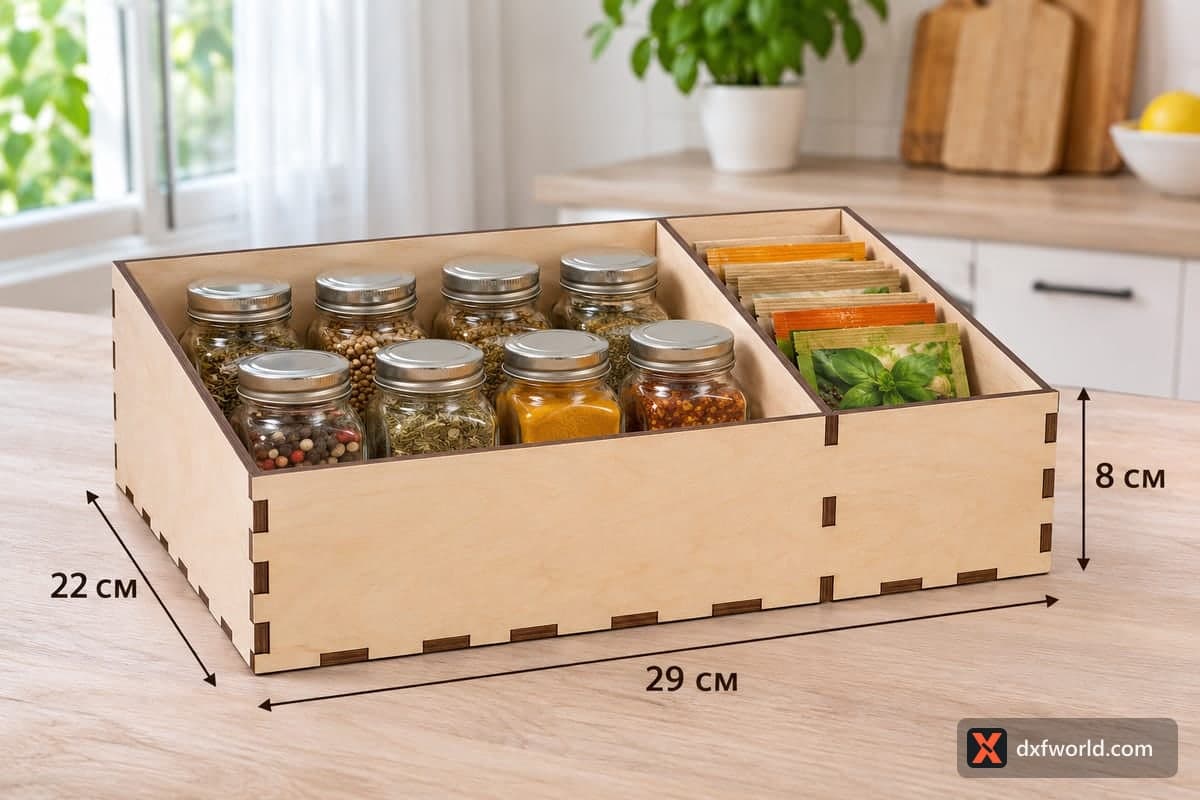
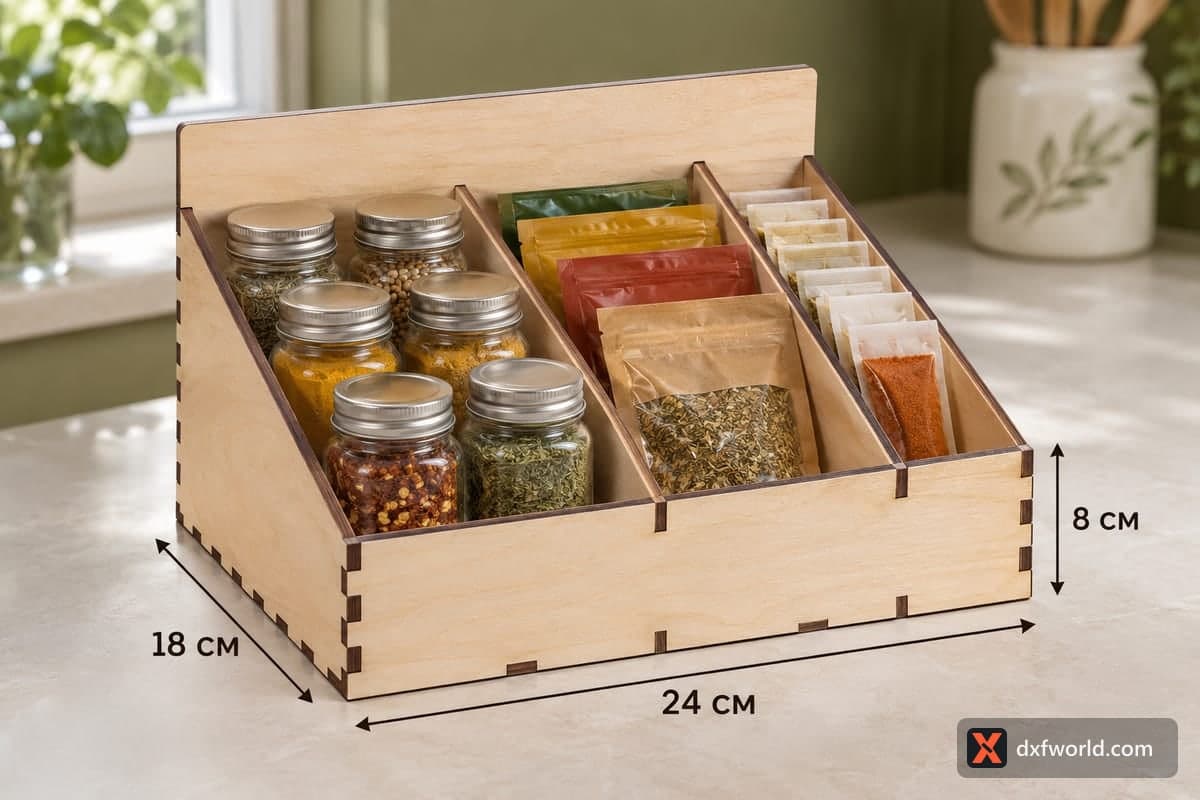
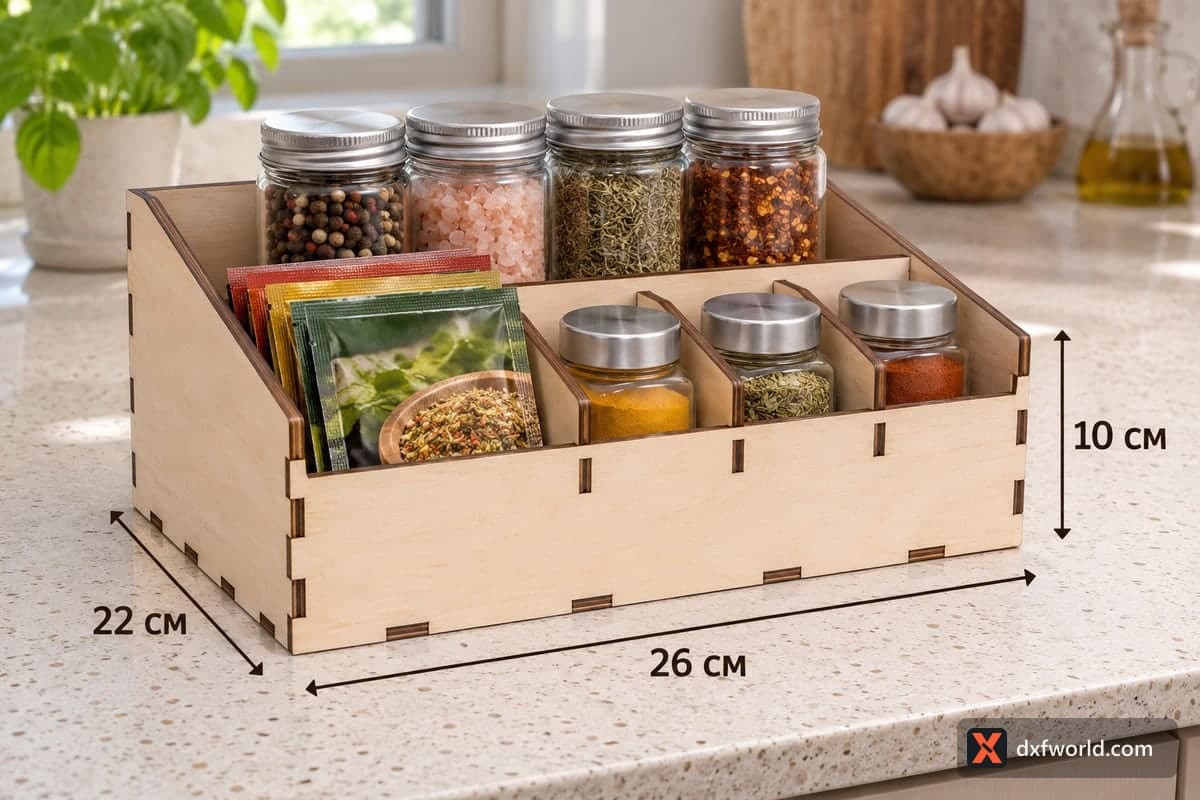
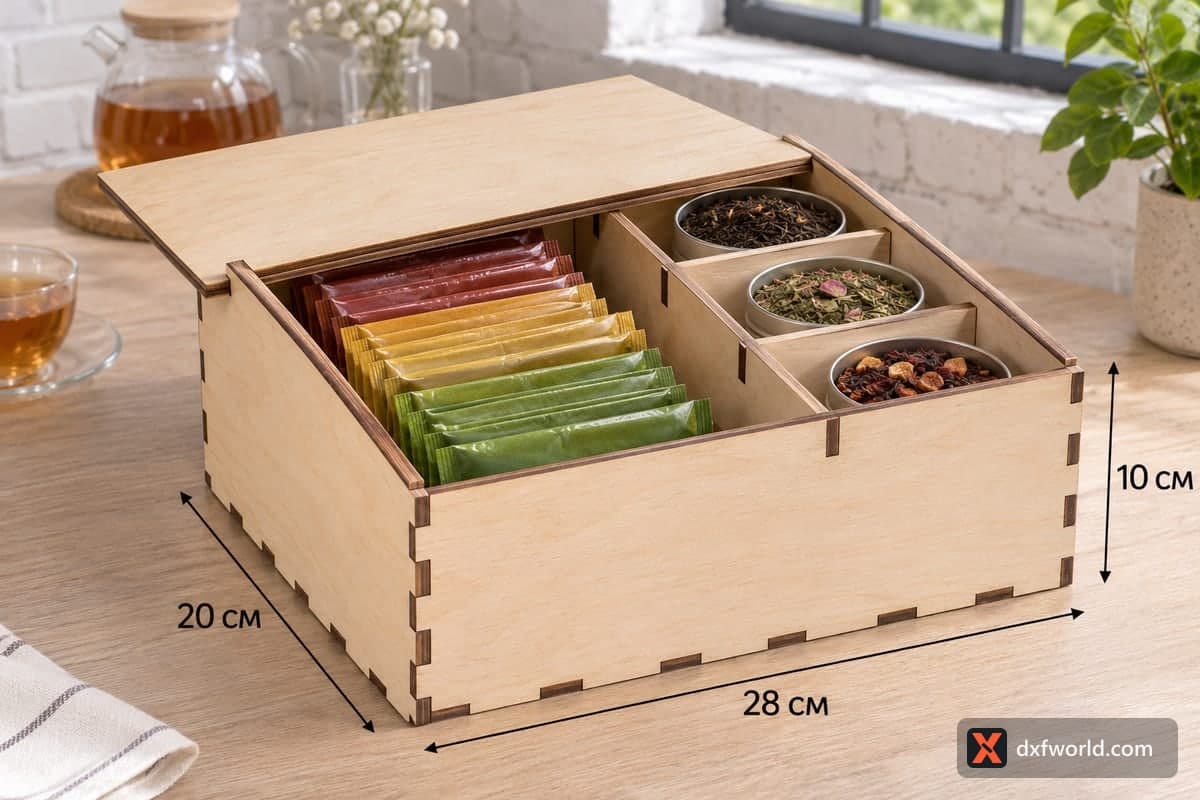
 Visualization
4 x 2 Spice Grid Box SVG, Eight Cell Spice Sachet Organizer DXF, Square Cell Seasoning Crate Laser Cut File
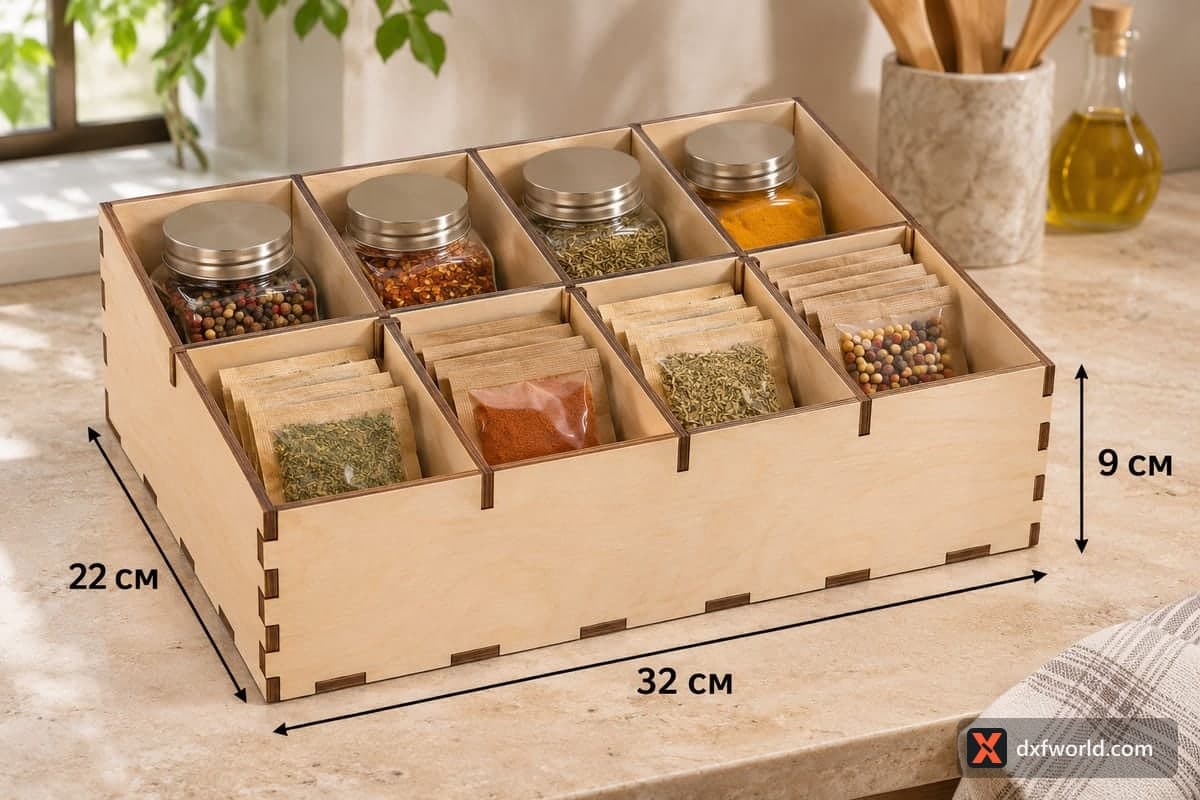
A free laser cut file for an open spice box with a grid of eight cells, four across and two deep, formed by dividers that slot together. It measures 320 × 220 × 90 mm (12.60 × 8.66 × 3.54 in), has straight 90 mm walls, is cut from 9 plywood pieces with tab-and-slot joints, and comes as SVG and DXF files for 3, 4, 5 and 6 mm plywood.
- Formats
- SVG, DXF
- Outer size (W × D × H)
- 320 × 220 × 90 mm (12.60 × 8.66 × 3.54 in)
- Parts
- 9
- Material thickness
- 3, 4, 5 or 6 mm plywood (a file for each)
- Layout size (3 mm file)
- 1,100 × 416 mm
- Cut length
- 10.30 m
- Est. time, 10 W diode (3 mm)
- 34 min 21 s
- Est. time, 40 W CO2 (3 mm)
- 14 min 19 s
- Layers
- CUT only, no engraving
Free account required to download
How to make it
- 01Pick the file for your sheet and cut one cross-slot test pair from scrap to check that the halving joint slides together.
- 02Cut the nine pieces over two or three sheets, depending on your bed size.
- 03Fit the four walls to the base, assemble the divider grid separately, and lower it in so its tabs drop into the slots.
- 04Ease the top edges of the grid, oil the box, and fill the back cells with jars and the front cells with sachets.
An egg-crate grid
Three short dividers, each 220 mm long, cross one long 320 mm divider, and all four are the full 90 mm height of the walls. They notch into each other like the inside of a wine carton, giving eight cells of the same height in two rows of four. Every cell is closed on four sides, so jars cannot tip into the next row.
In the photo the back row holds four squat jars with metal lids: peppercorn mix, chili flakes, dried herbs and turmeric. The front row is filled with paper sachets standing upright, each with a window showing oregano, paprika, herbs or mixed pepper. Using one row for jars and one for refills keeps each spice next to its backup.
Building the grid
Slot the four dividers together on the bench first, then lower the whole grid into the box once the walls are on the base. For the 3 mm file the cut takes about 34 min 21 s on a 10 W diode, about 14 min 19 s on a 40 W CO2 and about 6 min 52 s on a 100 W CO2. The 3 mm layout is 1100 × 416 mm, so most diode machines need it split over three sheets. A diode cuts 3 mm in one or two passes; 5–6 mm needs a stronger tube or slow repeats. Tight cross slots may need a light sanding.
Ideas for selling
Fill the eight cells with four jars and four matching refills and sell it as a refill station. Restaurants and spice shops can use it on the counter to show eight blends, with the shop name engraved on the front as an extra layer you add yourself.
Questions about this file
How big is each cell?
With 3 mm plywood each cell is roughly 76 mm wide and 105 mm from front to back, which takes one squat jar or a stack of sachets.
Can I make fewer, bigger cells?
Leave out one or more of the short dividers. The rest of the grid still holds together and you get wider cells for bigger jars.
Is 90 mm tall enough for spice jars?
Short jars sit below the rim and taller ones show their lids above it, which makes them easy to grab.
Which plywood works best for the grid?
Birch plywood in 3 or 4 mm gives clean halving joints. Poplar is lighter, but its softer core can make the cross slots loose.
Can I keep it in a drawer?
Yes, if the drawer has at least 95 mm of clear height. The flat top edges let the drawer close over it.
Similar files