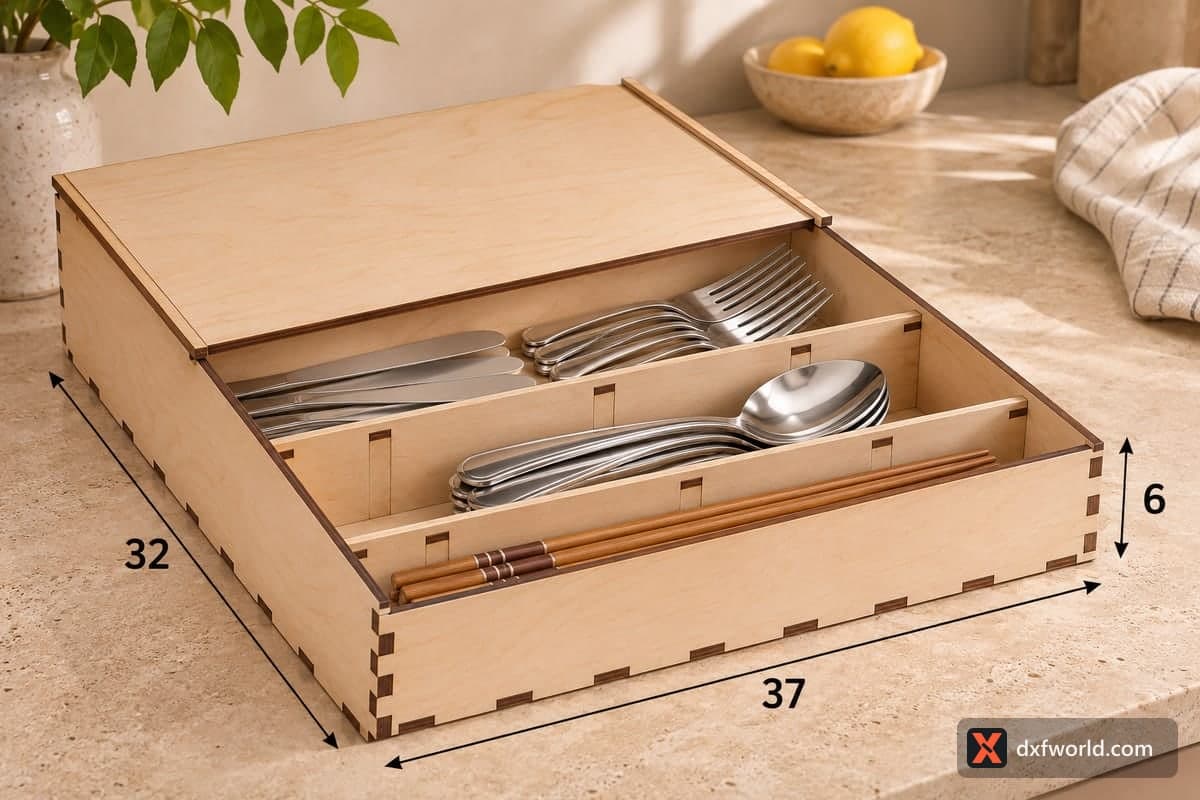
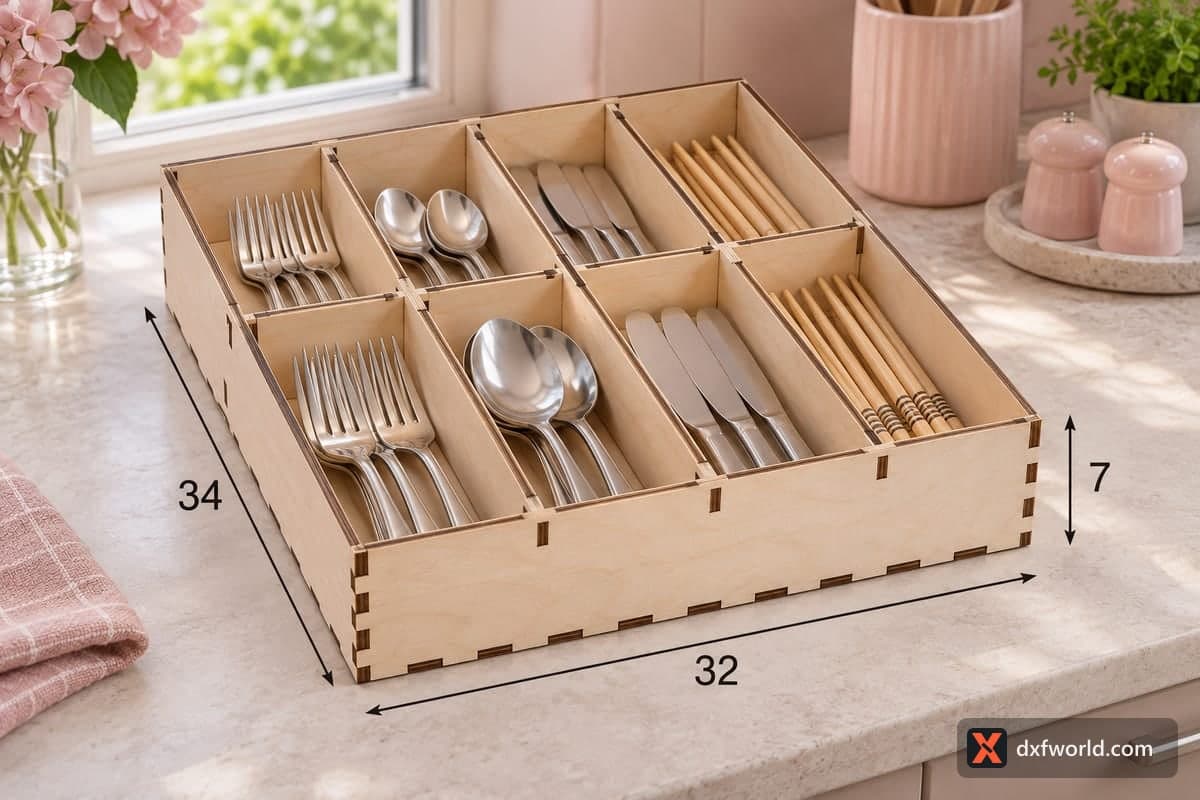
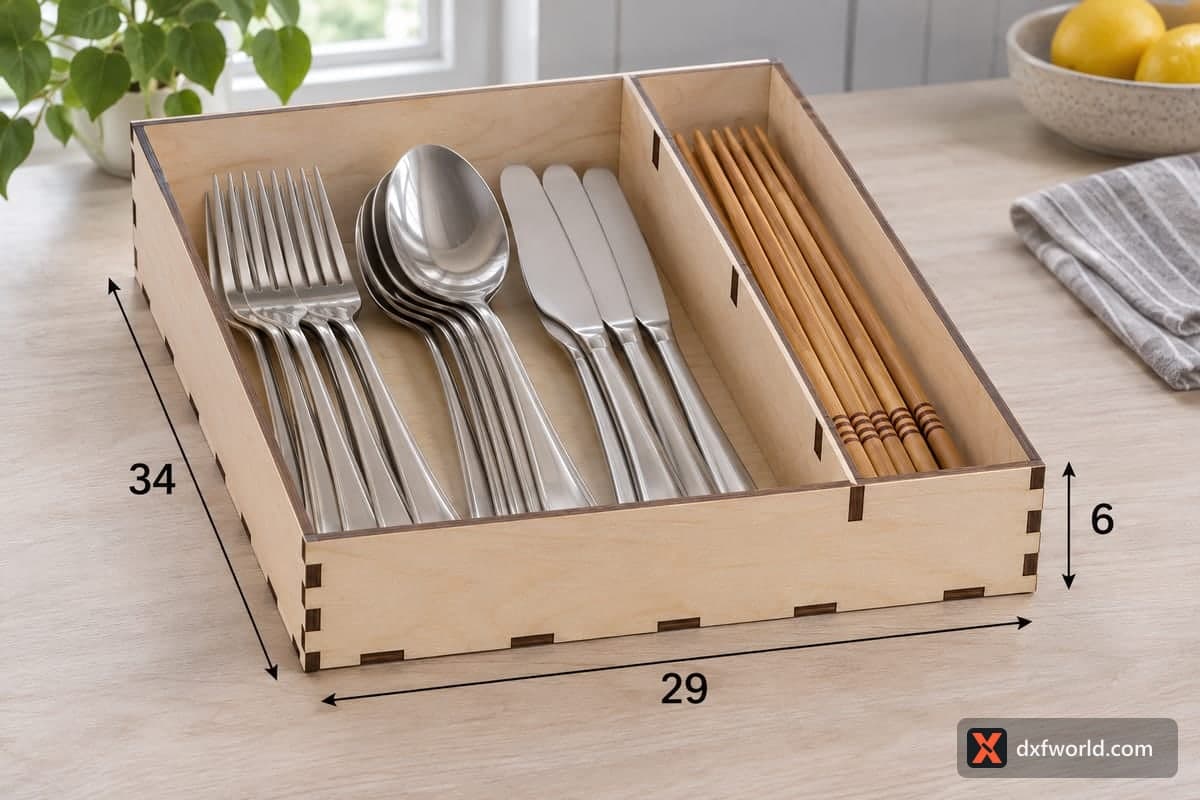
 Visualization
Five Lane Sliding Lid Cutlery Box SVG, 40 cm Silverware Chest Laser Cut File, Front to Back Flatware Storage DXF
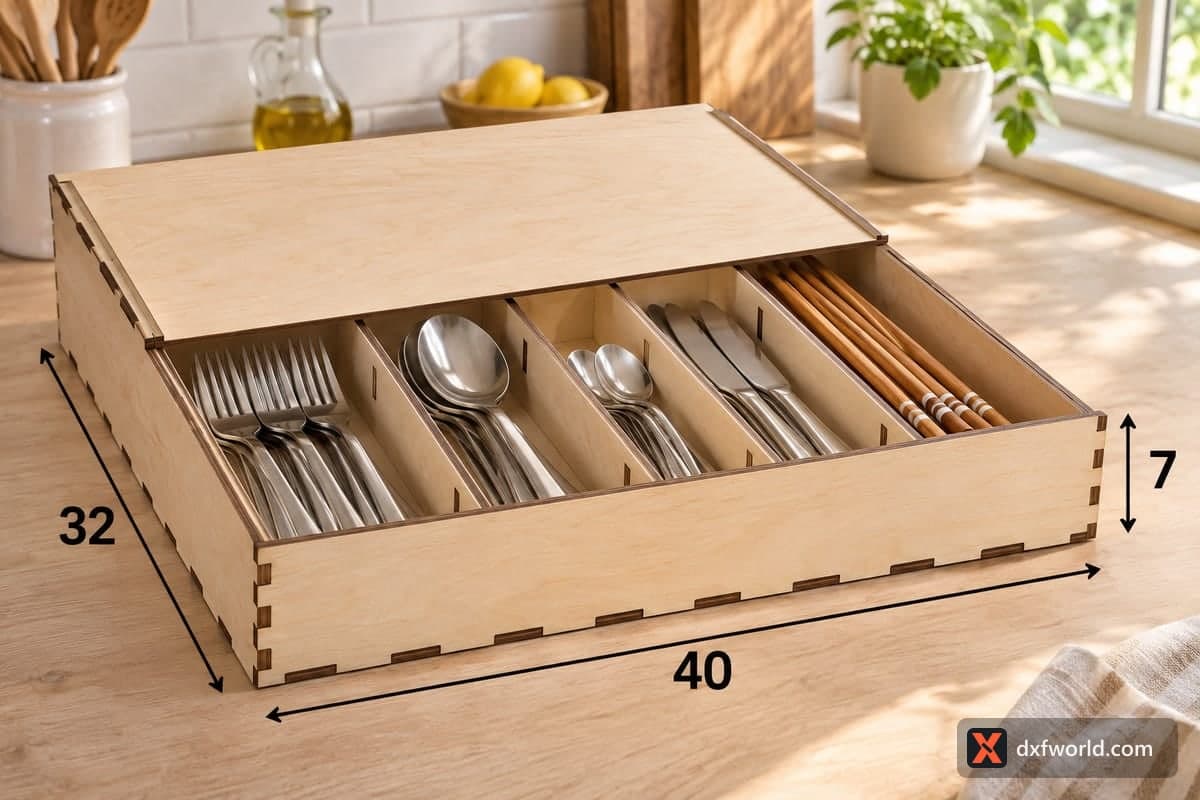
A free laser cut file for a large cutlery chest with a sliding lid, 400 × 320 × 70 mm (15.75 × 12.60 × 2.76 in) outside, holding five lanes that run from front to back. The download has SVG and DXF for 3, 4, 5 and 6 mm plywood; the 12 pieces join with tabs and slots, and the lid slides along two rails with no hinge or lock.
- Formats
- SVG, DXF
- Outer size (W × D × H)
- 400 × 320 × 70 mm (15.75 × 12.60 × 2.76 in)
- Parts
- 12
- Material thickness
- 3, 4, 5 or 6 mm plywood (a file for each)
- Layout size (3 mm file)
- 1,460 × 726 mm
- Cut length
- 13.46 m
- Est. time, 10 W diode (3 mm)
- 44 min 53 s
- Est. time, 40 W CO2 (3 mm)
- 18 min 42 s
- Layers
- CUT only, no engraving
Free account required to download
How to make it
- 01Choose the file for your sheet thickness and cut one rail with an edge strip of the lid on scrap to test the slide.
- 02Cut the 12 pieces over three or four sheets, using flat plywood for the 393.4 mm wide lid.
- 03Assemble the base, back and sides, add the lower front, slot the four dividers into place and glue the two rails inside the side walls.
- 04Wax the rails, sand and oil the chest, sort forks, spoons, teaspoons, knives and chopsticks into the five lanes and slide the lid in.
Five lanes, one per type
Four dividers, each 314 mm long, stand side by side and give five lanes of about 7.5 cm width running the full depth of the chest. That is enough room for a stack of twelve of each piece, so a complete service for twelve can live here sorted by type. In the photo the lanes hold dinner forks, tablespoons, teaspoons, table knives and wooden chopsticks from left to right. The 31 cm lane length takes the longest dinner knife lying flat.
The dividers are 60.7 mm tall and the front wall 63.7 mm, both lower than the 70 mm back. The lid, 393.4 × 319.7 mm, slides over them on two 317 mm rails and comes out over the front.
Machine and sheet planning
This is the biggest box of the series, so check your bed first. The base and the lid each need a work area of at least 400 × 320 mm; machines with a 400 × 400 mm bed are just big enough. The whole layout is 1460 × 726 mm and splits over three or four sheets.
The 3 mm file takes about 44 min 53 s on a 10 W diode, about 18 min 42 s on a 40 W CO2 and about 8 min 59 s on a 100 W CO2. With a lid this wide, 4 mm plywood stays flatter than 3 mm and still cuts on a strong diode in a few passes; 5 and 6 mm are best on CO2.
Ideas for selling
- A sideboard chest for a twelve-piece service, sold with felt-lined lanes
- A restaurant back-of-house box for rolled cutlery prep
- A personalised wedding chest, the couple's initials engraved on the lid by the maker
Questions about this file
How much cutlery does it hold?
Each lane is about 7.5 cm wide and 31 cm long, enough for a stack of twelve pieces. A full service for twelve fits sorted into five types.
What bed size does my laser need?
At least 400 × 320 mm, because the base and the lid are each almost that size and cannot be split.
Will the large lid warp?
Thin 3 mm plywood can bow across 39 cm. Use 4 mm, seal both faces of the lid evenly and store the chest away from radiators.
Can I leave a divider out?
You can leave dividers out to make wider lanes for serving pieces. Fill the unused base slots with a dab of wood filler.
Can I line the lanes?
Yes, felt or thin cork strips glued to the base stop rattling and protect plated cutlery from scratches.
Similar files