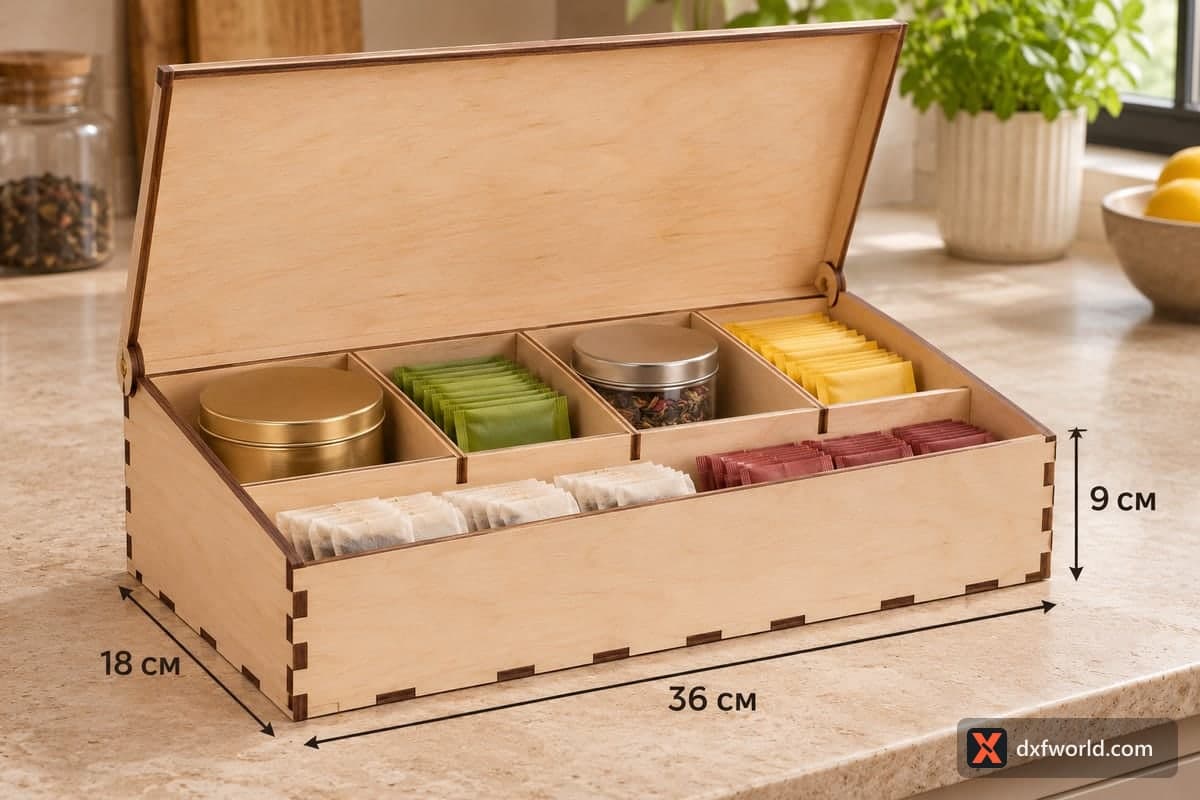
 Visualization
8 Compartment Hinged Tea Box SVG, Flip Top Tea Chest Laser Cut File, Wooden Tea Bag Organizer With Lid DXF
A free hinged tea box laser cut file in SVG and DXF, with separate versions for 3, 4, 5 and 6 mm plywood. The box is 360 × 180 × 90 mm (14.17 × 7.09 × 3.54 in) and has 8 compartments in two rows of four. It is cut as 10 pieces that join with tabs and slots, and the lid pivots open at the back on pins cut into the plywood, with no metal hardware.
- Formats
- SVG, DXF
- Outer size (W × D × H)
- 360 × 180 × 90 mm (14.17 × 7.09 × 3.54 in)
- Parts
- 10
- Material thickness
- 3, 4, 5 or 6 mm plywood (a file for each)
- Layout size (3 mm file)
- 1,284 × 467 mm
- Cut length
- 10.03 m
- Est. time, 10 W diode (3 mm)
- 33 min 27 s
- Est. time, 40 W CO2 (3 mm)
- 13 min 56 s
- Layers
- CUT only, no engraving
Free account required to download
How to make it
- 01Download the version for your plywood thickness and cut one tab joint on scrap, because the lid pivot depends on an accurate thickness.
- 02Cut the 10 parts: front, back, two taller side walls, base, three short dividers, the long divider and the lid.
- 03Join the walls to the base, slot the long divider and three short ones into a grid, then fit the lid between the side walls on its pins.
- 04Open and close the lid a few times, sand any tight spot, then finish the box and fill the eight compartments.
Two rows of four
A long divider runs the full 360 mm length and three short dividers cross it, giving four columns and two rows. All dividers stop below the rim so the lid closes flat over them. In the photo the back row holds a gold tin, a stack of green tea bags, a glass jar of fruit tea and yellow sachets, while the front row carries white and red tea bags lying in long rows. Each compartment is about 8.5 cm wide, which suits a single tin, a jar or a short stack of bags.
How the lid pivots
The lid pivots at the back on pins cut into the plywood, and the side walls stand a little taller than the front and back to carry it. It swings up and rests open behind the box, as in the photo. There are no screws and no metal hinges. Check that the lid turns freely before you glue anything, and sand the pivot lightly if it binds.
The 3 mm file takes about 33 min 27 s on a 10 W diode, about 13 min 56 s on a 40 W CO2 and about 6 min 41 s on a 100 W CO2. Its layout is 1284 × 467 mm; the lid and base are the two big parts, so on a small bed give each its own sheet and gather the walls and dividers on a third. Use 5 or 6 mm only with a laser that cuts that depth cleanly, since a charred pivot will not turn smoothly.
Making it a gift
Eight compartments make it a natural tea sampler: fill each with a different tea and tie a ribbon around it. The lid can take an engraved name, a date or a leaf border that you add in your own design before cutting. Small tea brands can use it as a branded presentation box.
Questions about this file
Do I need metal hinges or screws for the lid?
No. The lid pivots on pins cut from the plywood itself, so the whole box is wood.
What fits in the eight compartments?
Each one is about 8.5 cm wide and a little under 8 cm deep: one small tin or jar, or a short stack of standard tea bags.
Can I engrave the hinged lid?
Yes, add a name or pattern to the lid in your design software as an engrave layer; the downloaded file has cut lines only.
Which plywood works best for the pivot?
Flat, void-free birch plywood in 3 or 4 mm gives the cleanest pins; warped sheets can make the lid rub on the walls.
Can I make it waterproof?
Plywood is never fully waterproof, but two thin coats of lacquer protect it from kettle steam and wet spoons.
Similar files