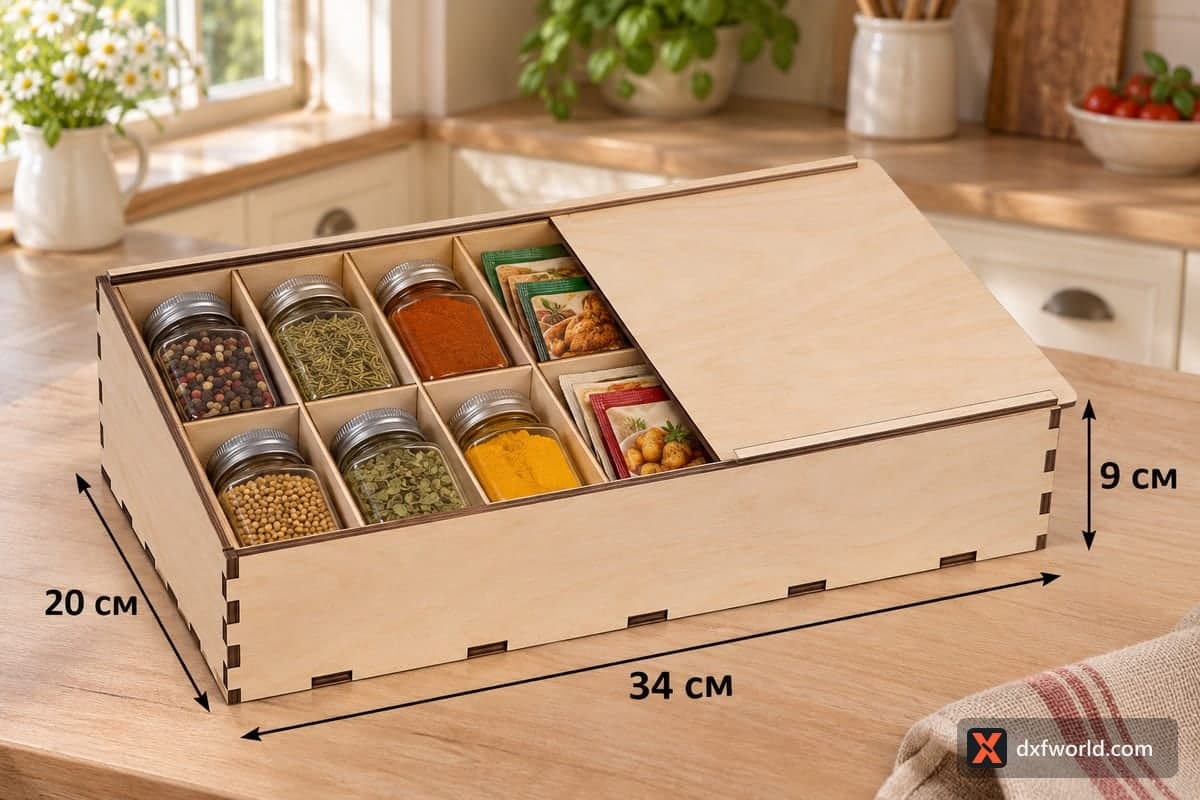
 Visualization
8 Compartment Sliding Lid Spice Box, Spice Jar Grid Box SVG, Slide Top Spice Chest Laser Cut File, Spice Cell Box DXF
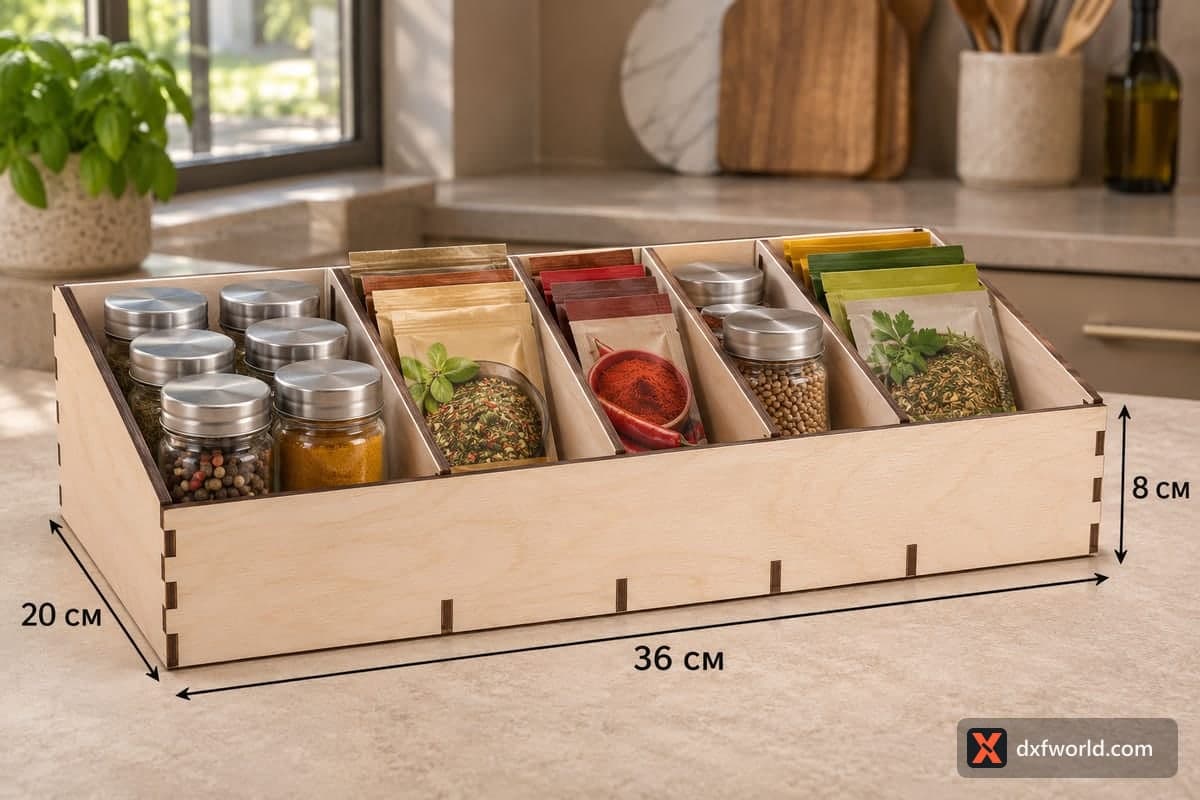
A free laser cut file for a spice box with a sliding lid and 8 compartments laid out as four columns by two rows, one small jar or a stack of packets per cell. It measures 340 × 200 × 90 mm (13.39 × 7.87 × 3.54 in), is cut from 12 plywood pieces that assemble with tabs and slots, and the lid runs on two rails with no hinge or lock. The package has SVG and DXF files for 3, 4, 5 and 6 mm plywood, with slots matched to each.
- Formats
- SVG, DXF
- Outer size (W × D × H)
- 340 × 200 × 90 mm (13.39 × 7.87 × 3.54 in)
- Parts
- 12
- Material thickness
- 3, 4, 5 or 6 mm plywood (a file for each)
- Layout size (3 mm file)
- 1,280 × 506 mm
- Cut length
- 10.87 m
- Est. time, 10 W diode (3 mm)
- 36 min 14 s
- Est. time, 40 W CO2 (3 mm)
- 15 min 06 s
- Layers
- CUT only, no engraving
Free account required to download
How to make it
- 01Pick the version for your plywood thickness and check the lid clearance by cutting one rail and a lid corner from scrap first.
- 02Cut all 12 pieces, keeping the three short dividers and the long one together for the grid.
- 03Assemble base, back, sides and lower front, interlock the four dividers into a 4 × 2 grid and drop it in, then fix a rail inside each side wall.
- 04Test the slide, sand or wax any tight spot, finish the outside with oil, and give each cell one jar or a small stack of packets.
A grid of eight cells
Three short dividers run front to back and one long divider runs across, so the dividers slot together into a 4 × 2 grid. Every cell holds one jar upright, which stops jars from tipping and clinking when the box is moved. In the photo the three left columns take six jars with silver lids: peppercorn mix, rosemary and paprika at the back, coriander seed, dried herbs and turmeric in front. The right-hand column holds seasoning packets, a stack in each of its two cells.
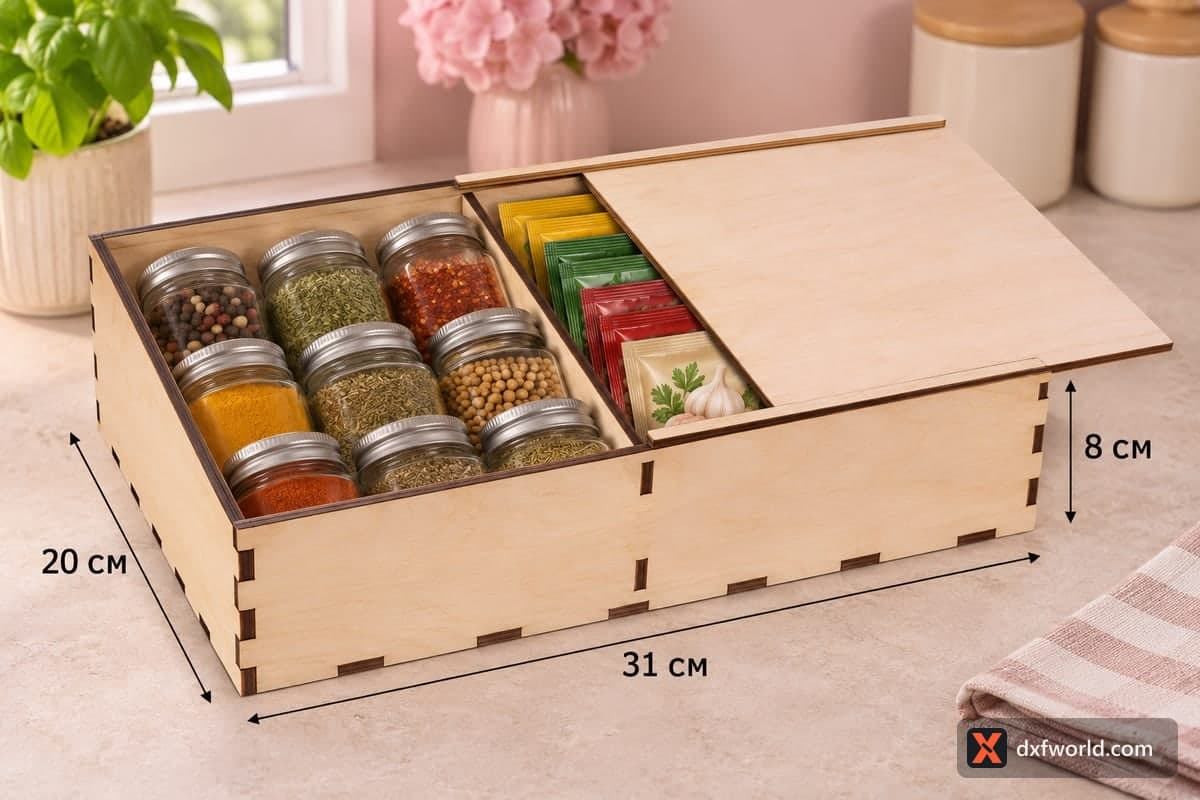
The flat lid slides on two rails along the side walls and passes over the front, which is a few millimetres lower than the back. Slide it part way to reach one column, or remove it completely while you cook. It keeps light off the spices and dust out of the cells.
Cutting the 12 parts
The file has front, back, two sides, base, three short dividers, one long divider, two rails and the lid. Cutting time for the 3 mm file is about 36 min 14 s on a 10 W diode, about 15 min 06 s on a 40 W CO2 and about 7 min 15 s on a 100 W CO2. The 3 mm layout is 1280 × 506 mm, two rows deep, so a hobby laser needs three sheets: base and lid, then the walls, then dividers and rails. Slot the divider grid together on the table before setting it into the box.
Gift and shop use
Fill it with eight spices from one cuisine, such as Indian or Mexican, for a themed gift. A spice shop can sell it as a sampler box with its logo engraved on the lid.
Questions about this file
How big is each cell?
The box is split into four columns and two rows, so each cell takes one small spice jar like those in the photo, or a stack of flat packets.
How is this different from the two-section sliding box?
This one has a full grid of eight cells and is 10 mm taller, so every jar has its own spot. The two-section box has one big jar section and one packet section.
Which thickness should I choose?
3 mm keeps the lid light and the cells roomy. 4 or 5 mm gives a sturdier chest but slightly smaller cells, as the dividers are thicker.
Can I engrave spice names in the cells?
Nothing is engraved in the file, but you can add names on the lid above each column, or on the front wall, as an engrave layer you add.
Do the divider grid and rails need glue?
The grid locks together by its slots and needs no glue. A thin line of glue under each rail keeps it from shifting as the lid slides.
Similar files