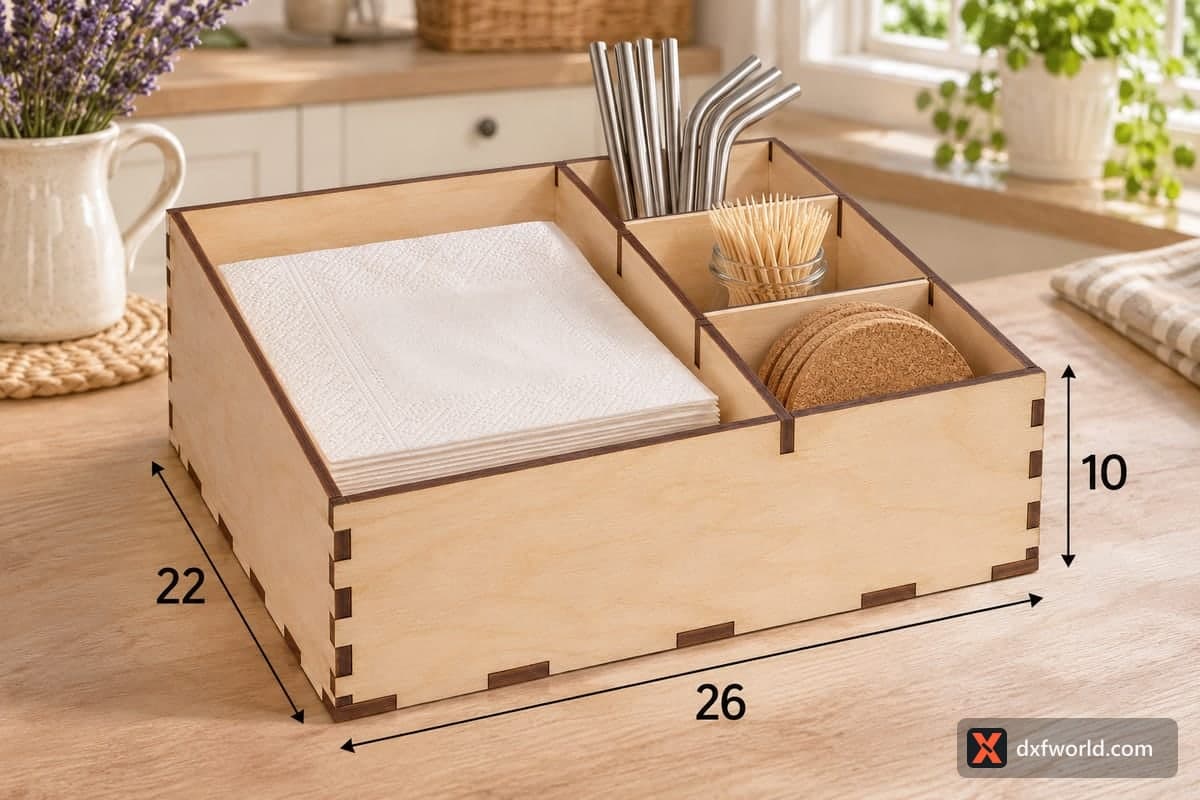
 Visualization
Deep Napkin Box SVG, Simple Two Compartment Napkin Holder Laser Cut File, Napkin and Straw Bin DXF
A free, deep open napkin box with straight 100 mm walls and one divider, giving a wide section for napkins and a side section for straws, toothpicks or coasters. The download has SVG and DXF files for 3, 4, 5 and 6 mm plywood; the box measures 260 × 220 × 100 mm (10.24 × 8.66 × 3.94 in) and has only 6 pieces that join with tabs and slots.
- Formats
- SVG, DXF
- Outer size (W × D × H)
- 260 × 220 × 100 mm (10.24 × 8.66 × 3.94 in)
- Parts
- 6
- Material thickness
- 3, 4, 5 or 6 mm plywood (a file for each)
- Layout size (3 mm file)
- 980 × 332 mm
- Cut length
- 5.65 m
- Est. time, 10 W diode (3 mm)
- 18 min 50 s
- Est. time, 40 W CO2 (3 mm)
- 7 min 51 s
- Layers
- CUT only, no engraving
Free account required to download
How to make it
- 01Download the file for your plywood thickness and cut one corner joint from scrap to check the fit.
- 02Cut the 6 pieces: base, front, back, two sides and the divider.
- 03Stand the four walls in the base, then press the divider down into its slots from above.
- 04Sand, seal with oil or lacquer, and load napkins on one side and straws or coasters on the other.
A simple first project
With just a base, four walls and a single divider, this is one of the easiest boxes in the napkin range to cut and put together. The walls are a straight 100 mm all round, which makes it the deepest of the open napkin boxes here: a full pack of paper napkins lies flat inside without spilling over the rim. The one divider runs from front to back and leaves a wide section on the left and a narrower one on the right.
What goes where
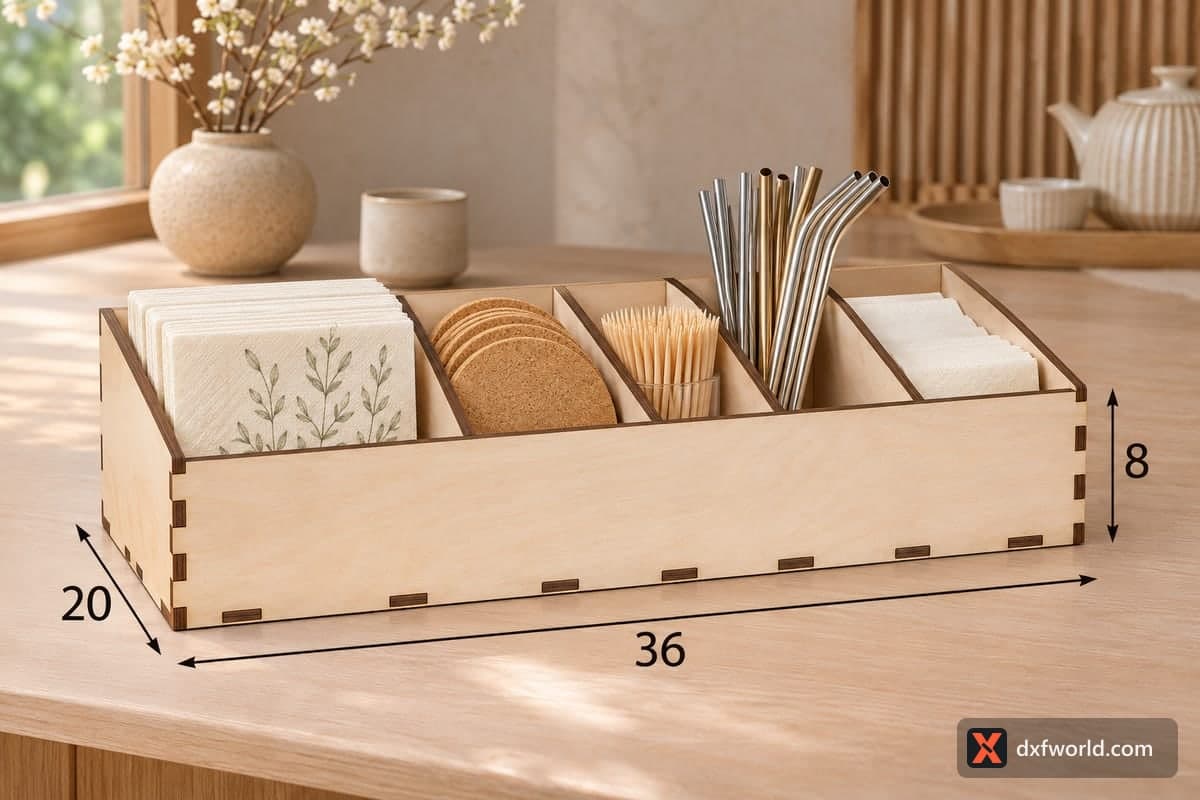
In the photo the wide section holds a thick stack of white paper napkins, and the side section carries metal straws, a small jar of toothpicks and a few cork coasters. The side section in the photo is split further into small cells; the file itself has one divider only, so glue in two strips of offcut if you want the same arrangement. On a kitchen island the box also works for tea towels, cutlery wrapped in napkins, or seed packets on a potting bench.
Cutting and finishing
The 3 mm layout is 980 × 332 mm. On a smaller bed, run the base and one long wall first and the other pieces after. The estimated time for the 3 mm file is about 18 min 50 s on a 10 W diode, about 7 min 51 s on a 40 W CO2 and about 3 min 46 s on a 100 W CO2. Diode users can cut 3 mm in one or two passes; 5 and 6 mm need more passes or a CO2 machine. The joints hold without glue, though a drop of wood glue in each corner makes the box permanent. Sand the edges and seal it with oil or lacquer.
Questions about this file
Why choose the deep version?
At 100 mm the walls hold a full stack of napkins and keep tall items like straws upright, which a low tray cannot do.
Is this box suitable for a beginner?
Yes. Six pieces and plain straight walls mean few joints to fit, and the whole box cuts in under 20 minutes on a 10 W diode for the 3 mm file.
Can I resize it for dinner napkins?
You can scale it up, but reset the slot and tab widths to your sheet thickness afterwards, or the corners will not close tightly.
Which thickness should I pick?
The 3 mm file is lightest and quickest. The 5 or 6 mm files give a chunkier, rustic look and a heavier box that stays put on the table.
Is it safe to keep beside a kitchen sink?
Seal all faces, including the underside of the base, with a waterproof lacquer or hard oil, and wipe off splashes rather than soaking it.
Similar files