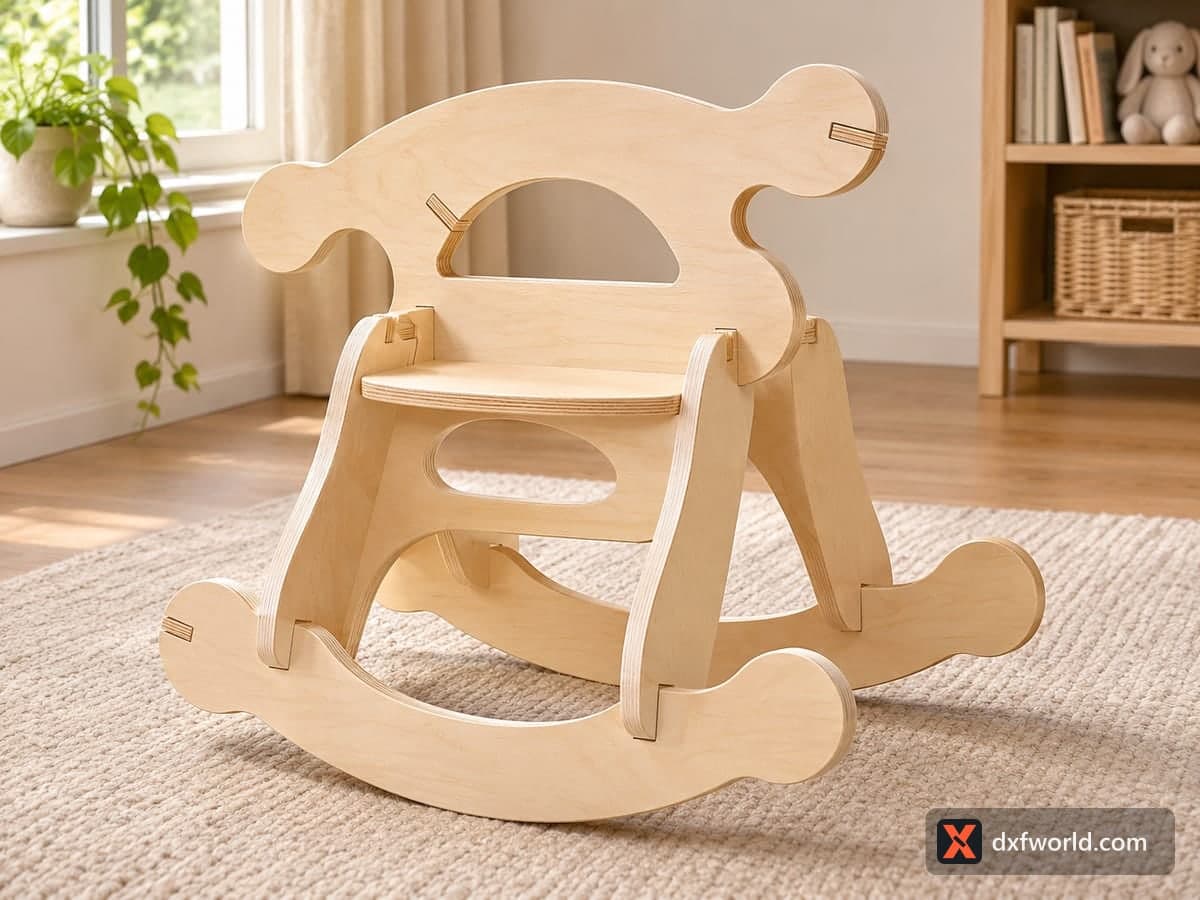
 Visualization
Kids Rocking Chair Plans DXF, Toddler Rocker SVG, Slot Together Plywood Chair CNC File, Nursery Furniture Cut File
A child-size rocking chair that assembles from seven flat parts without screws: two identical side frames that combine the rocker, the arm and a carrying handle, two wide panels for the seat and the backrest, and three narrow rails. The free SVG and DXF hold cut lines only on a 1280.2 × 835 mm (50.4 × 32.87 in) layout, which suits a CNC router or a large-format laser.
- Formats
- SVG, DXF
- Size
- 1,280 × 835 mm (50.40 × 32.87 in)
- Material
- Plywood, MDF, acrylic or metal (scale to your piece)
- Cut length
- 14.58 m
- Est. time, 10 W diode (3 mm)
- 48 min 36 s
- Est. time, 40 W CO2 (3 mm)
- 20 min 15 s
- Layers
- CUT only, no engraving
Free account required to download
How to make it
- 01Measure the slot width in the file, buy matching plywood and cut a test joint from scrap.
- 02Cut both side frames, the seat, the backrest and the three rails on a CNC router or large laser.
- 03Round and sand all edges, then slot the rails and panels into one side frame and press the second side on.
- 04Check every joint for a snug fit, add glue where needed and finish with a child-safe lacquer or oil.
The seven parts
The two side frames are the same shape, nested head to tail in the layout. Each has a long curved rocker at the bottom, an S-shaped upright and a rounded arm on top, with a half-moon window in the arm and a larger one in the rocker that double as hand grips and save weight. Between the sides sit two wide panels, the seat and the backrest, plus three narrow rails that brace the frame. Everything locks together with slots, so a finished chair can be taken apart flat for storage or shipping.
Material and slot fit
This is real furniture for a small child, so use sturdy birch plywood. The slots are drawn for one thickness that the file does not state: measure them in your CAM or laser software and buy plywood to match, or scale the layout until the slots fit what you have. Cut a test joint from offcuts first, because a sloppy fit makes a chair wobble. The pieces are large, so a CNC router with a small end mill is the usual tool; remember the inside corners of the slots will be rounded by the bit and may need a dogbone added.
Safety and finishing
Round over every edge, sand to 180 grit and finish with a child-safe water-based lacquer or hardwax oil. Check that all joints are tight before a child uses the chair, glue the rails if they loosen over time, and always use it on a flat floor. A name engraved on the backrest turns it into a lovely first-birthday or new-sibling gift.
Questions about this file
What plywood thickness do I need?
The file does not state it. Measure the slots in your software and use plywood of that thickness, or scale the whole layout to fit your sheet thickness.
Can I cut it on a desktop laser?
The side frames are about 612 mm long, so most desktop lasers are too small. A CNC router or a large-format CO2 laser handles the parts in one piece.
What age is it for?
It is sized as a small child's chair. Check the seat height against your child and always supervise rocking on hard floors.
Do I need screws or glue?
The slots hold it together. A little wood glue on the rails makes it permanent if the chair will see heavy use.
Why add dogbones on a CNC router?
A round bit cannot cut sharp inside corners, so the slots end up slightly short. Dogbone fillets let the panels seat fully.
Similar files