 Visualization
MDF Desk DXF, Scroll Apron Writing Table CNC File, Two Drawer Table Plans SVG, Fretwork Console Table
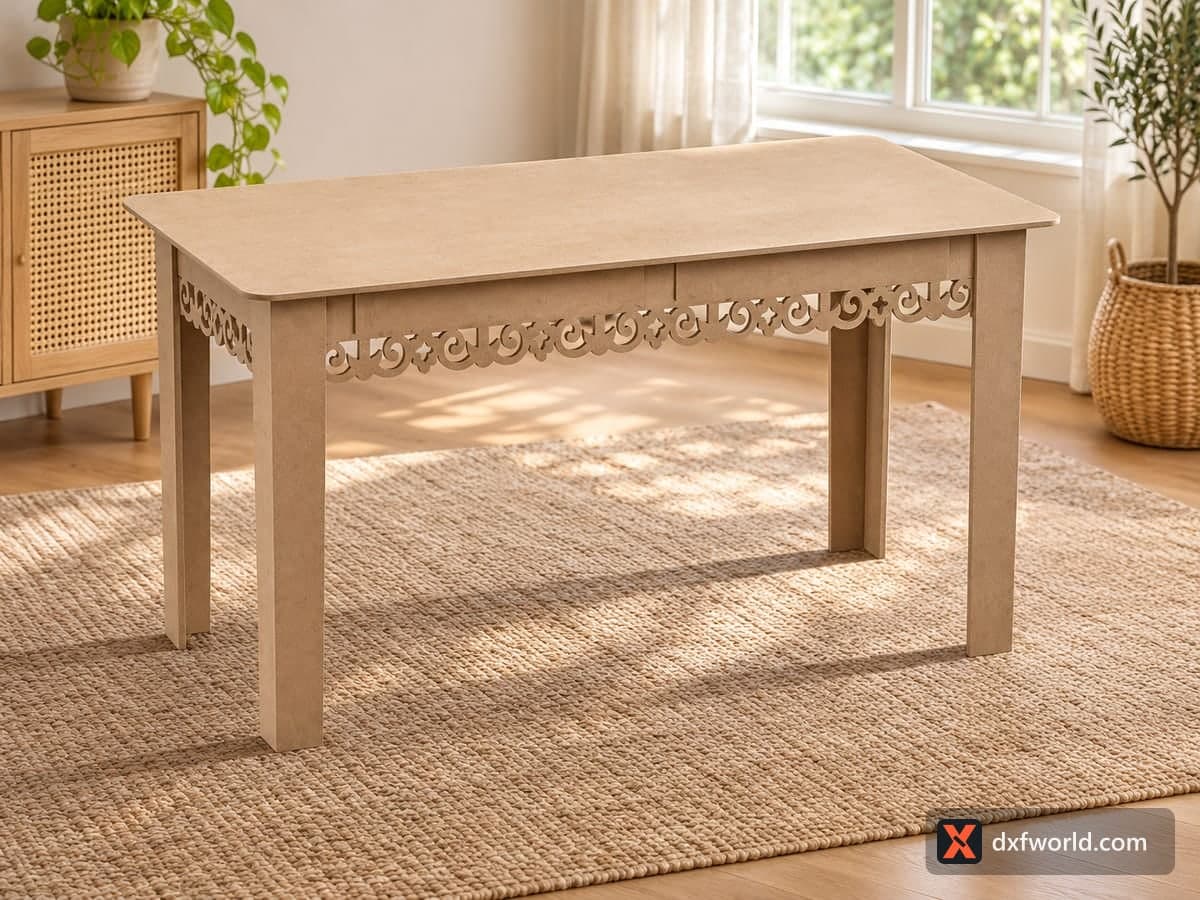
A tab-and-slot writing desk with a rounded-corner top, aprons edged with a band of scroll fretwork, two drawer openings in the front apron and two drawer boxes. In the free SVG and DXF everything sits on a 2845.7 × 2865.3 mm (112.04 × 112.81 in) router layout. Labels in the file mark the top, aprons and drawer parts for 9 mm board and the eight notched leg strips for 12 mm board.
- Formats
- SVG, DXF
- Size
- 2,846 × 2,865 mm (112.04 × 112.81 in)
- Material
- Plywood, MDF, acrylic or metal (scale to your piece)
- Cut length
- 77.34 m
- Est. time, 10 W diode (3 mm)
- 257 min 47 s
- Est. time, 40 W CO2 (3 mm)
- 107 min 25 s
- Layers
- CUT only, no engraving
Free account required to download
How to make it
- 01Delete the thickness labels and test a leg joint and an apron tab in your 9 mm and 12 mm boards.
- 02Cut the 9 mm parts and the 12 mm leg strips as separate jobs, openings first.
- 03Glue the leg strips in pairs, fit the aprons and tabbed panel, then lower the top onto its tabs.
- 04Assemble the two drawer boxes, slide them in, sand and paint or seal the desk.
Parts and thickness
The 9 mm group holds the top with rows of slots near its edges, two long aprons (the front one has two rectangular drawer openings), two short end aprons, a large tabbed panel and two drawer boxes, each a base with four tabbed walls. Every apron has a scrolling fretwork border along its lower edge. The 12 mm group is eight long leg strips with finger notches, joined in pairs into four corner legs. The labels 9mm and 12mm are drawn as outlines in the file; delete them before cutting.
Cutting tips
Cut the 9 mm and 12 mm parts as two separate jobs. Before committing a full sheet, cut one leg joint and one apron tab and push them into a test slot, since MDF and plywood thickness varies by supplier. The scroll fretwork has small curls and short bridges, so use a 3 or 4 mm bit and slow the feed on those passes. Cut inside openings before outlines to keep parts from shifting.
Assembly and finish
Build the four legs first, glue the strips together and let them dry square. Fit the aprons into the legs, drop the top onto the tabs, then slide in the drawer boxes. MDF takes paint well, so a primer and two coats of satin paint give a clean painted-furniture look; the photo shows it left in raw MDF.
Questions about this file
What material thickness does it use?
The file is labelled 9 mm for the top, aprons and drawers and 12 mm for the leg strips. Test the slots against your boards first.
Are the drawers included?
Yes, two drawer boxes, each a base with four walls, sit behind the openings in the front apron.
Does a laser cutter work for this?
Full size needs a CNC router. Scaled down, a laser can cut it as a dollhouse desk if you rescale the slots for thin sheet.
Should I glue the joints?
Glue the legs and the apron joints for a desk that takes daily use; the drawers can stay dry-fitted.
Can I leave out the fretwork?
Yes, delete the scroll cut-outs from the aprons for a plain desk, keeping the tabs.
Similar files