 Visualization
Grizzly Bear 3D Puzzle SVG, Standing Bear Laser Cut File, Layered Wooden Bear Model DXF, Rearing Bear Sculpture
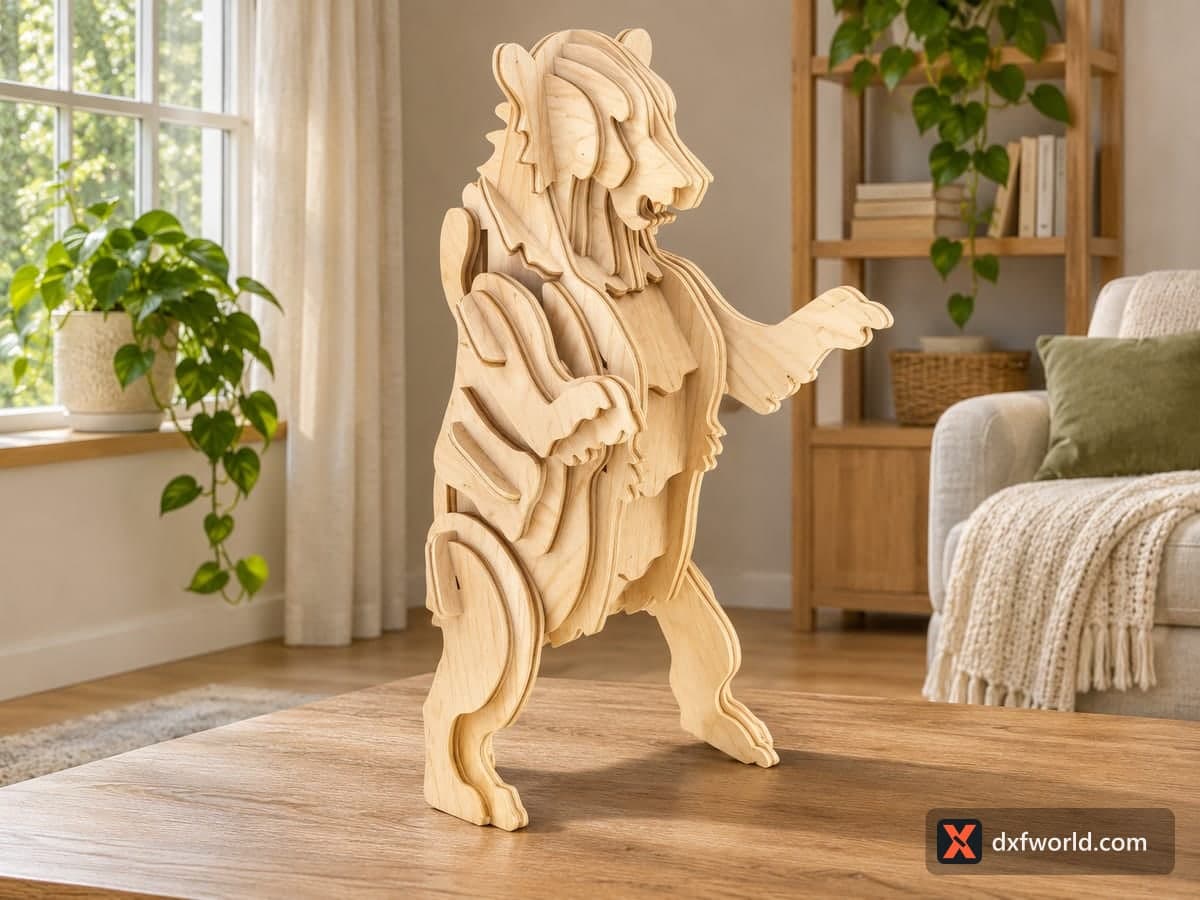
A 3D bear model that stands upright on its hind legs with one paw raised, built from stacked profile layers: graduated head slices, two slotted body plates, two outer body layers, curved arm layers, leg layers and a column of spacer blocks. SVG and DXF files, both free, place every part inside a square of 294.3 × 294.4 mm (11.59 × 11.59 in).
- Formats
- SVG, DXF
- Size
- 294 × 294 mm (11.59 × 11.59 in)
- Material
- Plywood, MDF, acrylic or metal (scale to your piece)
- Cut length
- 7.56 m
- Est. time, 10 W diode (3 mm)
- 25 min 13 s
- Est. time, 40 W CO2 (3 mm)
- 10 min 30 s
- Layers
- CUT only, no engraving
Free account required to download
How to make it
- 01Read one slot gap on screen, get plywood of that thickness and push a spacer block into a body plate as a test.
- 02Cut all parts and sort them into head slices, body layers, arm layers, leg layers and spacers.
- 03Join the two core body plates with the spacers, add the outer body layers, then the legs and arms.
- 04Slide the head slices onto the neck from smallest to largest, add the ear piece and glue loose joints.
How the layers stack
The bear is built from the middle outward. The two large slotted plates form the core of the body, and short spacer blocks push into their slots to hold them apart. On the outside go the two plain body layers with the shoulder hump. The head is a stack of profile slices that grow from the snout layer to the widest layer with the open mouth and ear, each with a slot that slides onto the neck. Three curved layers make each front arm and three tapered layers each hind leg, so the limbs have real depth when seen from the side. A small piece with two ears caps the top of the head. The layout sits inside a square frame line; delete it or use it as the sheet edge.
Scaling and material
At the file size the bear is a desk model. The photo shows a much larger one standing on a table, which you get by scaling up and using thicker plywood. Slot gaps widen as you enlarge, so check one after resizing, buy board to fit, then trial a spacer block and a head slice. Scaling down below the file size is not a good idea, since the thin claws and spacer tabs get fragile.
Finishing ideas
Leave the layers bare so the dark laser edges trace the fur lines, or stain the whole bear in a warm brown. A large version makes a striking piece for a cabin, a hunting lodge or a kids room with a forest theme, and a small one suits a gift for anyone who loves the wild.
Questions about this file
How large is the finished bear?
Unscaled, the bear stays a small desk piece. Scale it up for a floor piece, and choose thicker plywood that matches the larger slots.
Does the bear stand on its own?
Yes, it balances on both hind legs. For a big version, screw the feet to a plywood base so it cannot tip over.
Which plywood do I need?
No thickness is printed on the drawing. Your sheet must equal the slot gap, so read that on screen or resize the bear to fit the sheet you have.
Can I paint it like a polar bear?
Yes, a white or cream paint turns it into a polar bear. Paint the layers before assembly so the gaps between them are covered too.
Do I need glue?
The spacers grip by friction; glue on the leg and head joints keeps a larger bear rigid.
Similar files