 Visualization
Fishing Boat Model DXF, Wooden Trawler Kit Laser Cut File, Plywood Ship Model SVG, Display Boat on Stand Plans
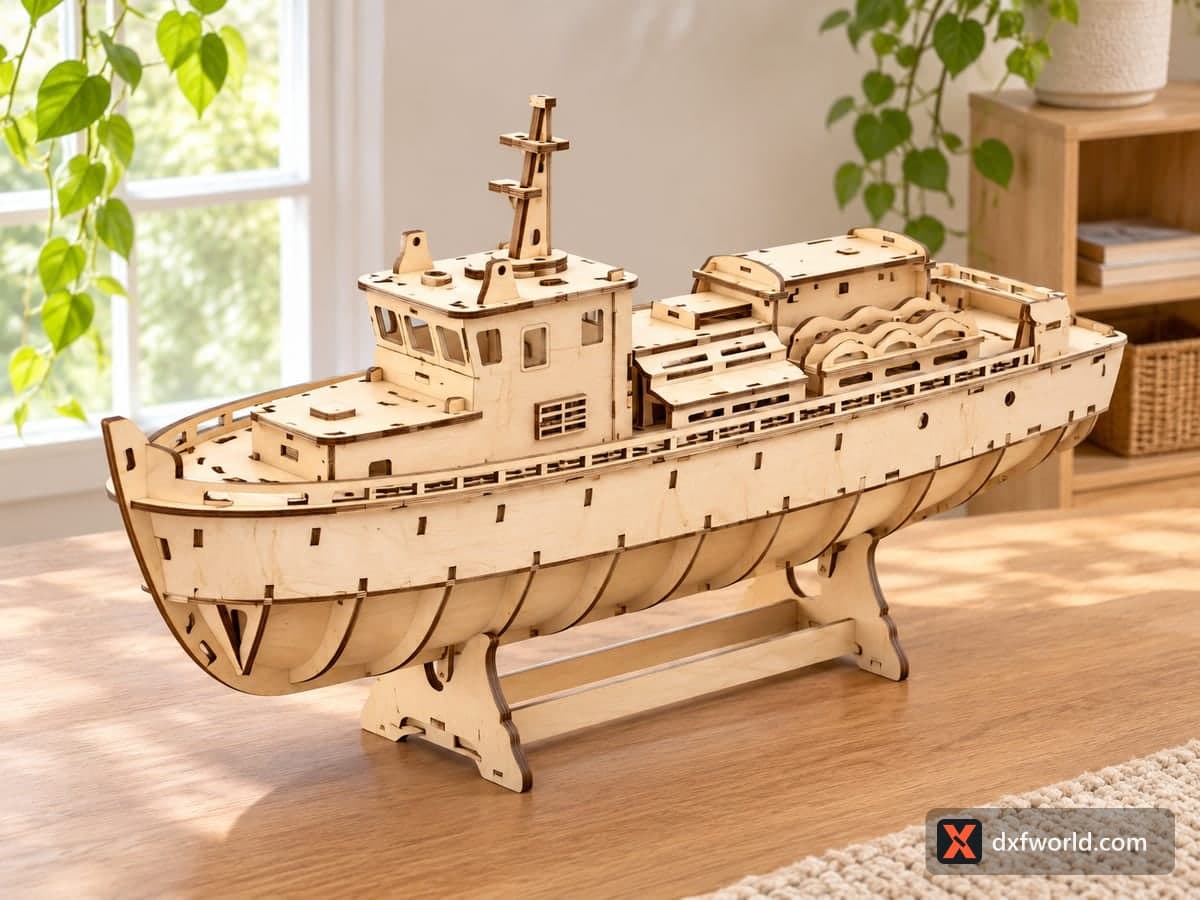
A large plywood model of a fishing trawler built on numbered hull frames and a keel, with side stringers, a deck, a wheelhouse with windows, a mast and a two-cradle display stand. Both free files, DXF and SVG, hold every part on a 1295.9 × 2074.4 mm (51.02 × 81.67 in) layout, and labels beside the part groups name the sheet thickness each group needs.
- Formats
- SVG, DXF
- Size
- 1,296 × 2,074 mm (51.02 × 81.67 in)
- Material
- Plywood, MDF, acrylic or metal (scale to your piece)
- Cut length
- 65.69 m
- Est. time, 10 W diode (3 mm)
- 218 min 57 s
- Est. time, 40 W CO2 (3 mm)
- 91 min 14 s
- Layers
- CUT only, no engraving
Free account required to download
How to make it
- 01Split the layout by the thickness labels and cut one 5 mm frame and a stringer to test the slot fit.
- 02Cut each group from its own sheet, keeping the numbered parts together in bags or trays.
- 03Slot the frames onto the keel, add the stringers in pairs, then fit the deck, wheelhouse, railings and mast.
- 04Assemble the cradle stand, set the hull on it and finish with clear varnish or paint.
Three sheet thicknesses
This is not a one-sheet kit. Small labels beside the groups name the material: 5 mm for the hull frames, the keel parts and the long side stringers, 2 mm for a group of lighter parts and 1.2 mm for the main deck. Separate the groups in your software and cut each one from its own sheet. Every part carries a number, which you can engrave lightly as an assembly guide or delete before cutting. The layout is large, so expect to split the 5 mm group across several sheets on a desktop laser bed.
What is in the layout
The hull starts with rounded, cello-shaped frames that slot onto two long keel pieces, then four tall slotted stringers that run the length of the boat and lock into the frame notches. The 1.2 mm deck has slots along both edges, a square hatch grid and holes for the mast and funnel. The thinner panels form the wheelhouse, the side railings with their rows of openings, small cabin walls with window cut-outs and curved fittings for the aft deck. Two shaped cradles and two rails make the stand.
Building tips
Dry-fit the frames on the keel first and check that they stand square before any glue goes on, because a twisted keel shows along the whole hull. Glue the stringers one pair at a time, left and right together, so the hull does not pull to one side. A 10 W diode handles the 1.2 mm and 2 mm parts easily; the 5 mm frames cut faster and cleaner on a CO2 laser. The finished boat is a fine shelf piece for a fisherman, a harbour-themed cafe or a nautical study.
Questions about this file
What materials does this boat need?
The labels call for 5 mm sheet for the hull structure, 2 mm for lighter parts and 1.2 mm for the deck. Thin birch plywood works for all three.
Can I build it from one thickness only?
Not without changing the slots. The frames and stringers interlock with notches sized for 5 mm, and the deck slots match those frames.
How big is the finished boat?
The full parts layout covers 1295.9 × 2074.4 mm. Measure the longest stringer in your software to see the hull length before you buy sheets.
Will it work at half size?
Only if every sheet thickness scales with it. Halving the size would need 2.5 mm frames and very thin deck veneer, so most builders keep the original size and split the layout.
Should I paint the hull?
Bare plywood with a clear coat looks like the photo. For a working-boat look, paint the hull below the stringer line red and the upper sides white.
Similar files