 Visualization
Math Wall Clock SVG, Equation Clock Face Laser Cut File, Teacher Classroom Clock DXF, Geek Gift
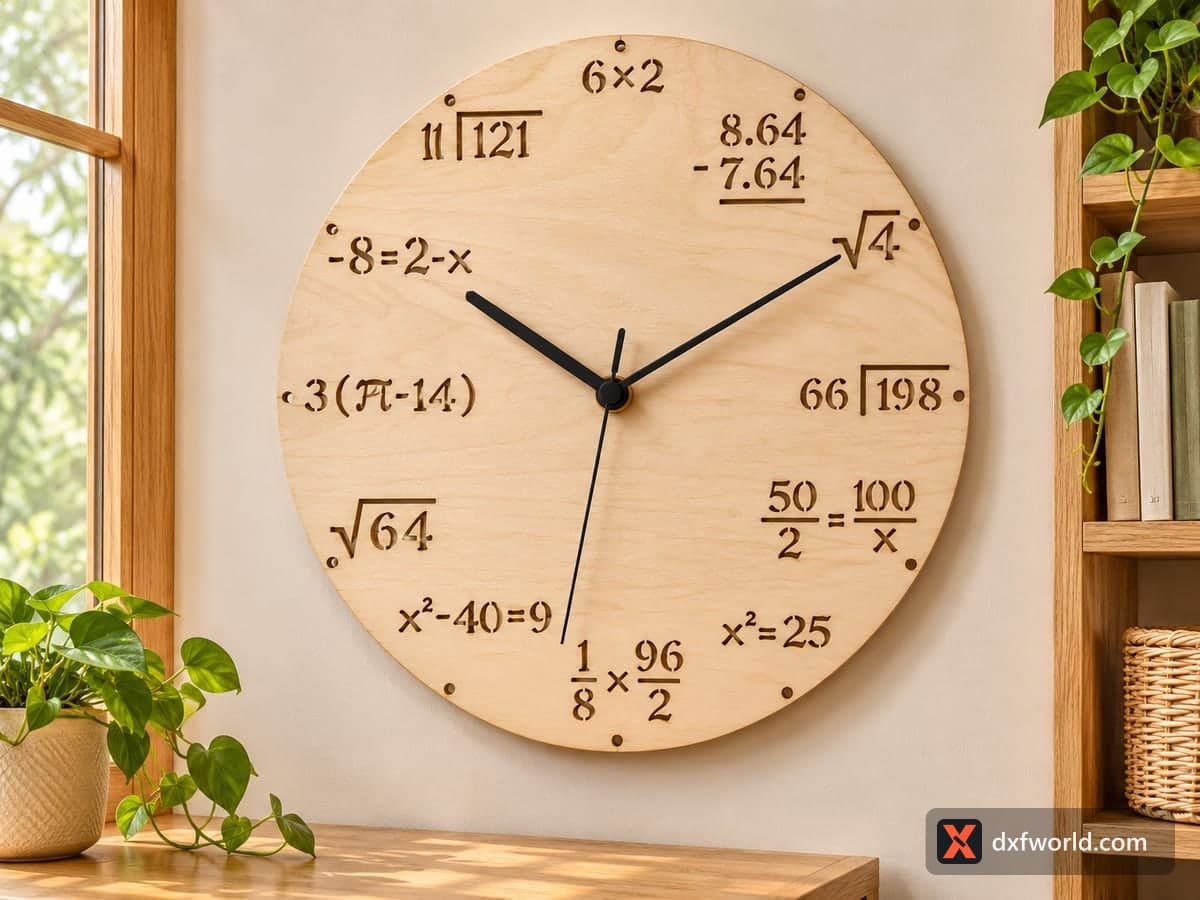
A round 12 in wall clock face where every hour is written as a little math problem, from 6×2 at the top to the square root of 64 at eight o'clock. The free download is one SVG and one DXF with cut lines only, sized 304.8 × 304.8 mm (12 × 12 in), with stencil-style figures cut through the board, twelve small hour holes around the rim and a centre hole for a quartz movement.
- Formats
- SVG, DXF
- Size
- 305 × 305 mm (12.00 × 12.00 in)
- Material
- Plywood, MDF, acrylic or metal (scale to your piece)
- Cut length
- 5.46 m
- Est. time, 10 W diode (3 mm)
- 18 min 11 s
- Est. time, 40 W CO2 (3 mm)
- 7 min 35 s
- Layers
- CUT only, no engraving
Free account required to download
How to make it
- 01Measure the shaft of your quartz movement and enlarge the 5.8 mm centre hole in the file if needed.
- 02Cut the stencil figures and the twelve rim holes first, then the outer edge of the face.
- 03Sand the face lightly, wipe off soot around the figures and seal it with oil or clear lacquer.
- 04Fit the movement from the back, press on the hands so they point to twelve, add a battery and hang it.
The twelve puzzles
Reading clockwise from the top: 6×2 is twelve, 8.64 minus 7.64 is one, the root of 4 is two, 198 divided by 66 is three, 50/2 = 100/x gives four, x² = 25 is five, 1/8 × 96/2 is six, x² − 40 = 9 is seven, the root of 64 is eight, 3(Pi − .14) is nine, −8 = 2 − x is ten and 121 divided by 11 is eleven. Each answer matches its hour, so the face doubles as a quiz for anyone who glances at it.
The figures use a stencil lettering with small bridges, so the middles of 0, 4, 6, 8 and 9 stay attached to the board and nothing drops out. A 4.6 mm hole sits at every hour mark on the rim.
Movement, hands and scaling
The centre hole is 5.8 mm. Most quartz movements need about 7.5 to 8 mm, so check yours and widen the hole in the file or with a drill. Choose hands around 120 to 140 mm long for this face. The outer edge is drawn as a polygon with 32 short straight sides; replace it with a true circle in your software if you want a perfectly round rim. The face can be scaled up for a classroom wall, but shrinking it much below 12 in makes the stencil bridges hard to cut.
Finishing and who it suits
Birch plywood with clear oil looks like the photo. Paint the board, then cut the numbers so a dark backing board shows through them. It makes a good gift for maths teachers, engineering students and graduation tables, and a school can order one per classroom.
Questions about this file
Are all the equations correct?
Yes. Each one works out to the hour it sits on, from 6×2 at twelve to 121 divided by 11 at eleven.
Will a standard clock movement fit?
The centre hole is drawn at 5.8 mm, a little small for most quartz movements. Widen it to the shaft size of yours, usually 7.5 to 8 mm.
Why are there small gaps in the numbers?
The lettering is a stencil style. The gaps are bridges that keep the inside of letters like 8 and 9 attached, so the face stays one piece.
Can I add a backing board?
Yes. Glue a second disc of a contrasting colour behind the face and the figures will stand out against it.
Can I make it bigger for a classroom?
Scale the whole file up to 400 or 500 mm, enlarge the centre hole for a high-torque movement and use longer hands.
Similar files