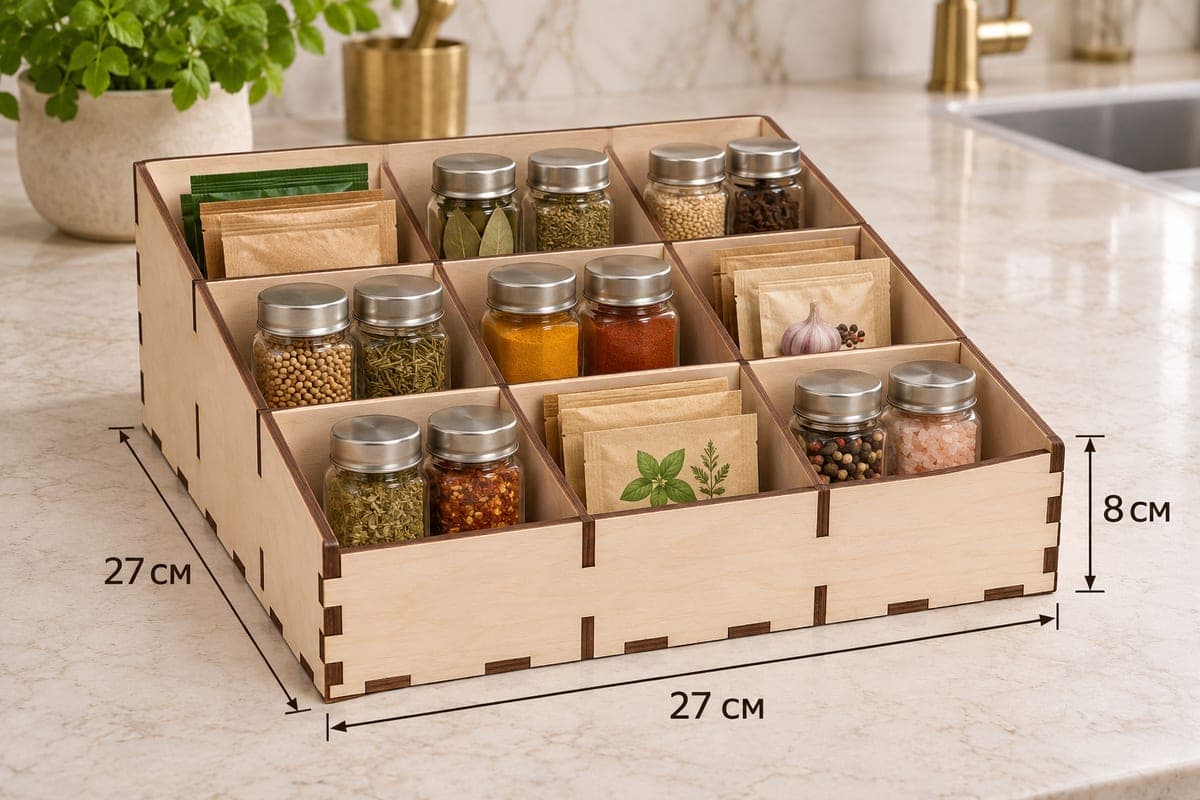
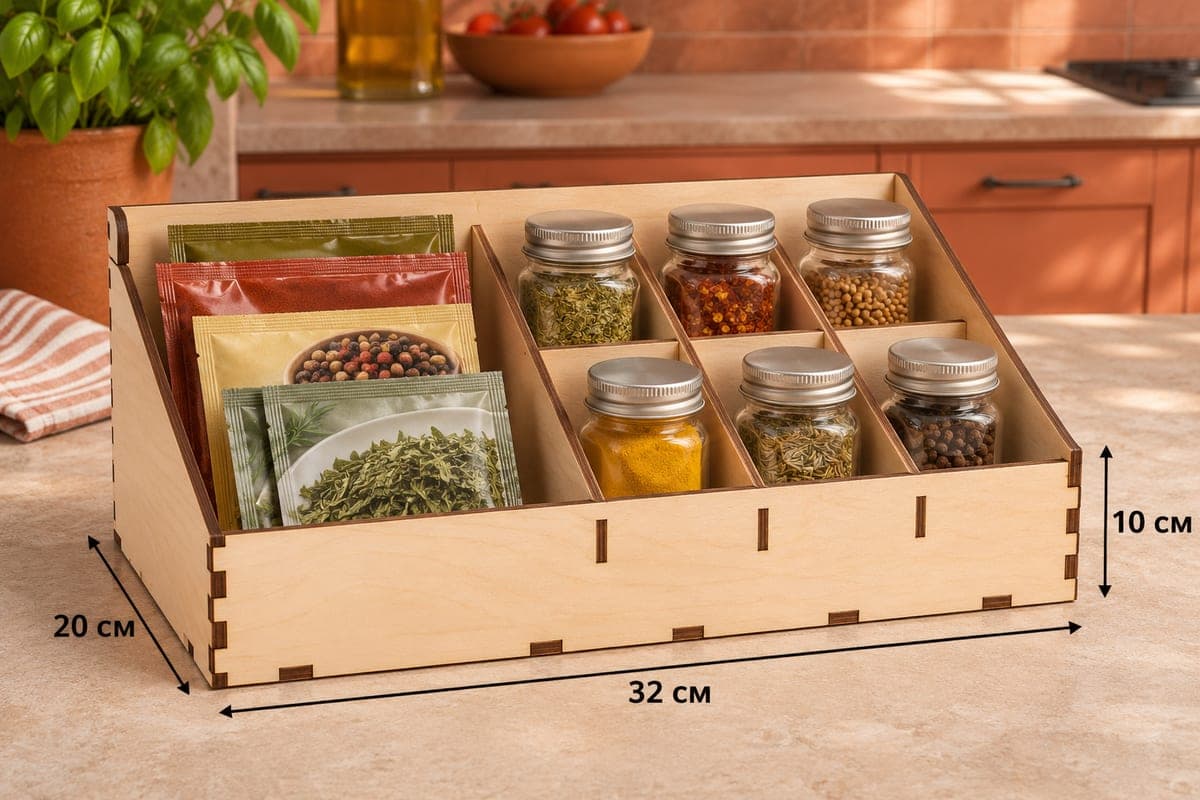
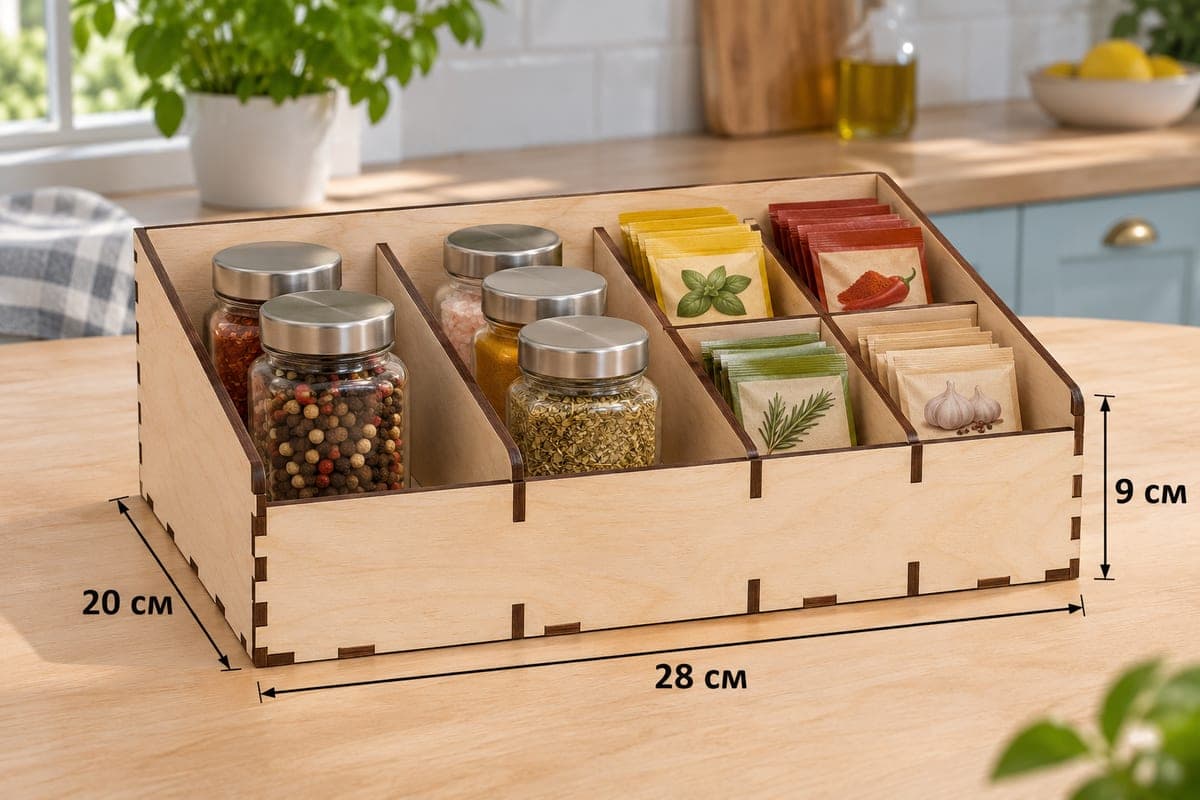
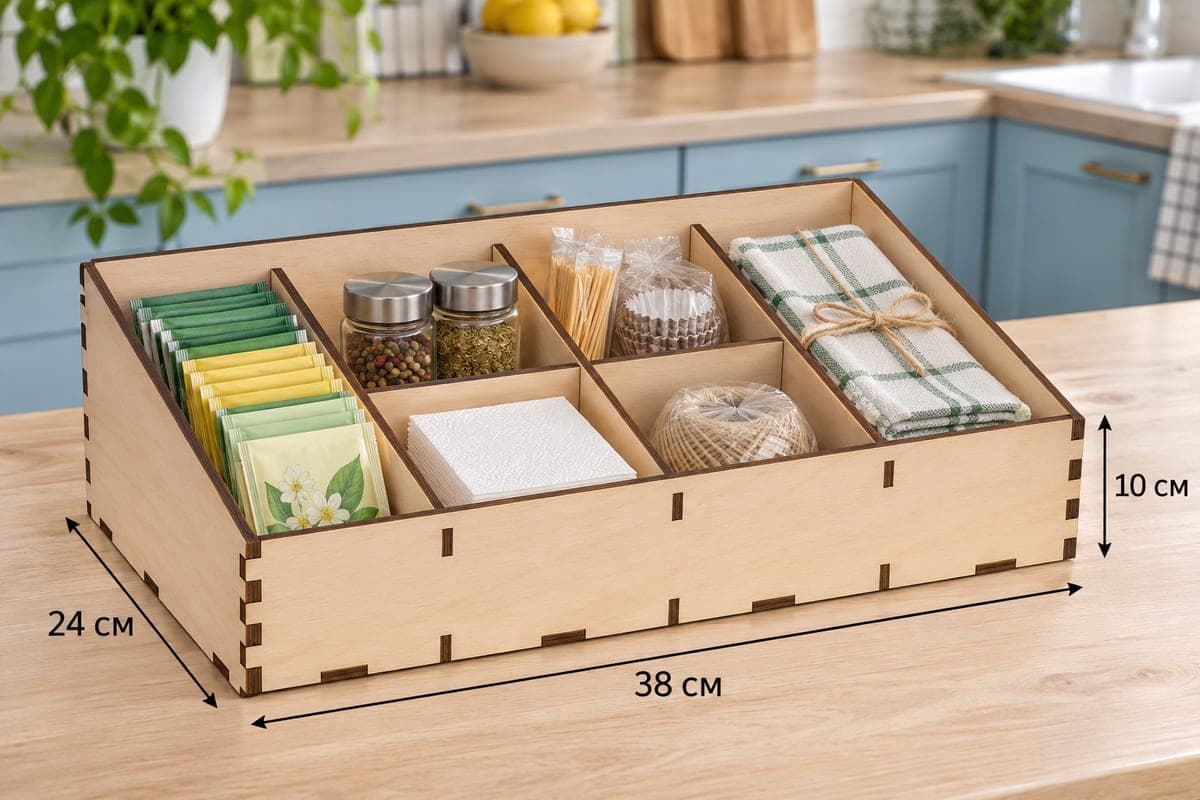
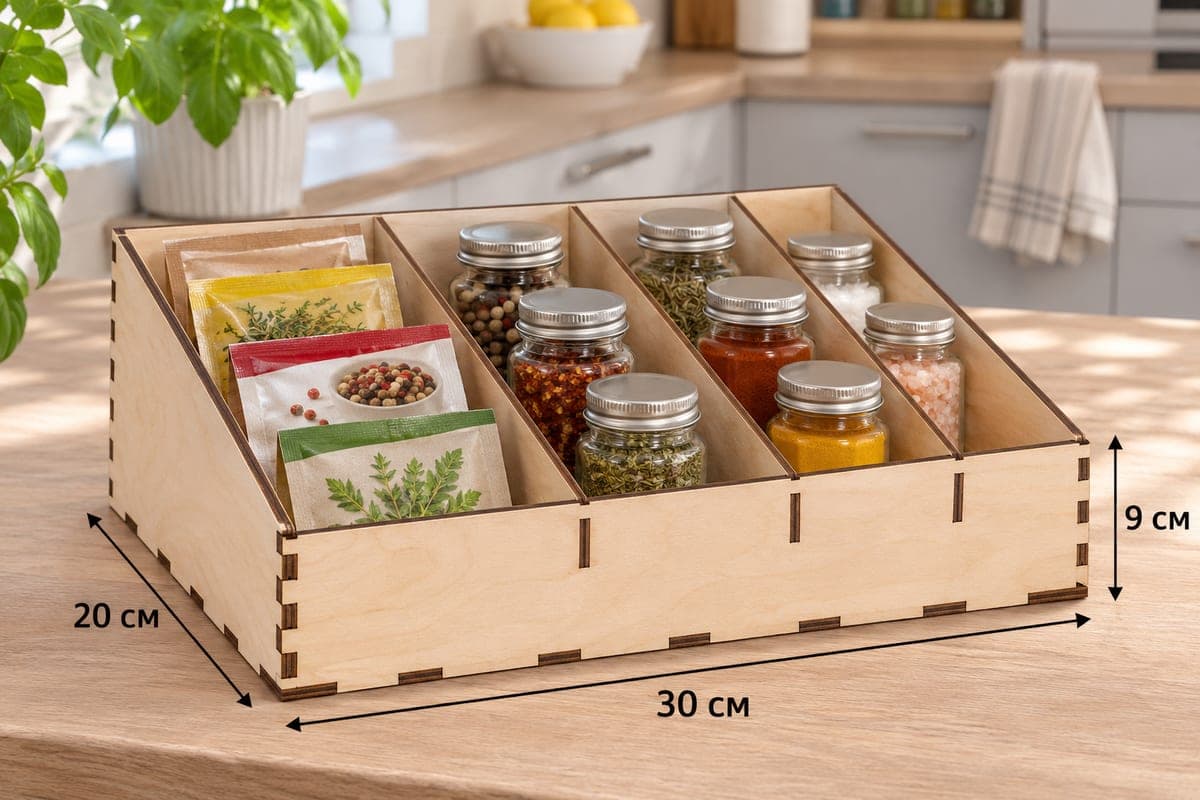
 Visualization
Spice Jar Organizer Laser File, Four Lane Spice Rack SVG, Front to Back Spice Divider Box DXF, Wooden Seasoning Holder
A simple four-lane spice organizer in which three dividers run the full depth of the box, so jars line up front to back in each lane. It is provided as SVG and DXF files for 3, 4, 5 and 6 mm plywood, measures 300 × 200 × 90 mm (11.81 × 7.87 × 3.54 in) when assembled, and uses 8 pieces with tab-and-slot joints. The sides slope from a 90 mm back to a 54 mm front, and it is a free download from DXF World.
- Formats
- SVG, DXF
- Outer size (W × D × H)
- 300 × 200 × 90 mm (11.81 × 7.87 × 3.54 in)
- Parts
- 8
- Material thickness
- 3, 4, 5 or 6 mm plywood (a file for each)
- Layout size (3 mm file)
- 1,020 × 302 mm
- Cut length
- 5.99 m
- Est. time, 10 W diode (3 mm)
- 19 min 59 s
- Est. time, 40 W CO2 (3 mm)
- 8 min 20 s
- Layers
- CUT only, no engraving
Free account required to download
How to make it
- 01Pick the thickness version that matches your plywood and test-cut a single slot to confirm a snug divider fit.
- 02Cut the eight pieces: base, back, front, two sloped sides and the three full-depth dividers.
- 03Seat all three dividers in the base, then add the back wall, the two sides and finally the 54 mm front.
- 04Sand the edges, oil the box and slide jars into each lane from the front, staggering them so every lid is visible.
How the lanes work
There is no cross divider here: three dividers, each the full 200 mm deep and 90 mm tall, split the box into four long lanes. That makes it the easiest of the spice organizers to load, because you slide jars in from the front and they queue toward the back wall.
In the photo the left lane holds four seasoning packets standing up in a fan, and each of the other three lanes holds three small jars placed slightly off-line so all the lids show: peppercorn mix, chili flakes and dried herbs; dill, paprika and thyme; sea salt, pink salt and turmeric. That is nine jars plus a stack of packets in a box no bigger than a cutting board.
If you prefer only jars, the left lane takes three more, for twelve in total.
Making it
Eight parts keep the build short. The 3 mm layout is 1020 × 302 mm, which most desktop machines will take in two jobs: the 300 × 200 base with the back, then the sides, front and three dividers. A 10 W diode gets through the 3 mm file in about 19 min 59 s; on a 40 W CO2 it is about 8 min 20 s, on a 100 W CO2 about 4 min 00 s. If you want 6 mm walls, use a CO2; a 10 W diode will need several passes per line and the char gets heavy.
Push the dividers into the base before fitting the back so you can see each tab seat. A small bead of glue under each divider keeps the lanes straight.
Ideas for selling
- A four-lane rack with nine jars makes a tidy listing photo for a spice-lover gift.
- Offer it in pairs for people with long counters.
- Market it to bakers as well: the same lanes hold vanilla, sprinkles and cinnamon jars.
Finish with a food-safe oil to make it easy to wipe.
Questions about this file
How many jars does each lane hold?
Three small round jars per lane, so nine with one lane of packets as in the photo, or twelve if every lane holds jars.
Is there a way to split the lanes into cells?
The file has none, but you could cut small blocks to wedge between jars; real slotted cross dividers would need new slots in the lane dividers.
Is acrylic an option?
Yes, 3 mm acrylic cut on a CO2 laser with the 3 mm file works, joined with acrylic cement.
How do I keep it from staining?
Seal the inside faces with clear lacquer before loading turmeric or paprika, which stain bare wood quickly.
Which thickness looks best?
4 mm birch gives slightly bolder edges than 3 mm and stays rigid across the 300 mm width; use the 4 mm file for it.
Similar files