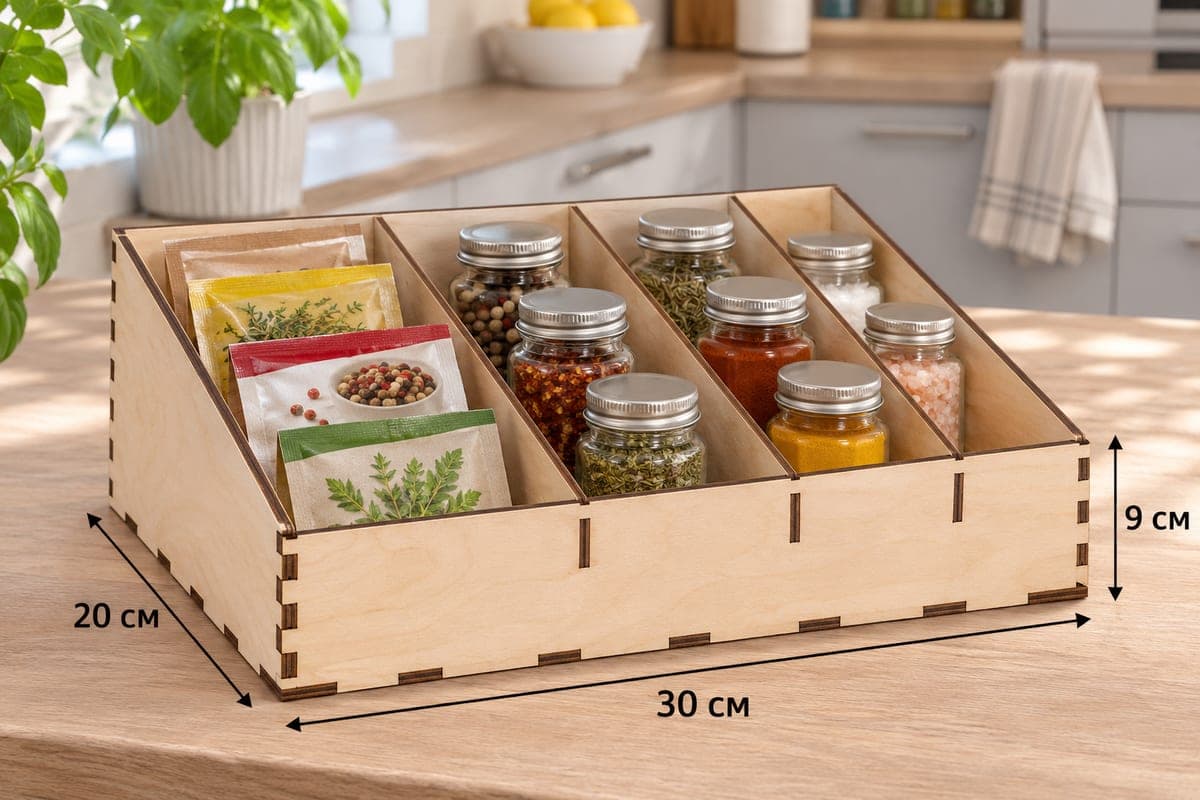
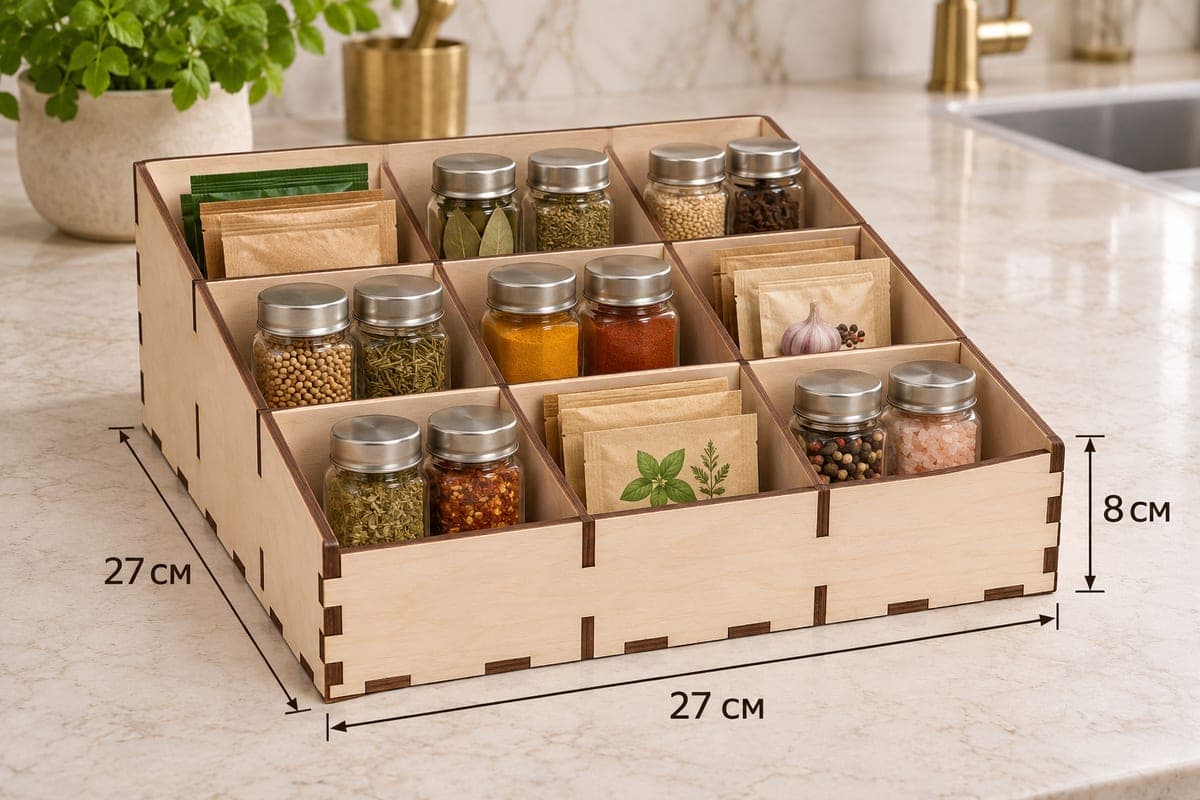
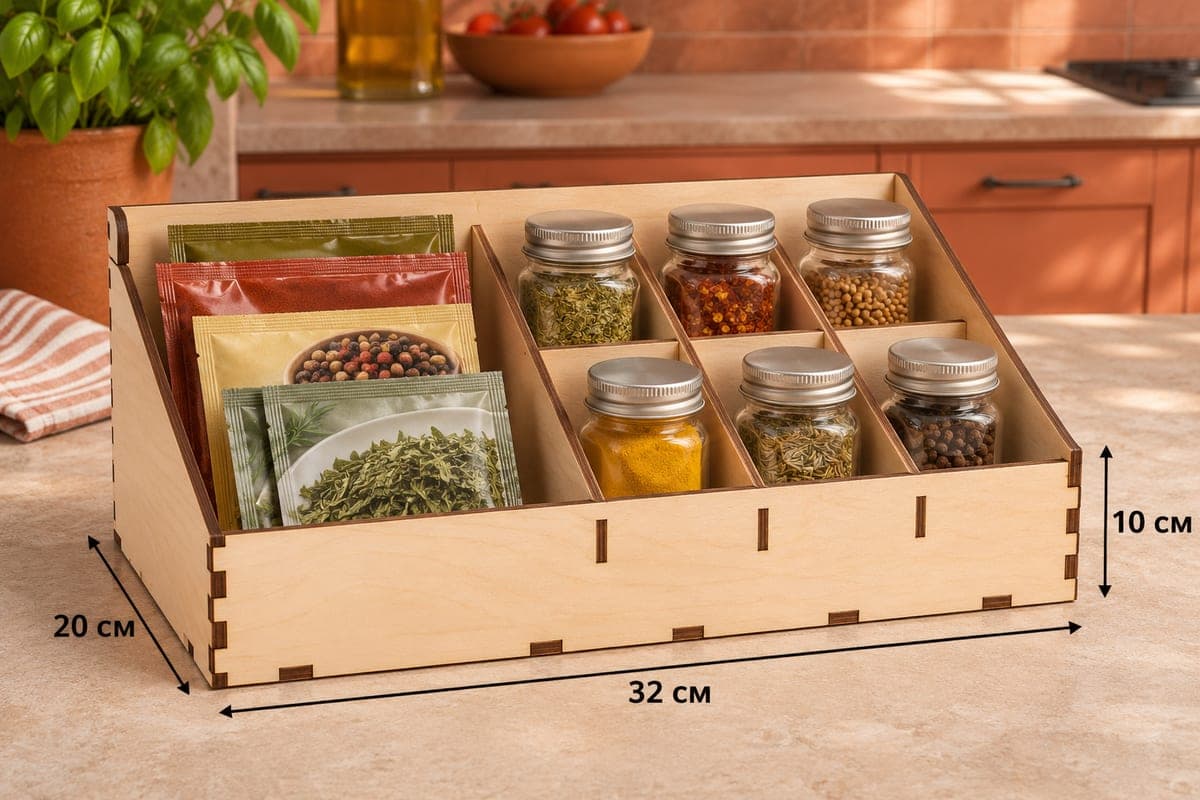
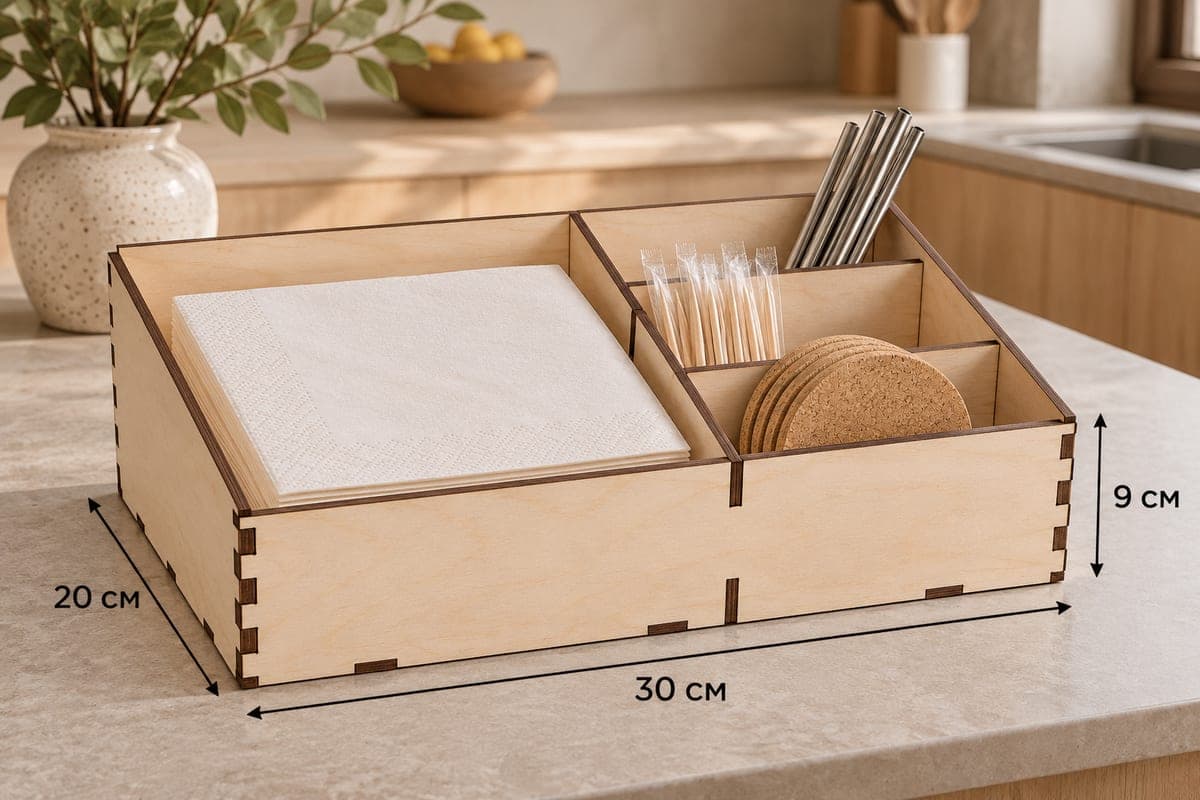
 Visualization
Spice Jar Organizer SVG, Sloped Spice Tray Laser Cut File, Wooden Seasoning Box DXF, Countertop Spice Holder
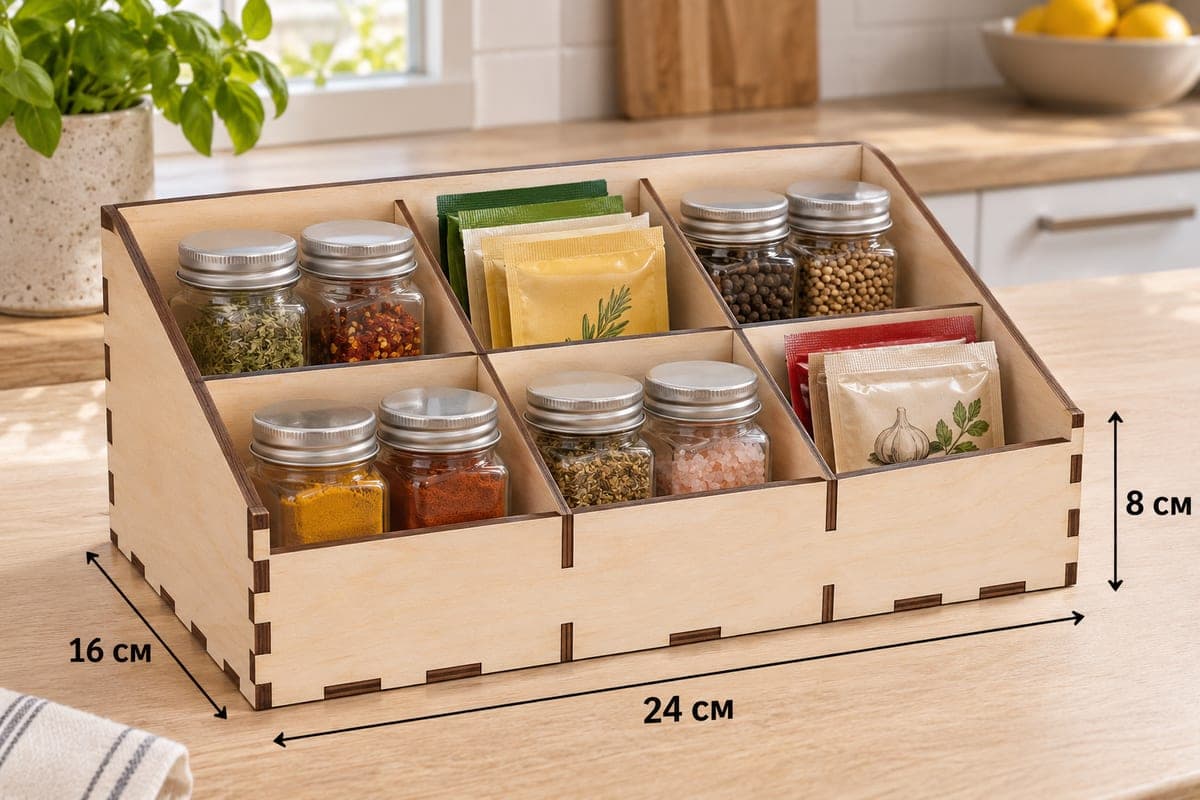
A compact countertop spice jar organizer with six sections arranged in two rows of three, cut from plywood on a laser. The download contains SVG and DXF files prepared separately for 3, 4, 5 and 6 mm plywood; the finished box is 240 × 160 × 80 mm (9.45 × 6.30 × 3.15 in), has 10 pieces that lock together with tabs and slots, and its front wall drops to 48 mm so the sides slope toward you. You can download all eight files for free.
- Formats
- SVG, DXF
- Outer size (W × D × H)
- 240 × 160 × 80 mm (9.45 × 6.30 × 3.15 in)
- Parts
- 10
- Material thickness
- 3, 4, 5 or 6 mm plywood (a file for each)
- Layout size (3 mm file)
- 834 × 252 mm
- Cut length
- 5.67 m
- Est. time, 10 W diode (3 mm)
- 18 min 53 s
- Est. time, 40 W CO2 (3 mm)
- 7 min 52 s
- Layers
- CUT only, no engraving
Free account required to download
How to make it
- 01Measure your plywood with calipers, open the SVG or DXF for that thickness, and cut one divider slot on scrap to check that a divider slides in snugly.
- 02Cut the base, back, front, two sloped sides, the long cross divider and the four short dividers, splitting them across two sheets if your bed is under 834 mm.
- 03Fit the sides and back into the base, add the 48 mm front, then drop in the cross divider and slot the two front and two rear dividers into it.
- 04Break the sharp edges with fine sandpaper, wipe on oil or lacquer, and load the taller back row with the jars you reach for less often.
What fits inside
At 240 mm from end to end this is the shortest tray in the spice set, and with 160 mm of depth it sits next to the stove without taking over the counter. One full-width cross divider splits it into a front row and a back row, and each row has three cells. The back cells use 80 mm dividers and the front ones only 62.1 mm, so the rear row stands taller and the labels on the back jars stay visible over the front ones.
In the photo each cell holds two short screw-top jars side by side (oregano, chili flakes, turmeric, paprika, pink salt, peppercorns), and two of the cells hold flat seasoning sachets standing upright instead. The 48 mm front wall is low enough to read the jar lids from above and pick one out with two fingers.
Cutting it on your laser
The 3 mm layout is 834 × 252 mm, which is wider than most hobby beds. If yours is smaller, move the base and the back to one sheet and the sides, front and five dividers to another. Expect about 18 min 53 s on a 10 W diode for the 3 mm file, about 7 min 52 s on a 40 W CO2 and about 3 min 47 s on a 100 W CO2. A diode handles 3 mm in one or two passes; 5 or 6 mm wants a CO2 or several slow passes.
Press the joints together dry first. If everything sits square, a thin line of wood glue in the base slots makes it permanent. Nothing is engraved, so the panels come off the laser as plain birch.
Ideas for selling
- Sell it filled with six small jars as a housewarming gift.
- Offer a matching larger version for customers with bigger collections.
- Add a family name to the front panel as a paid option.
An oil or clear lacquer finish helps it wipe clean after spills of paprika or oil.
Questions about this file
How many spice jars fit in this tray?
Each of the six cells takes two small round jars of about 45–50 mm diameter, so a full tray holds about twelve, or fewer if you keep sachets in some cells.
Why is the back row taller than the front row?
The back dividers are 80 mm high and the front ones 62.1 mm, which steps the rows so you can see the rear jars over the front ones.
Can I make it wider for more jars?
You can scale the drawing, but the slots must stay the width of your material, so only stretch the outer outline and keep every slot and tab at the original plywood thickness.
Will it work in acrylic?
Yes, 3 mm cast acrylic cuts cleanly with a CO2 laser using the 3 mm file; use a drop of acrylic cement instead of wood glue at the joints.
Does the tray work inside a cupboard?
Yes, at 80 mm tall it slides onto most cupboard shelves, and the low 48 mm front still lets you see the lids when the door is open.
Similar files