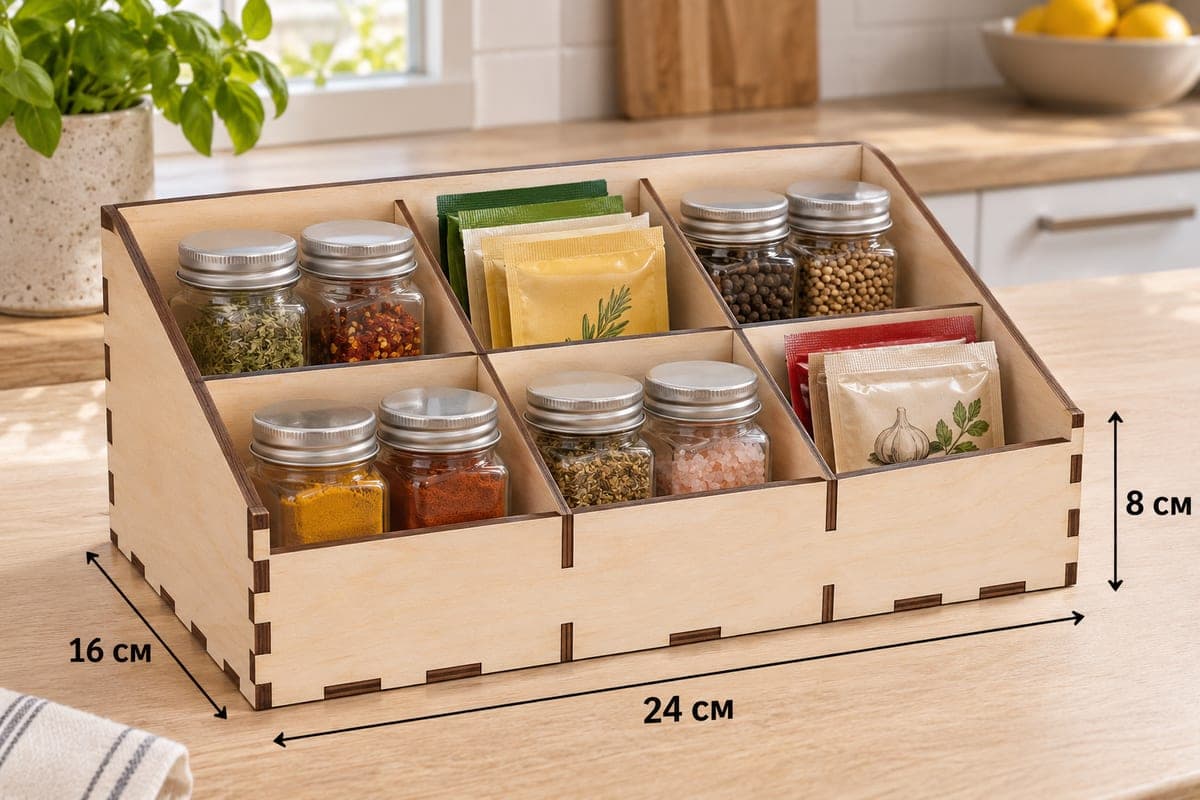
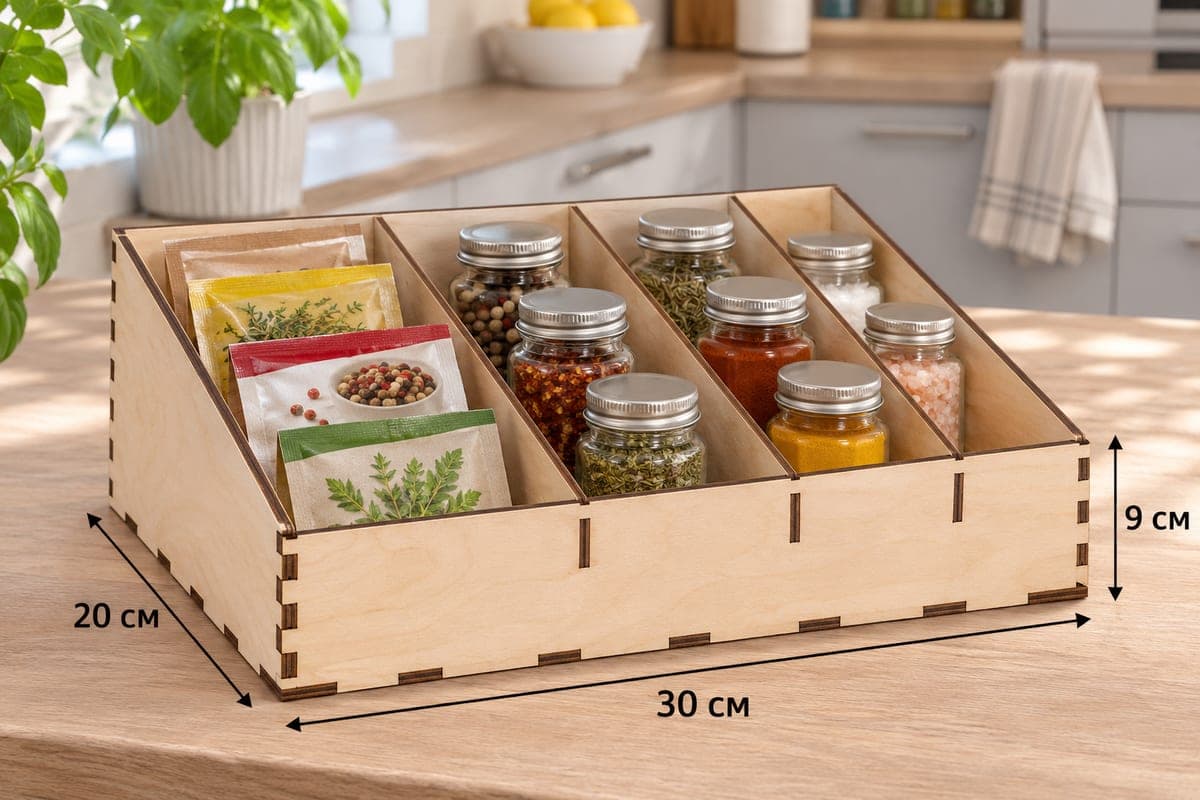
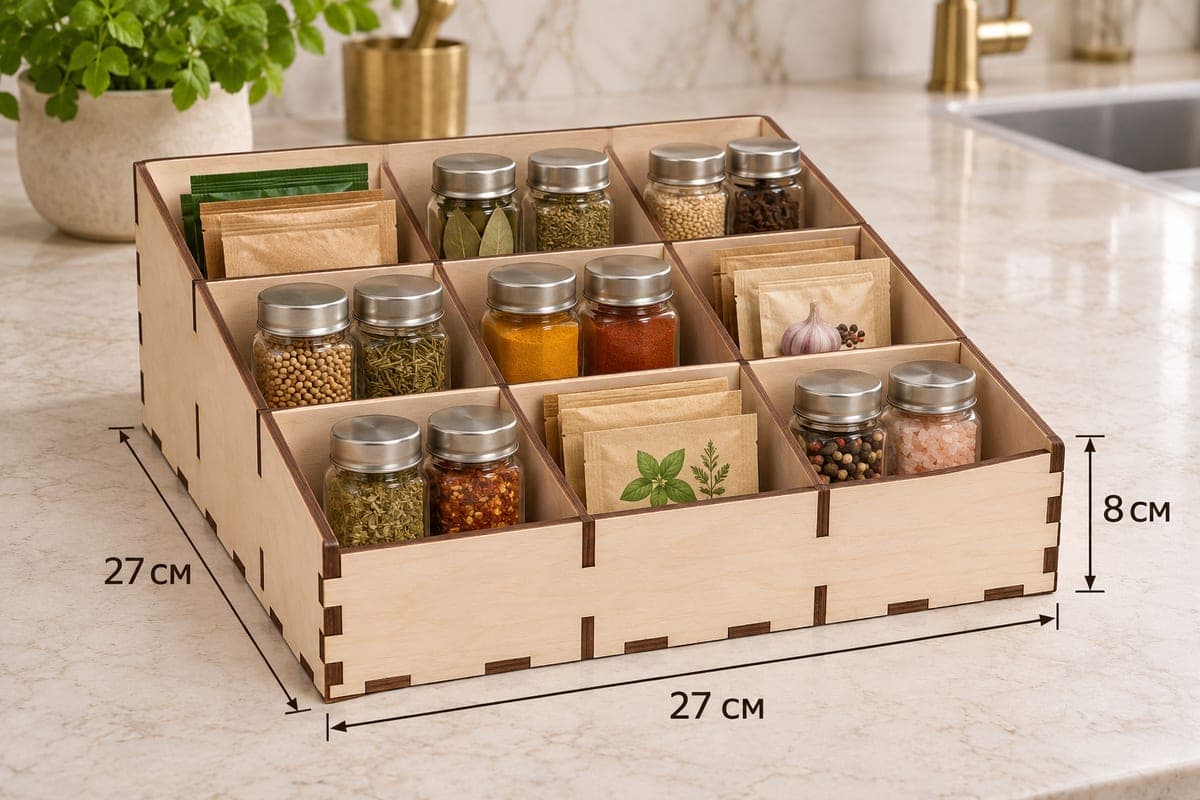
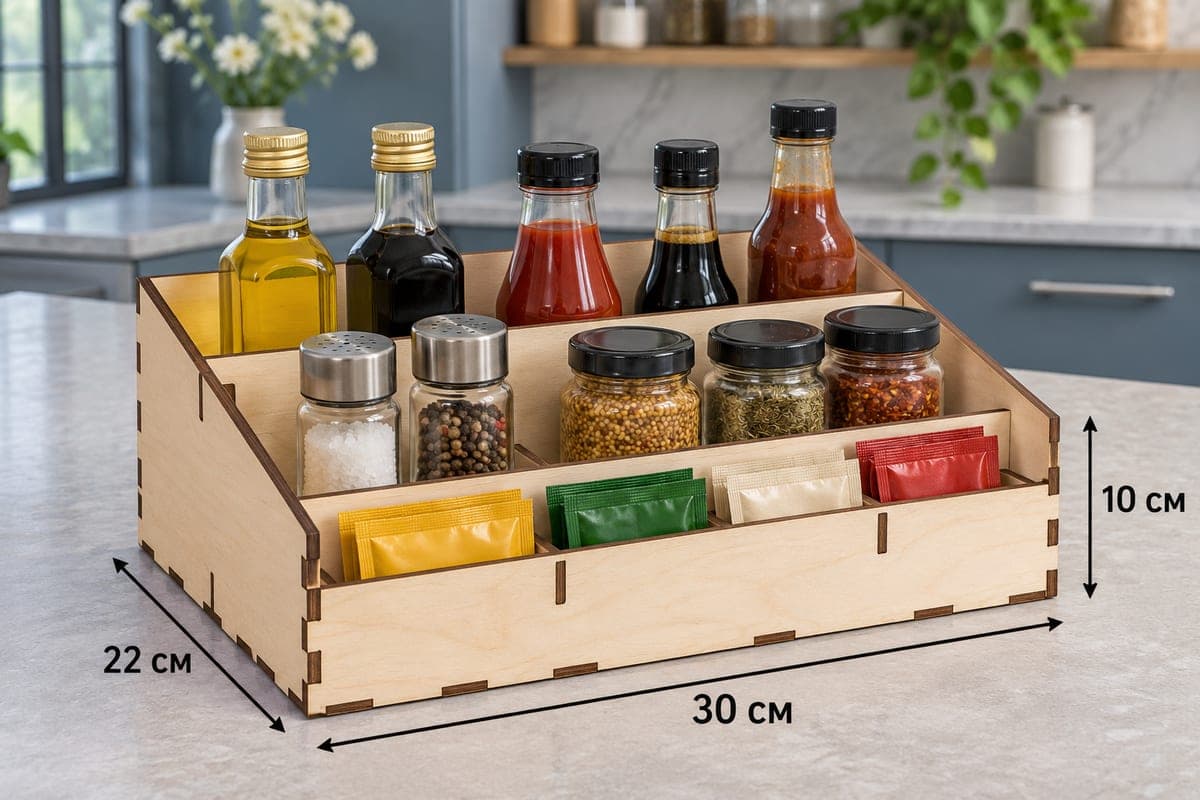
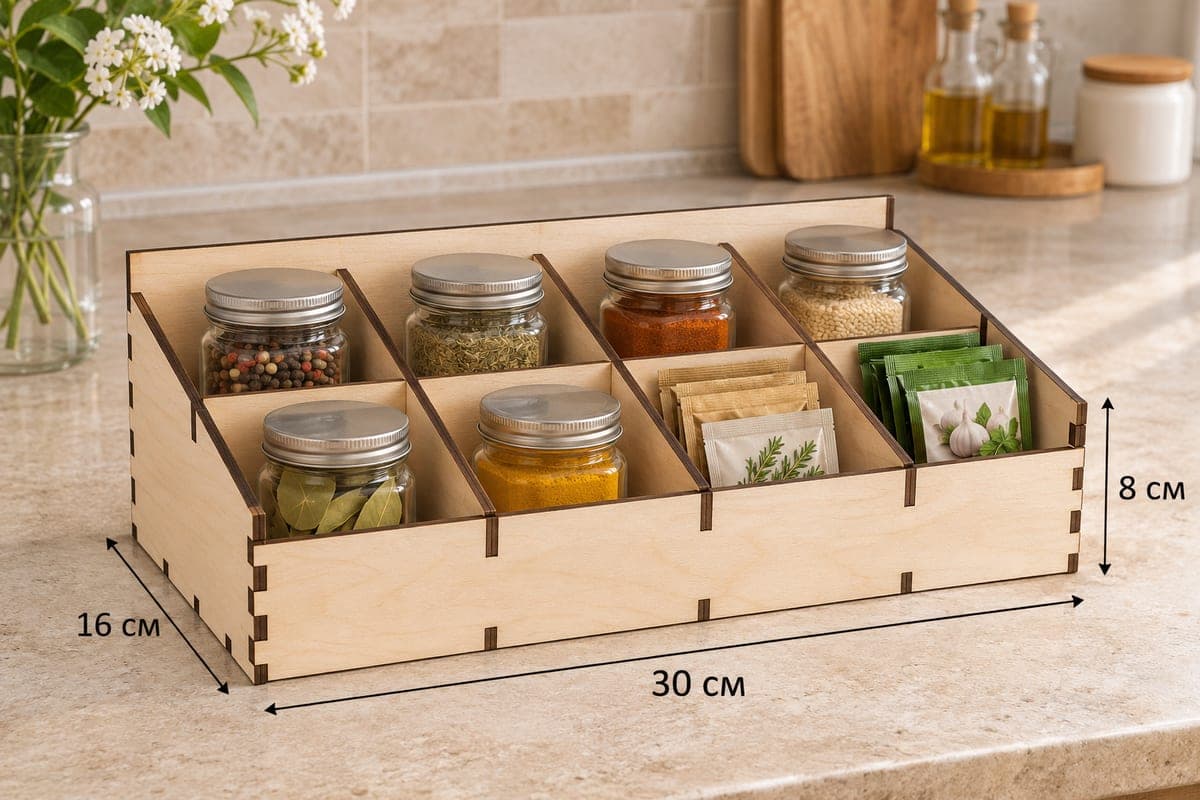
 Visualization
Eight Cell Spice Organizer Laser File, Two Row Spice Jar Holder SVG, Wooden Spice Caddy DXF, Kitchen Counter Rack
This is a two-row spice jar organizer with eight cells, four in front and four behind, for a kitchen counter or a wide shelf. It comes as SVG and DXF files, one set for each of 3, 4, 5 and 6 mm plywood, and the assembled box measures 300 × 160 × 80 mm (11.81 × 6.30 × 3.15 in). Its 12 plywood pieces join with tabs and slots, the sides slope from the 80 mm back to a 48 mm front, and the whole set is free to download.
- Formats
- SVG, DXF
- Outer size (W × D × H)
- 300 × 160 × 80 mm (11.81 × 6.30 × 3.15 in)
- Parts
- 12
- Material thickness
- 3, 4, 5 or 6 mm plywood (a file for each)
- Layout size (3 mm file)
- 1,116 × 252 mm
- Cut length
- 6.94 m
- Est. time, 10 W diode (3 mm)
- 23 min 07 s
- Est. time, 40 W CO2 (3 mm)
- 9 min 38 s
- Layers
- CUT only, no engraving
Free account required to download
How to make it
- 01Choose the 3, 4, 5 or 6 mm file to match your sheet, then cut a single slot on an offcut and push a scrap strip into it to confirm the fit.
- 02Cut the 12 pieces, rearranging them onto two sheets because the 3 mm nest is 1116 mm long.
- 03Assemble the base, back and both sloped sides, close it with the 48 mm front, then add the cross divider and push three dividers into each row.
- 04Sand the top edges of the dividers smooth, oil the box, and set one jar in each of the eight cells with the tallest jars in the back row.
Eight cells, one jar each
A long cross divider runs the full 300 mm width and splits the floor into a front row and a back row. Three short dividers in each row make four cells per row, eight in total. The rear dividers are the full 80 mm tall while the front ones stop at 63.7 mm, which gives the tray a stepped look and keeps the back labels readable.
The cells are sized for one standard round spice jar each. In the photo the back row holds peppercorn mix, dried herbs, paprika and mustard seed; the front row has bay leaves and curry powder in jars plus two cells of flat seasoning packets standing on edge. If you buy spices in sachets, half the tray can be packets and half jars without changing anything.
Before you cut
Laid flat for 3 mm plywood, the parts span 1116 × 252 mm. That is longer than the bed on most diode machines and many 40 W CO2 lasers, so plan to move the parts onto two sheets: base, back and front on one, both sides and all seven dividers on the other. For the 3 mm file a 10 W diode needs about 23 min 07 s, while a 40 W CO2 takes about 9 min 38 s and a 100 W CO2 about 4 min 37 s. Thicker plywood in 5 or 6 mm is better left to a CO2; on a diode it takes several passes and the edges darken more.
The joints are tight enough to stand dry. Add a little wood glue only once you are sure the cross divider is seated straight.
Gift and shop ideas
- Fill all eight cells with matching jars and sell it as a starter spice set.
- Pair it with handwritten jar labels for a wedding or housewarming present.
- List it as a refill station for people who buy spices in bulk bags.
A wipe of food-safe oil keeps turmeric stains from soaking in.
Questions about this file
What jar size suits the cells?
Four cells share the 300 mm width, so each is roughly 70 mm across inside, a bit less with thick plywood. That suits common round spice jars; very large shaker bottles will not fit.
Can I mix jars and seasoning packets?
Yes. Flat sachets stand on edge in any cell, and the photo shows two front cells used that way.
Will grease from the stove ruin the wood?
Seal all faces with clear lacquer or a hard-wax oil so grease and spice dust wipe off with a damp cloth.
Is 4 mm plywood a good choice?
4 mm gives stiffer dividers than 3 mm and still cuts quickly on a 40 W CO2; just use the 4 mm file so the slots match.
Can I engrave labels on the front?
The file is cut lines only, but you can add your own engraving layer to the 300 mm front panel for spice names or a family name before cutting.
Similar files