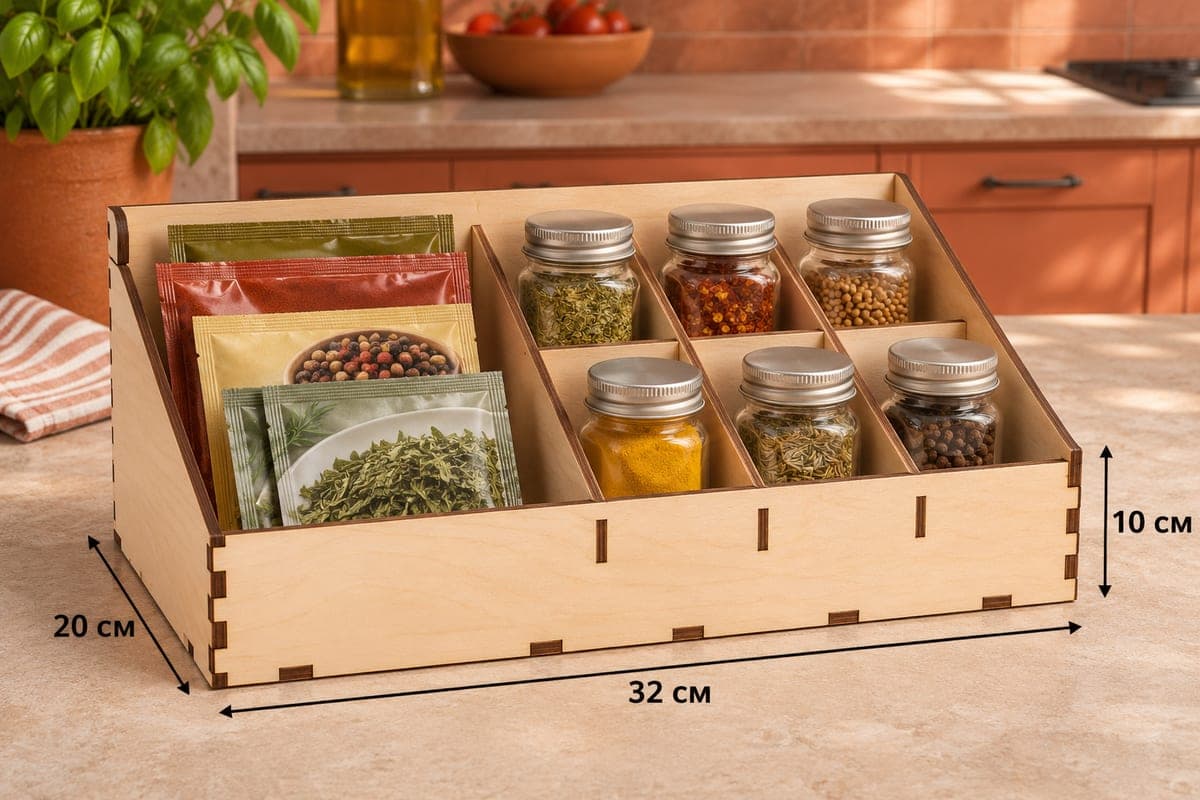
 Visualization
Seasoning Pouch Organizer SVG, Spice Jar Caddy Laser Cut File, Large Spice Packet Holder DXF, Wooden Kitchen Spice Box
A tall spice caddy that combines one wide bay for large seasoning pouches with six small cells for spice jars. It comes as SVG and DXF in four thickness versions (3, 4, 5 and 6 mm plywood), measures 320 × 200 × 100 mm (12.60 × 7.87 × 3.94 in), and is built from 11 pieces with tab-and-slot joints, giving seven compartments in total. The sides slope from a 100 mm back to a 60 mm front; all eight cut files are free to grab.
- Formats
- SVG, DXF
- Outer size (W × D × H)
- 320 × 200 × 100 mm (12.60 × 7.87 × 3.94 in)
- Parts
- 11
- Material thickness
- 3, 4, 5 or 6 mm plywood (a file for each)
- Layout size (3 mm file)
- 1,160 × 312 mm
- Cut length
- 7.45 m
- Est. time, 10 W diode (3 mm)
- 24 min 51 s
- Est. time, 40 W CO2 (3 mm)
- 10 min 21 s
- Layers
- CUT only, no engraving
Free account required to download
How to make it
- 01Choose the cut file for your plywood, then test one slot to check that the dividers press in snugly without splitting the veneer.
- 02Cut all 11 pieces, rearranging the 1160 mm layout over two sheets if your bed is smaller.
- 03Assemble the shell, fit the long 200 mm divider first, then the cross divider, the two 79.7 mm front dividers and the two 100 mm back dividers.
- 04Sand, apply a food-safe oil, stand the pouches in the wide bay and place one jar in each of the six cells.
Layout
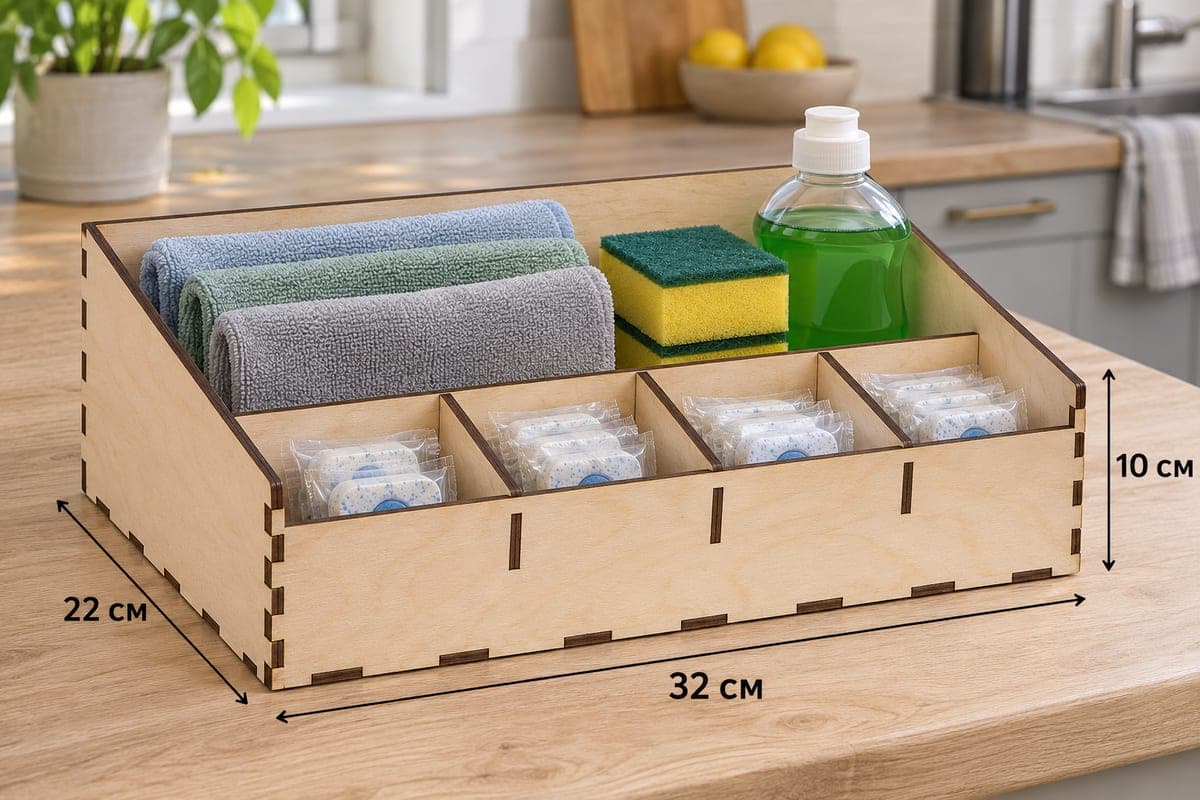
A single 200 mm divider splits the box into two unequal parts. The left third is one open bay for big seasoning pouches, the kind that are too wide for an ordinary spice rack. The photo has four of them stacked upright: an olive herb pouch, a red pepper blend, a peppercorn mix and a dried parsley bag.
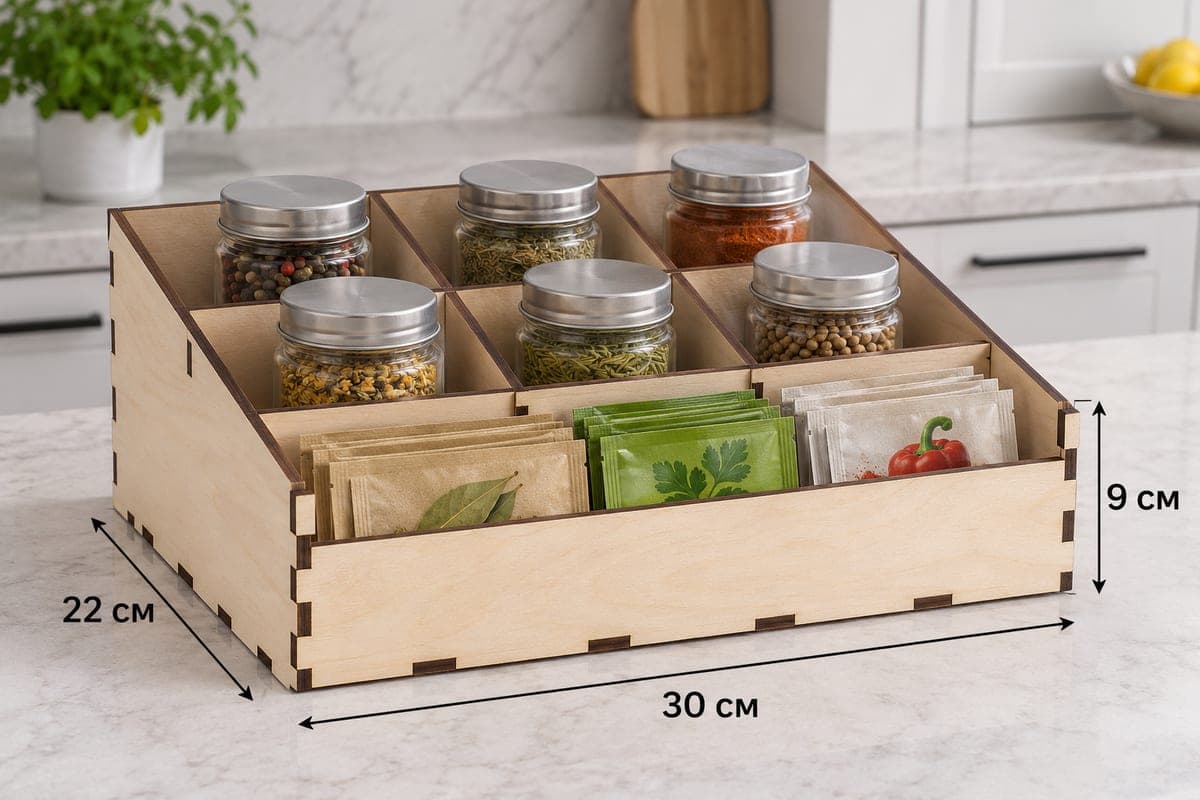
The right two thirds are a grid of six jar cells in two rows of three. A cross divider 208.2 mm long separates the rows; the back cells use 100 mm dividers and the front cells 79.7 mm ones, so the back jars sit visibly higher. In the photo they hold oregano, chili flakes, coriander seed, turmeric, dried herbs and black peppercorns, one jar per cell.
With a 100 mm back wall this is one of the two tallest spice boxes in the collection, along with the three-lane packet box.
Cutting notes
Nested for 3 mm stock, the pieces fill 1160.2 × 312 mm. Split it in two for a typical hobby laser: base and back together, then the sides, front, cross divider and five dividers. Cutting the 3 mm file takes a 100 W CO2 about 4 min 58 s, a 40 W CO2 about 10 min 21 s and a 10 W diode about 24 min 51 s. Stick with 3 or 4 mm on a diode; 5 and 6 mm call for a CO2 laser or extra passes.
Put the long 200 mm divider in first, because the cross divider and the jar-row dividers all lean on it. Glue is optional; a line along the base slots makes the grid stiffer.
Selling and gifting
This layout works for people who buy spices in bulk pouches and decant a few into jars. Bundle it with six empty jars and blank labels, or sell it to a spice shop as a counter display for sample pouches.
Questions about this file
How big can the pouches in the wide bay be?
The bay is the full 200 mm depth and about a third of the 320 mm width, so standard flat seasoning pouches stand upright; check your largest bag against those sizes first.
How many jars fit in the grid?
Six, one round spice jar per cell, three in the taller back row and three in front.
Can I turn the box so the bay is on the right?
Mirror the whole drawing horizontally in your laser software before cutting; the slots move with the parts, so everything still lines up.
Will 6 mm plywood fit the same jars?
The outer size stays the same, so thicker walls take a few millimetres from each cell; small jars still fit, larger ones may be snug.
Do the six jar cells hold grinders?
Slim pepper or salt grinders stand best in the back cells, where the 100 mm dividers give them the most support; wide grinders will not fit.
Similar files