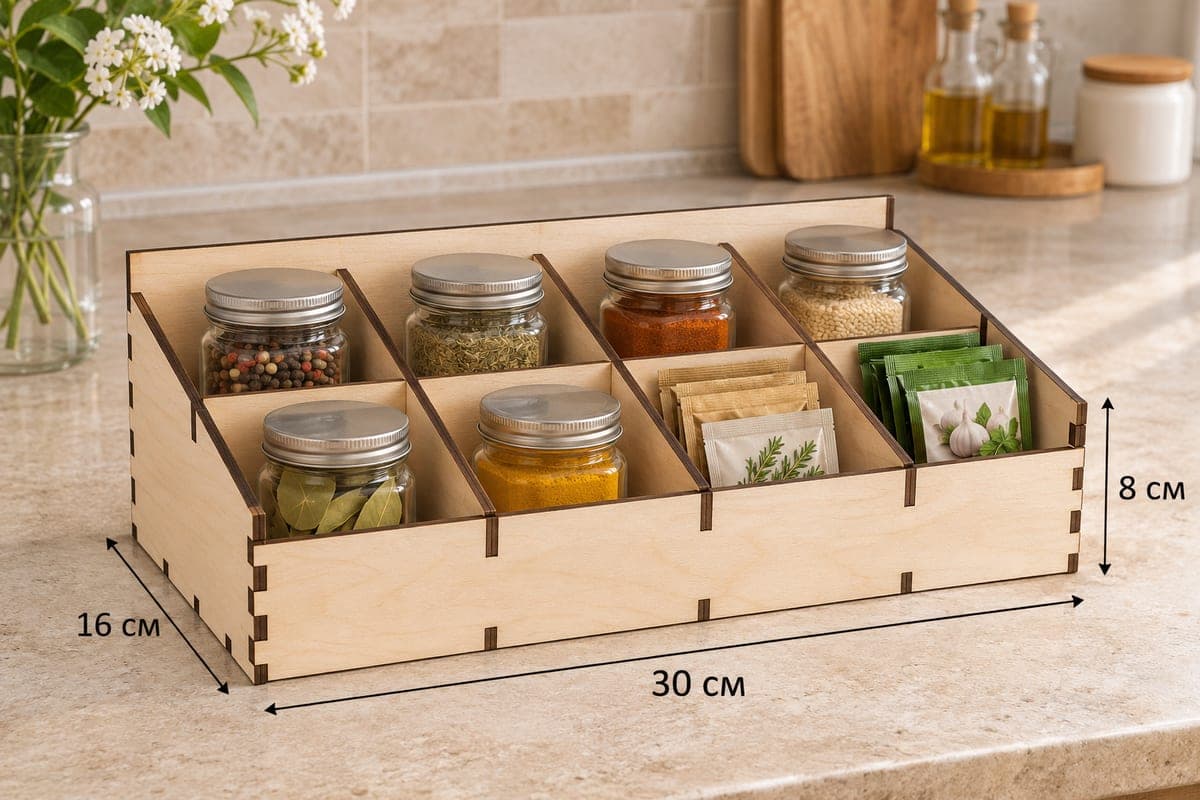
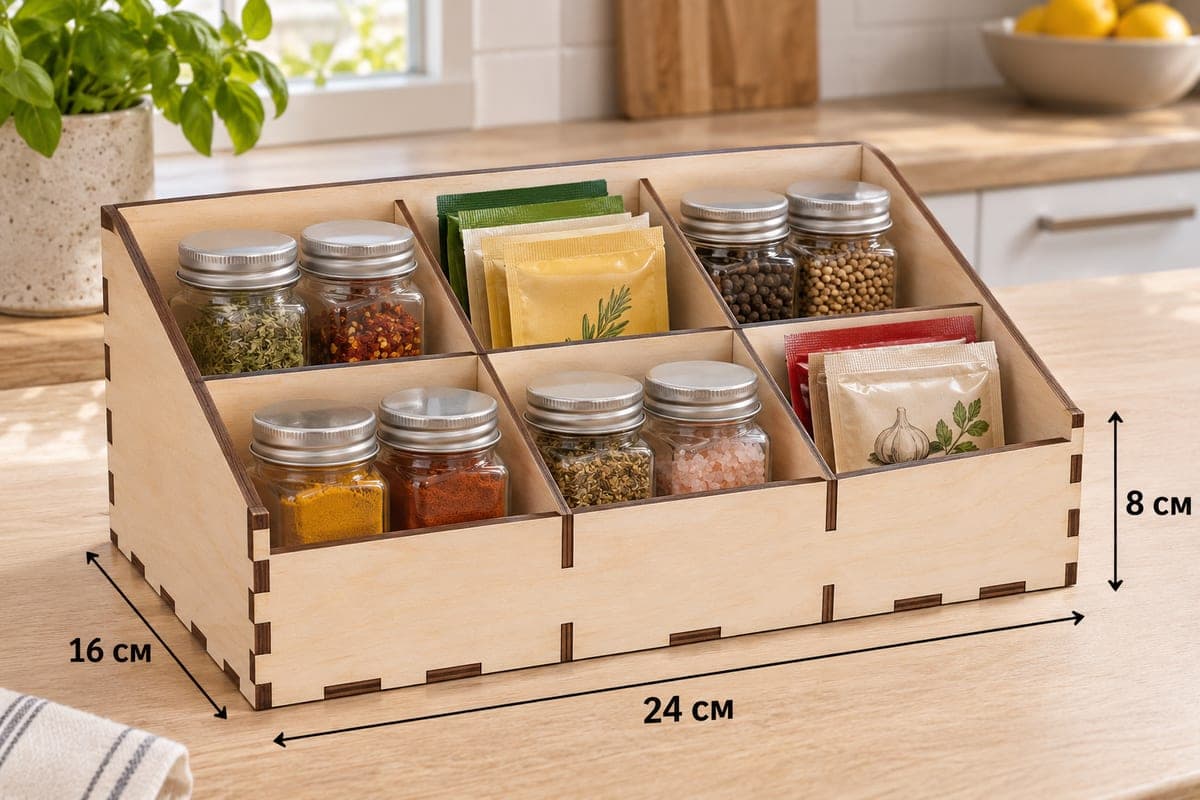
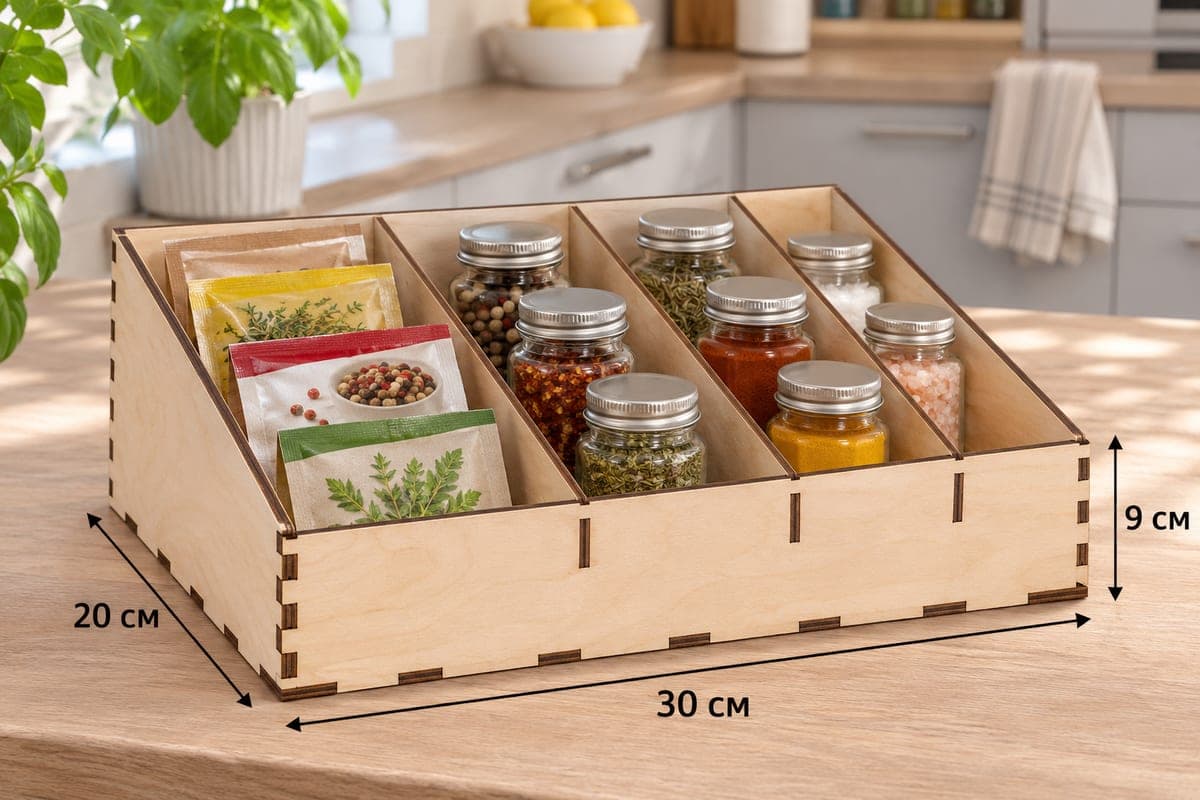
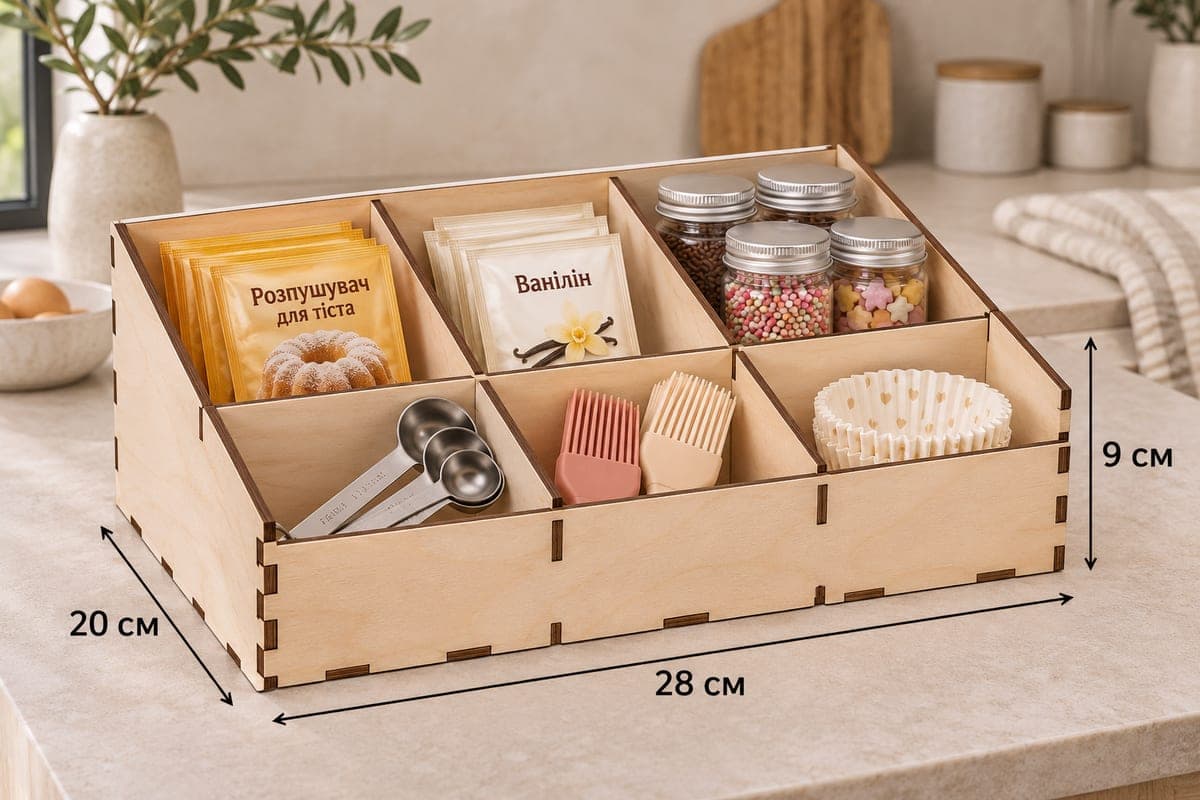
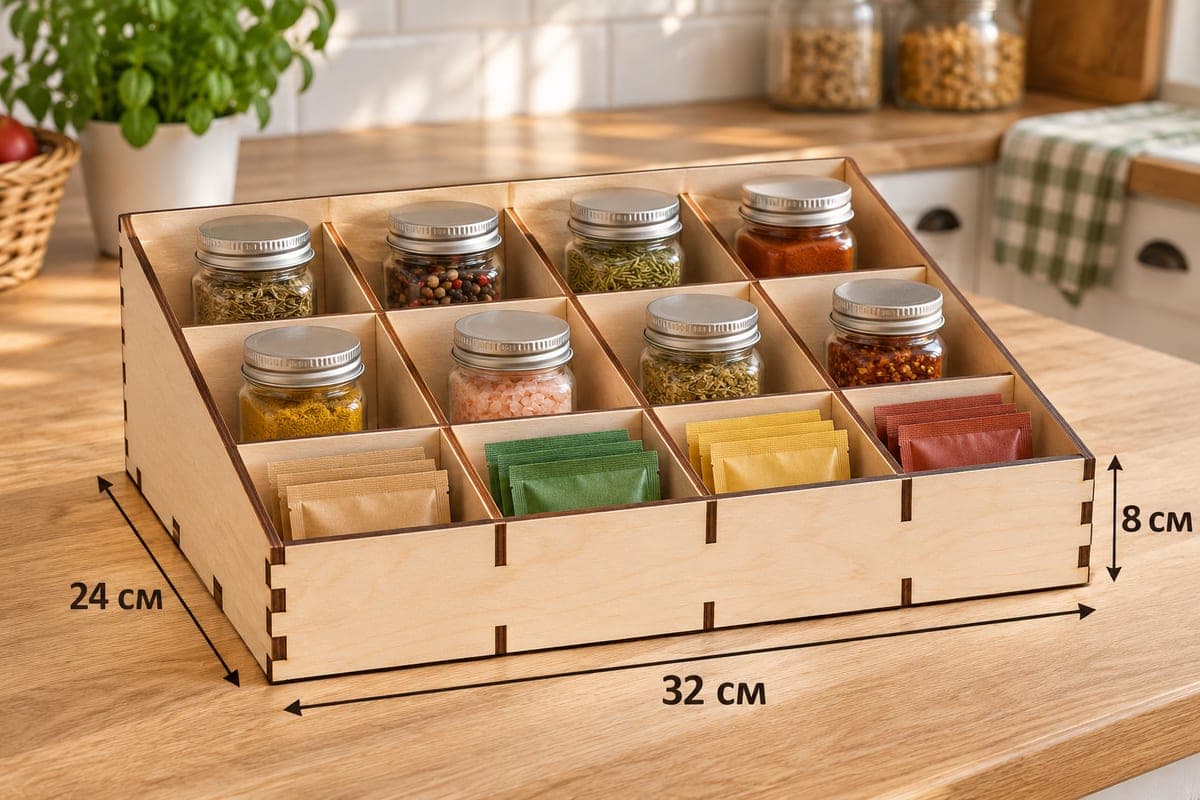
 Visualization
Tiered Spice Tray SVG, 12 Compartment Spice Organizer Laser Cut File, Stepped Spice Jar Rack DXF, Drawer Spice Insert
A deep, tiered spice tray with twelve compartments in three stepped rows of four, meant for a counter, a pantry shelf or a wide kitchen drawer. The download includes SVG and DXF files for 3, 4, 5 and 6 mm plywood; the tray measures 320 × 240 × 80 mm (12.60 × 9.45 × 3.15 in) and is built from 16 pieces held together by tabs and slots. The front wall is 48 mm high with sloped sides, and the files are a free download.
- Formats
- SVG, DXF
- Outer size (W × D × H)
- 320 × 240 × 80 mm (12.60 × 9.45 × 3.15 in)
- Parts
- 16
- Material thickness
- 3, 4, 5 or 6 mm plywood (a file for each)
- Layout size (3 mm file)
- 1,232 × 405 mm
- Cut length
- 9.81 m
- Est. time, 10 W diode (3 mm)
- 32 min 41 s
- Est. time, 40 W CO2 (3 mm)
- 13 min 37 s
- Layers
- CUT only, no engraving
Free account required to download
How to make it
- 01Select the file for the plywood you have, then run a test slot and check that a cross piece slides in without forcing.
- 02Cut all 16 parts over two or three sheets and sort the eight cross pieces into the 58.4 mm and 69.2 mm heights.
- 03Build the outer box first, set the three long dividers into the base, then press the taller cross pieces into the middle row and the shorter ones into the front row.
- 04Sand, finish with oil or lacquer, and load jars into the two back rows and seasoning packets along the front.
A grid of twelve
This is the biggest grid in the spice set. Three long dividers run the full 240 mm from front to back and make four lanes. Each lane is then closed off by two short cross pieces, one 58.4 mm tall near the front and one 69.2 mm tall in the middle, so every lane holds three cells and the cells climb toward the 80 mm back wall like theatre seats.
The photo shows eight jars in the two rear rows (dried herbs, peppercorn mix, pink salt, chili, mustard seed, chopped garlic) and the four front cells full of flat seasoning packets sorted by colour. Packets work well in the lowest row because you can flick through them; jars go higher where the lids catch your eye.
Cutting a 16-piece kit
The 3 mm sheet layout is 1232.4 × 405.2 mm, so most people will need two or three sheets on a desktop machine. Keep the eight small cross pieces together on one sheet so you do not mix the two heights. This twelve-cell file needs about 32 min 41 s of laser time on a 10 W diode for the 3 mm file, about 13 min 37 s on a 40 W CO2 and about 6 min 32 s on a 100 W CO2. With a diode, stay on 3 mm; 5 and 6 mm sheets need repeated passes or a CO2 tube.
Mark the cross pieces lightly in pencil, short ones front, taller ones middle, before you start pressing them in. A drop of glue at each lane divider is enough to make the grid rigid.
Make it a set
The tray pairs with the narrow five-slot spice box for a second shelf. For selling, a pre-filled version with twelve labelled jars is an easy gift listing, and drawer owners often ask for a custom depth.
Questions about this file
Will this fit inside a kitchen drawer?
Only a drawer with at least 320 × 240 mm of floor and enough height for your tallest jar will take it; the back wall alone is 80 mm.
Why are there two heights of cross dividers?
The shorter pieces form the front row and the taller ones the middle row, which steps the three rows up toward the back.
Can I use MDF?
MDF cuts well but is often thicker than its nominal size, so measure it and cut a test slot; seal it because spills soften raw MDF.
Which thickness is easiest to assemble?
3 mm is lightest and quickest to cut, while 4 or 5 mm makes the long dividers less flexible on a tray this deep.
Can I leave out some cross dividers for bigger jars?
Yes, skip a cross piece in any lane to join two cells into one longer slot for a tall grinder or a bag of bay leaves.
Similar files