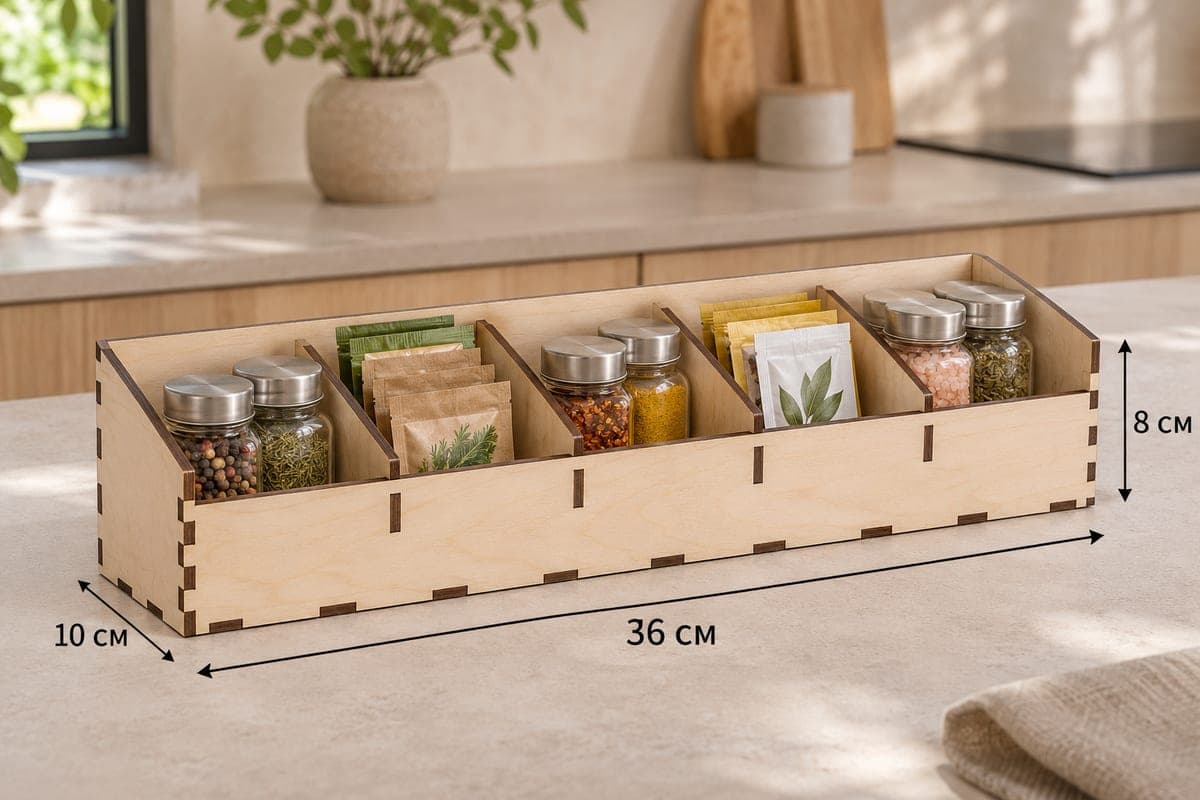
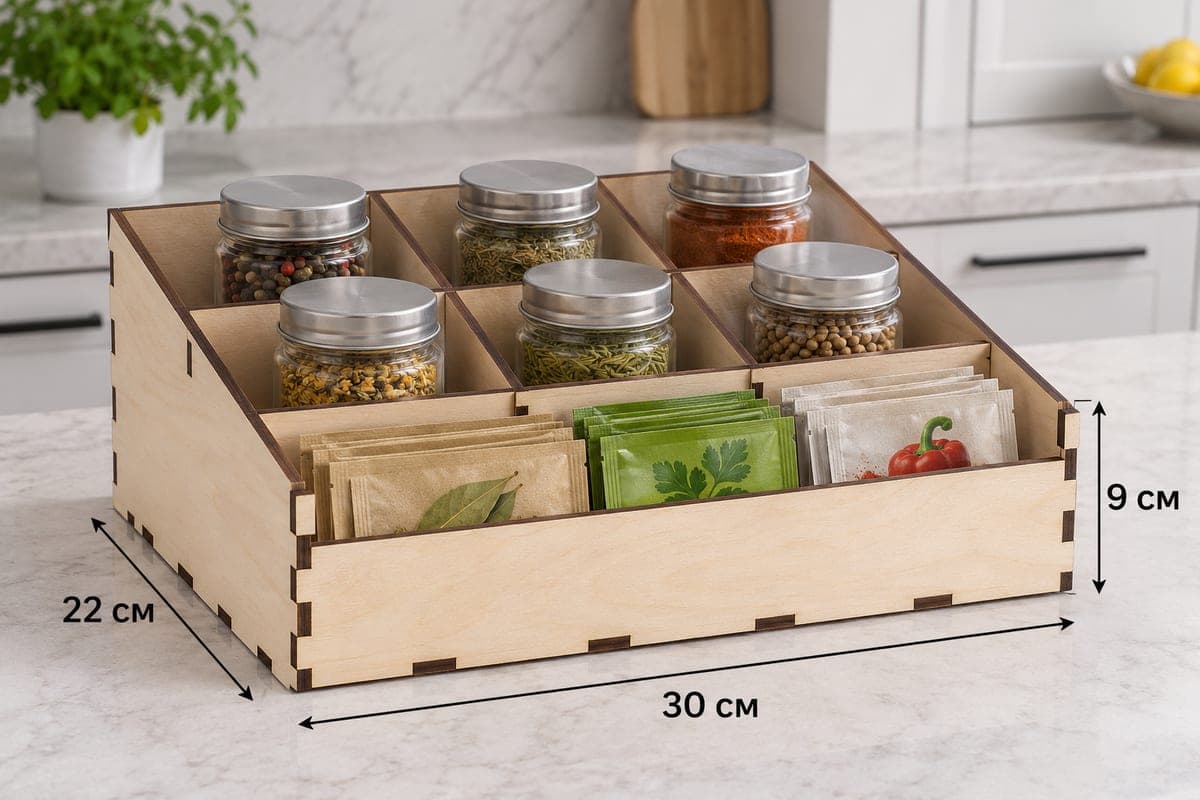
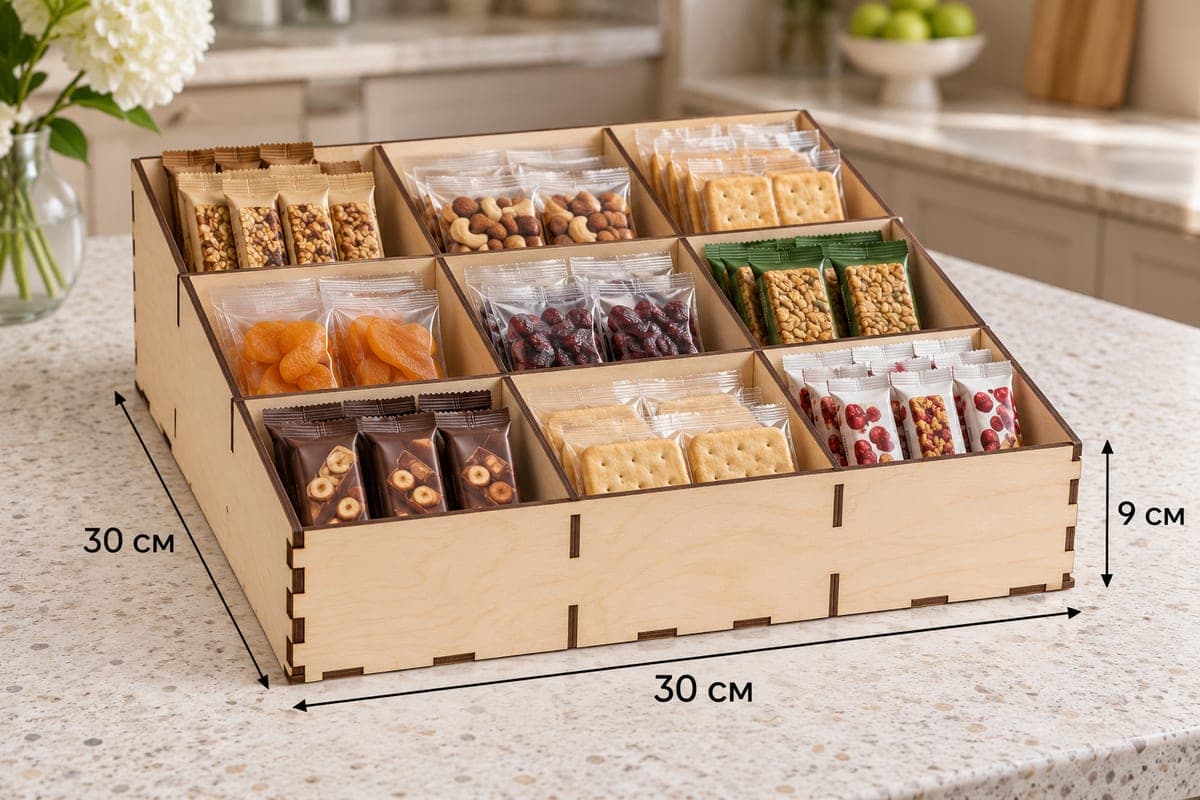
 Visualization
Spice Jar and Seasoning Packet Organizer SVG, Split Spice Box Laser Cut File, Wooden Sachet Holder DXF
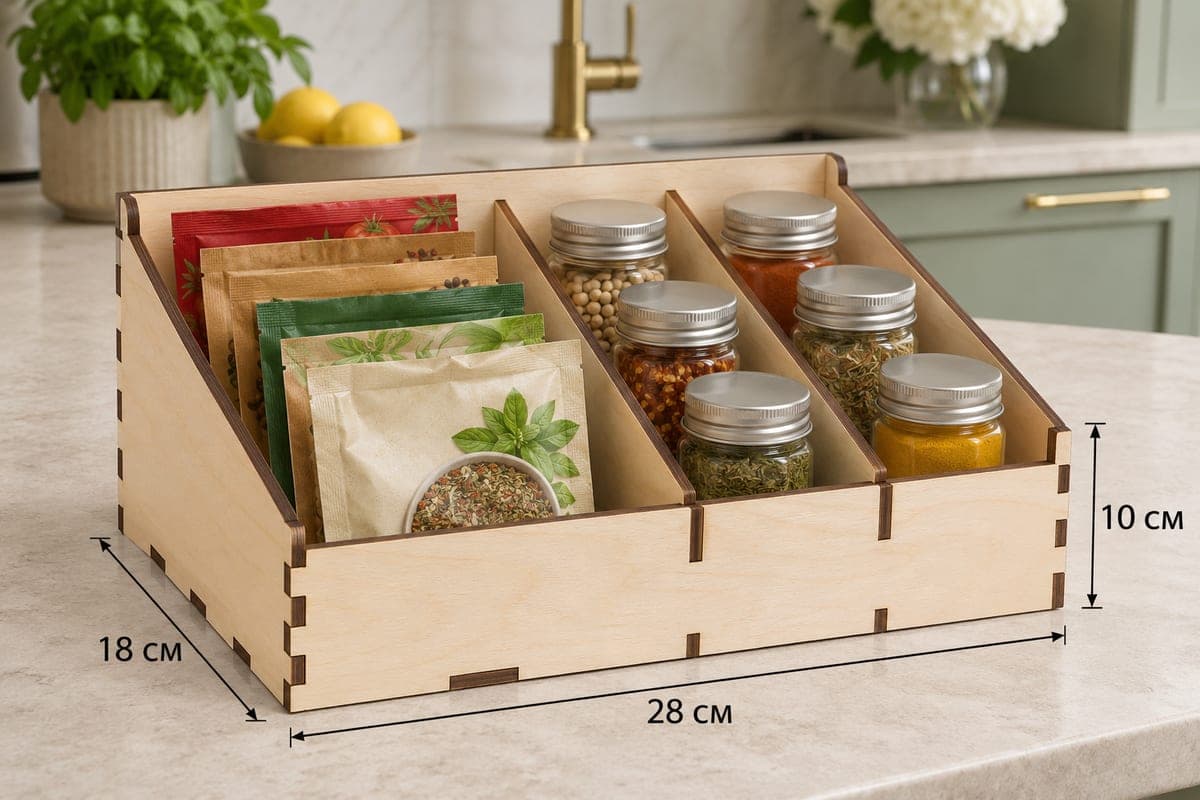
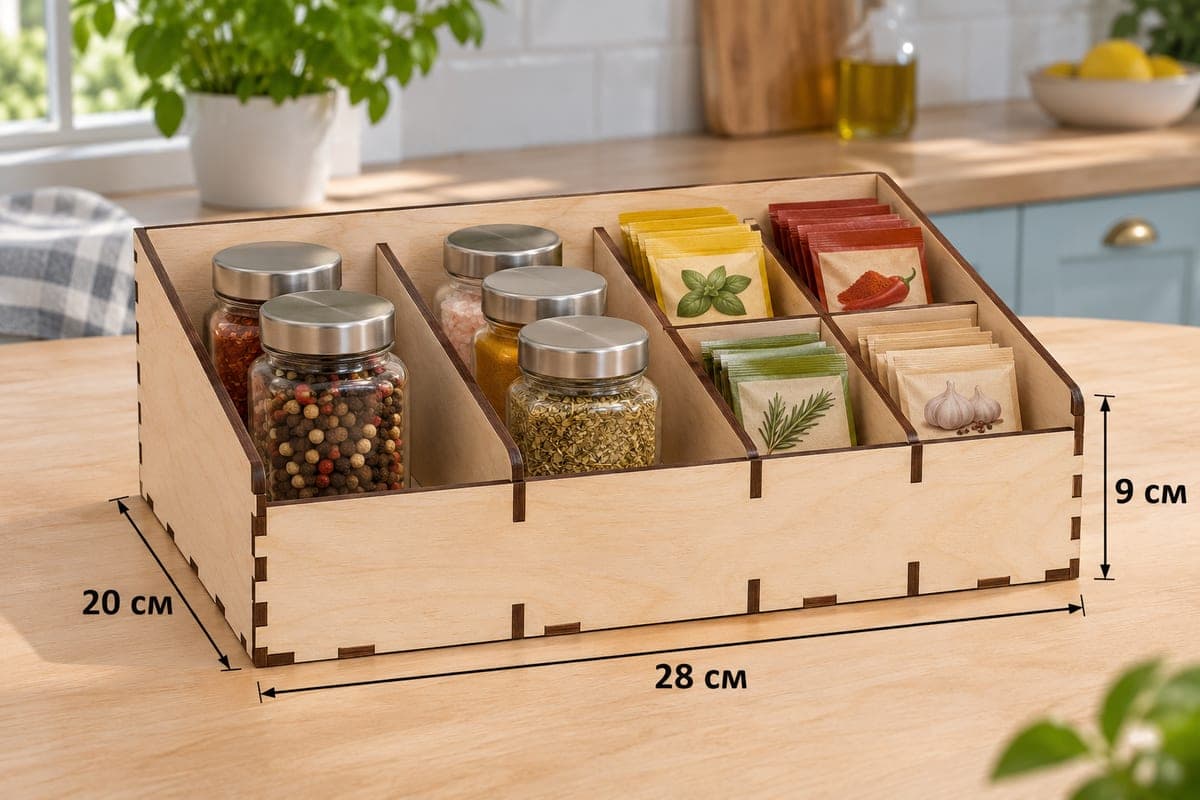
A mixed spice organizer with two long lanes for jars and a separate block of four small pockets for seasoning packets. You get SVG and DXF files in versions for 3, 4, 5 and 6 mm plywood; the finished box is 280 × 200 × 90 mm (11.02 × 7.87 × 3.54 in), has 10 pieces and six compartments, and goes together with tabs and slots. Its sides slope from a 90 mm back to a 54 mm front, and every version downloads free of charge.
- Formats
- SVG, DXF
- Outer size (W × D × H)
- 280 × 200 × 90 mm (11.02 × 7.87 × 3.54 in)
- Parts
- 10
- Material thickness
- 3, 4, 5 or 6 mm plywood (a file for each)
- Layout size (3 mm file)
- 1,035 × 302 mm
- Cut length
- 6.61 m
- Est. time, 10 W diode (3 mm)
- 22 min 03 s
- Est. time, 40 W CO2 (3 mm)
- 9 min 11 s
- Layers
- CUT only, no engraving
Free account required to download
How to make it
- 01Use the file drawn for your plywood thickness and cut a test slot to make sure the small pocket dividers will not wobble.
- 02Cut the 10 parts and sort them: two lane dividers, one cross piece, one short and one tall pocket divider, plus the five box panels.
- 03Assemble the shell, set the two lane dividers, then slide the cross piece into the right lane and add the 92 mm divider in front of it and the 111 mm one behind.
- 04Sand the edges, apply oil or lacquer, put jars in the two left lanes and sort sachets into the four pockets.
Half jars, half packets
This layout splits the box into two different zones. On the left, two long dividers that run the full 200 mm depth create two open lanes for jars: one holds a chili jar behind a larger jar of peppercorn mix, the other three jars of pink salt, turmeric and dried herbs in a row. On the right, a short cross divider (124 mm wide, 70 mm tall) halves the third lane, and one small divider on each side of it turns that lane into four pockets.
Those four pockets are sized for flat packets. The photo shows yellow herb sachets and red pepper sachets in the back pair, green rosemary and garlic sachets in the front pair. Keeping packets in their own small pockets stops them sliding under the jars, which is the usual mess in a single open tray.
Laser settings and layout
The 3 mm layout is 1035 × 302 mm, so a 400 × 400 mm bed needs about three jobs; the base alone is 280 × 200 mm. With the 3 mm file, a 40 W CO2 cuts everything in about 9 min 11 s, a 100 W CO2 in about 4 min 25 s, and a 10 W diode in about 22 min 03 s. For 5 or 6 mm plywood a CO2 is the practical choice; a diode needs slow repeated passes and leaves darker edges.
The parts look similar, so lay them out after cutting: two 200 mm lane dividers, the 124 mm cross piece, a 92 mm front pocket divider and a taller 111 mm back pocket divider.
Finishing
Sand off scorch marks with 180 grit, then oil the box. A wipe of mineral oil or a clear lacquer keeps spice dust from staining the pale birch. Sell it as a spice-blend gift box with your own packets in the pockets, or offer it to market stall owners who sell loose spices.
Questions about this file
Which side has the packet pockets?
The pockets are in the right-hand lane as shown in the photo; flip the box around if you prefer them on the left.
What size jars fit in the lanes?
The lanes take a single line of round spice jars; in the photo one lane holds two jars and the other three.
Can I make all three lanes plain jar lanes?
Just leave out the cross piece and the two pocket dividers when you assemble; the box stands without them.
How do I protect it from kitchen grease?
Seal it with a hard-wax oil or water-based lacquer and wipe it with a damp cloth when it gets sticky.
Can I cut it in MDF for painting?
Yes, MDF takes paint well; measure it, use the matching file and run a test slot first.
Similar files