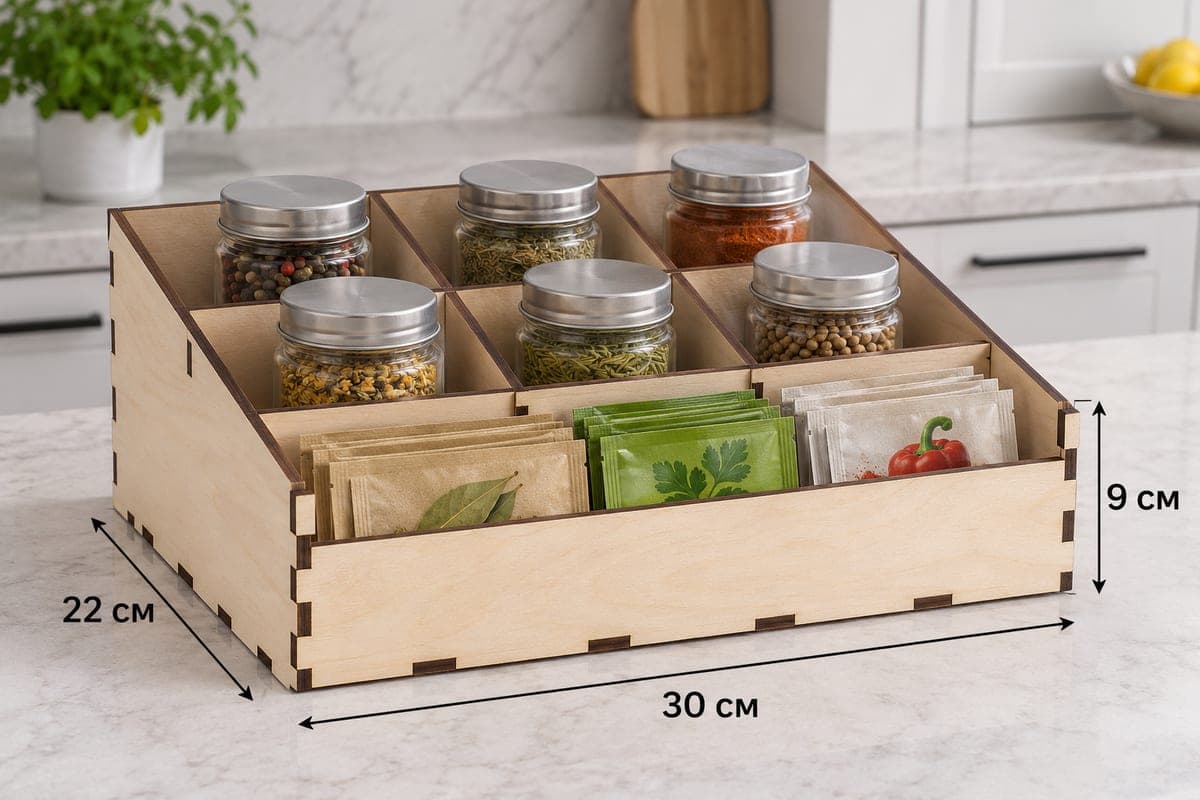
 Visualization
Deep Spice Organizer SVG, Spice Jar and Sachet Holder Laser Cut File, Two Row Seasoning Tray DXF, Wooden Spice Station
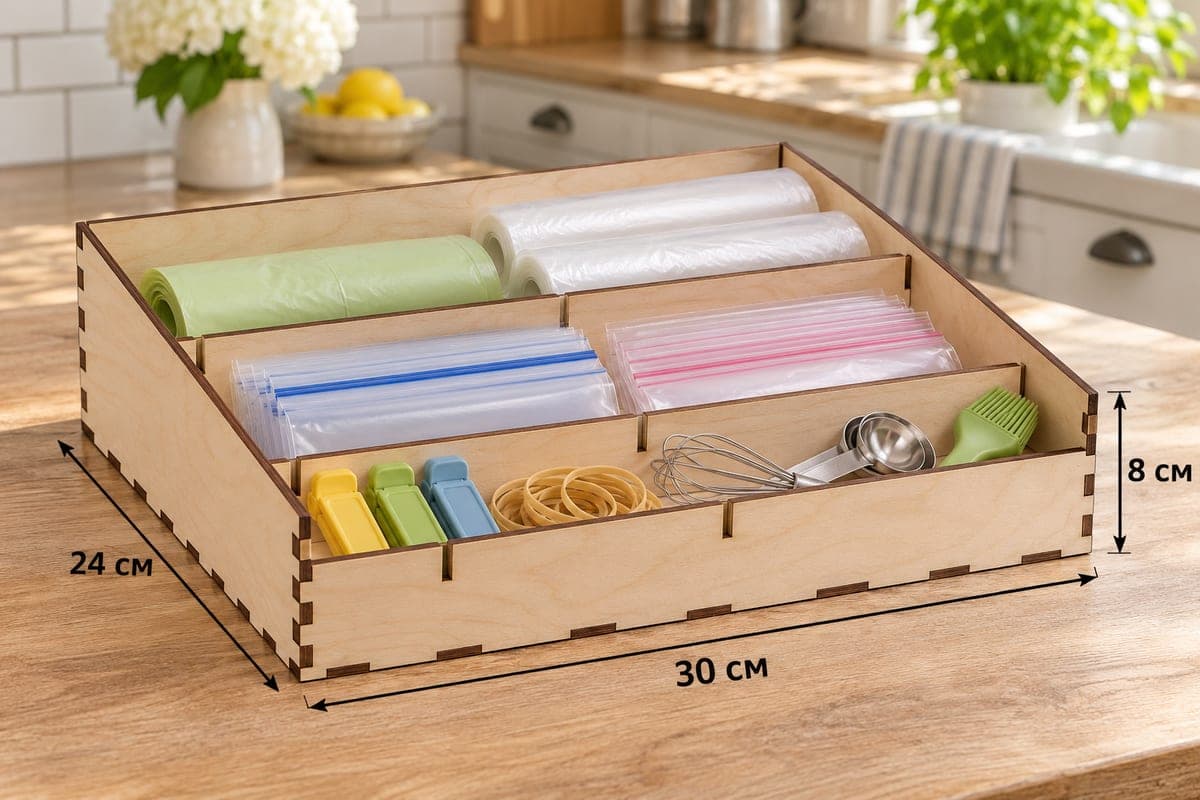
A deep two-row spice organizer that keeps jars in three long back compartments and seasoning sachets in three shallow front ones. It is supplied as SVG and DXF with a separate version for 3, 4, 5 and 6 mm plywood, measures 300 × 220 × 90 mm (11.81 × 8.66 × 3.54 in), and is made of 10 pieces that fit together with tabs and slots. The sides slope from a 90 mm back to a 54 mm front, and you can download it for free.
- Formats
- SVG, DXF
- Outer size (W × D × H)
- 300 × 220 × 90 mm (11.81 × 8.66 × 3.54 in)
- Parts
- 10
- Material thickness
- 3, 4, 5 or 6 mm plywood (a file for each)
- Layout size (3 mm file)
- 1,074 × 322 mm
- Cut length
- 7.08 m
- Est. time, 10 W diode (3 mm)
- 23 min 36 s
- Est. time, 40 W CO2 (3 mm)
- 9 min 50 s
- Layers
- CUT only, no engraving
Free account required to download
How to make it
- 01Match the file to your measured plywood thickness and cut a short test slot to check that a divider pushes in firmly by hand.
- 02Cut the ten parts in two jobs if needed, and keep the two 68.2 mm front dividers separate from the two 90 mm back dividers.
- 03Assemble base, back, sides and the 54 mm front, set the cross divider in its slots, then add the short dividers at the front and the tall ones behind.
- 04Sand, oil or lacquer the box, then load two jars into each deep back cell and stand sachets in the front cells.
Two depths in one box
The rows in this organizer are deliberately unequal. A full-width cross divider sits well forward, so the back row is about 132 mm deep and the front row only about 90 mm. Two dividers in each row make three cells per row, six in all.
The deep back cells take two jars each, one behind the other, which is how the photo shows them: six jars of peppercorns, herb blends, paprika, rosemary and coriander seed in three pairs. The shallow front cells are ideal for flat seasoning sachets, here bay leaf, parsley and sweet pepper, standing on edge so you can read every packet at a glance. With 220 mm of depth this is one of the deeper boxes in the spice set, so it suits a counter corner or a deep pantry shelf.
Thickness and cutting
Pick the file that matches your plywood: the slots are drawn for 3, 4, 5 or 6 mm and will be loose or too tight with anything else. The 3 mm layout is 1074 × 322 mm and the thicker ones 1068 × 322 mm, so on a 400 mm bed you will cut the base and back in one job and the remaining eight parts in another. The 3 mm file keeps a 10 W diode busy for about 23 min 36 s, a 40 W CO2 for about 9 min 50 s and a 100 W CO2 for about 4 min 43 s. 5 and 6 mm cut cleanly on a CO2; a small diode will need multiple passes.
The front dividers are shorter (68.2 mm) than the back ones (90 mm); keep them apart after cutting so they go into the right row.
Finishing for the kitchen
Sand the edges, then use a hard-wax oil or a clear water-based lacquer. Both resist the greasy film that collects near a hob. As a gift, fill the back cells with six refillable jars and the front with sachets of your own spice blends.
Questions about this file
How many jars fit?
The three back cells each take two round jars one behind the other, so six jars, while the three front cells are meant for sachets.
Why is the front row shallower?
Flat sachets do not need much depth, so the cross divider is placed forward to give the jar row more room.
Does the deep organizer work in acrylic?
Clear or frosted 3 mm acrylic works with the 3 mm file on a CO2 laser; diode lasers cannot cut clear acrylic.
Does it need glue?
No, the tab-and-slot joints hold, but a little wood glue under the cross divider stops it rocking when you pull jars out.
Can I make a version with four cells per row?
You can add dividers yourself, but draw their slots at your plywood thickness and space them evenly along the cross divider.
Similar files