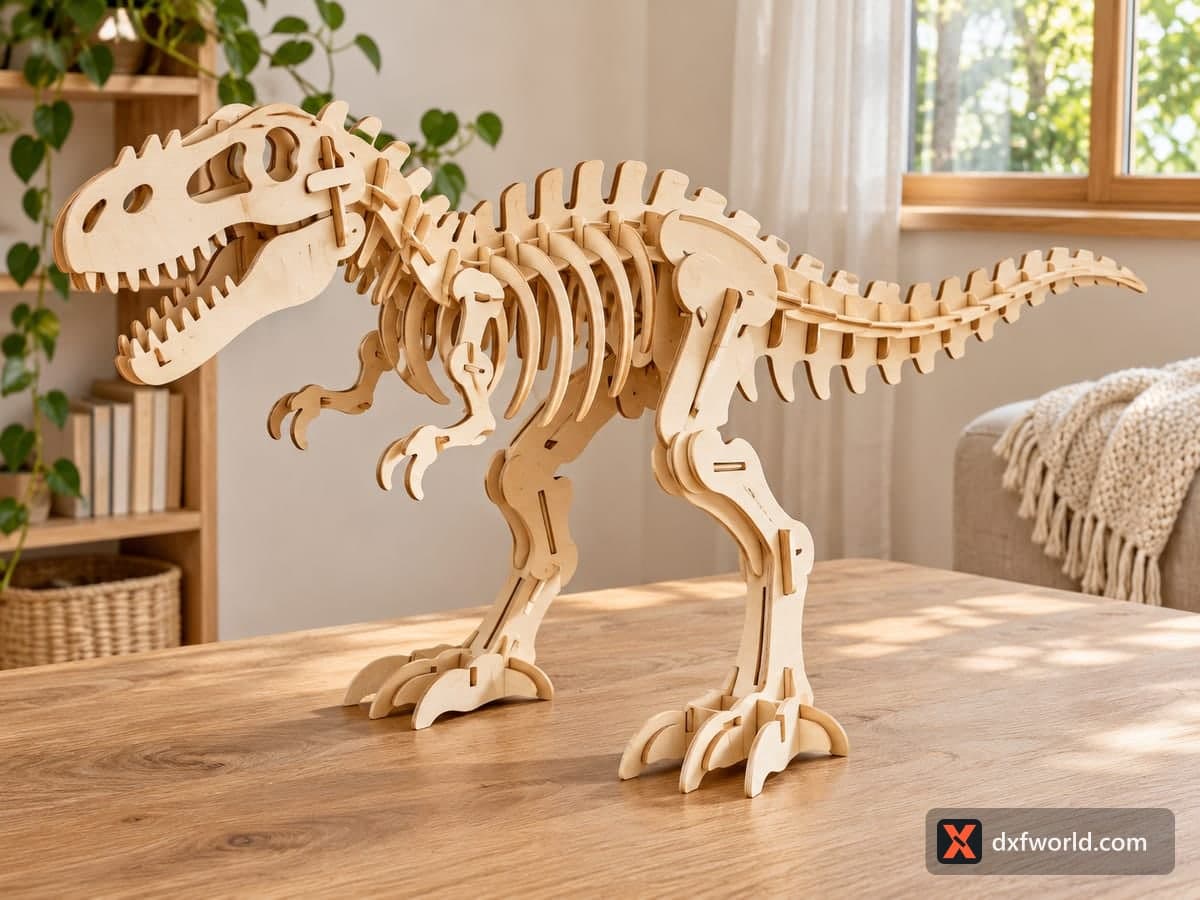
Wooden T-Rex Skeleton SVG, Dinosaur Model Laser Cut File, 3D Dinosaur Skeleton DXF, Slot Together Dino Display
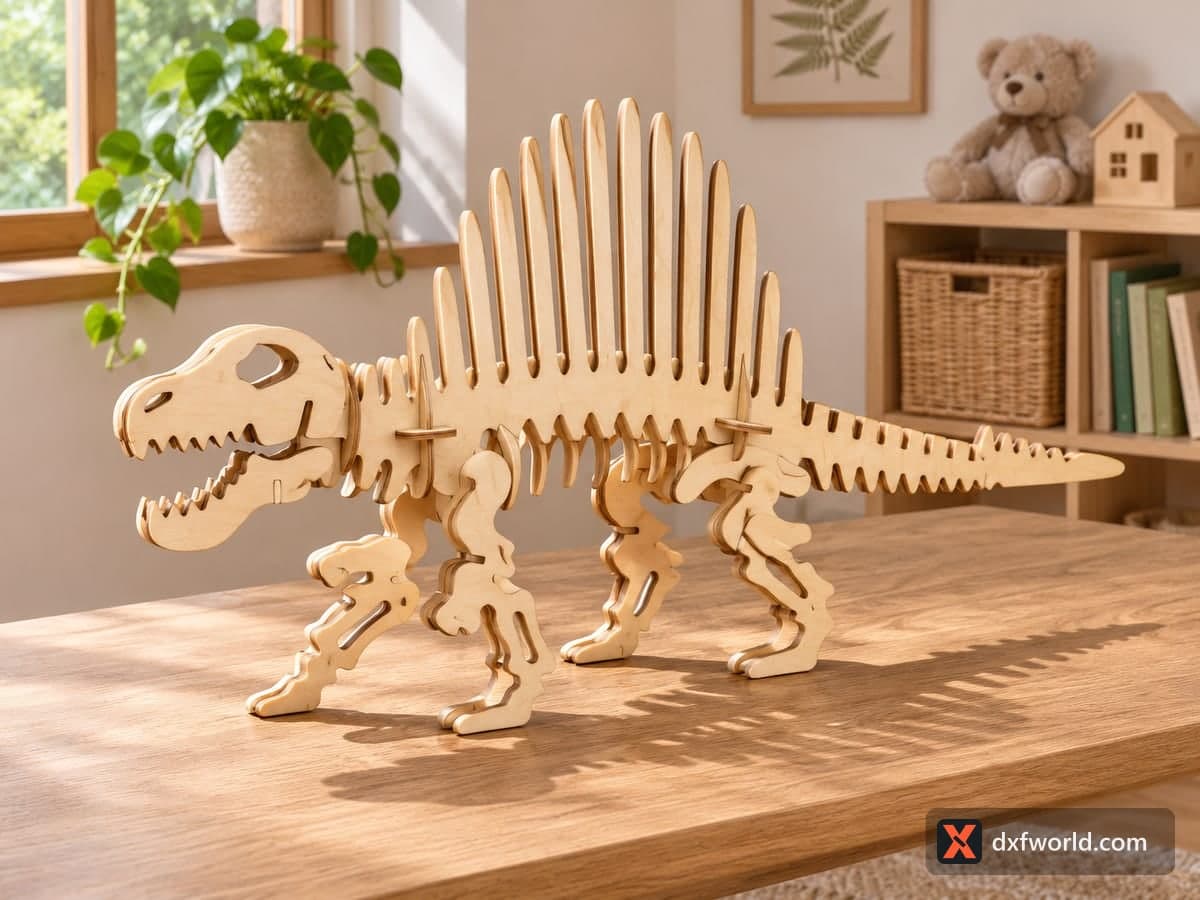
A slot-together T-Rex skeleton model with a toothed skull, open lower jaw, spine, curved ribs, small arms, strong legs with clawed feet and a long tail of vertebrae. The free download is one SVG and one DXF file with all flat parts laid out on 419.8 × 327.6 mm (16.53 × 12.90 in), cut lines only; the slots are drawn for one thickness.
- Formats
- SVG, DXF
- Size
- 420 × 328 mm (16.53 × 12.90 in)
- Material
- Plywood, MDF, acrylic or metal (scale to your piece)
- Cut length
- 12.29 m
- Est. time, 10 W diode (3 mm)
- 40 min 57 s
- Est. time, 40 W CO2 (3 mm)
- 17 min 04 s
- Layers
- CUT only, no engraving
Free account required to download
How to make it
- 01Check the slot width and pick plywood of matching thickness, or scale the file to your board.
- 02Cut one pair of joined parts to test the fit, then cut all sheets.
- 03Assemble the spine and tail, then fit the ribs and the skull.
- 04Attach the legs, check balance, then glue the joints and sand.
What the model looks like
The photo shows a standing tyrannosaur skeleton about as long as a table, with a big head, an open mouth with separate teeth along the jaw, a row of ribs and a tail of tall vertebrae curving up behind it. The file image holds about sixty flat parts: ribs and spine segments, jaw parts, foot toes and leg bones. Several parts carry long slots where the pieces cross.
Thickness and building
The file gives no thickness. Measure the slot width in your software and choose a sheet of the same thickness, or scale the file until the slots equal your board, then cut one pair of parts to test the fit. Plywood of about 3 mm gives a fine skeleton; thicker boards make a sturdier display piece. The layout is 419.8 mm wide, so some hobby lasers need it split over several sheets.
Assembly tips
Sort the parts by group before gluing: skull, spine and tail, ribs, legs. Build the spine first, add the ribs, then attach the legs, and balance the model on its feet before fixing them. Leave joints unglued until the whole model stands, because the skeleton can be adjusted. It makes a good project for a classroom, a museum shop or a collector's shelf.
Questions about this file
What thickness is needed?
The slot width sets it; measure it and test one joint before cutting everything.
Can I scale it up?
Yes, if you scale the file and the material thickness together, or accept looser slots and add glue.
How long is the finished model?
It depends on the scale; the photo shows it about table length.
Is it hard to assemble?
There are around sixty parts; sorting by group first makes it much easier.
Can I paint it?
Yes, a light stain or a bone-white paint suits a fossil look.
Similar files