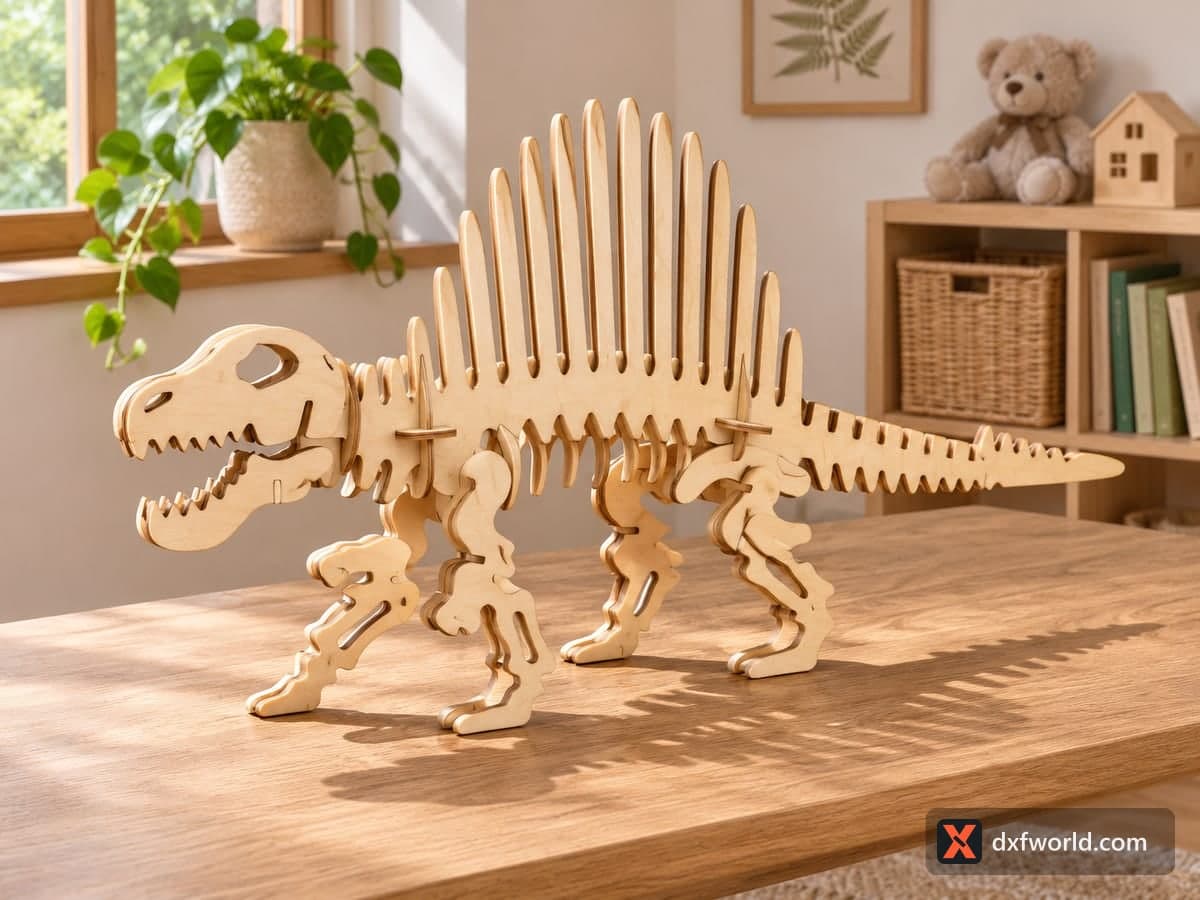
Dimetrodon 3D Puzzle SVG, Wooden Dinosaur Skeleton Laser Cut File, Sail Back Model DXF, Plywood Dino Kit
A slot-together wooden Dimetrodon model with a tall spiny sail, jointed skull and jaw, four legs, rib arches and a long tail. The free download is one SVG and one DXF file, cut lines only, laid out on 876 × 595.6 mm (34.49 × 23.45 in), with the slots drawn for one material thickness.
- Formats
- SVG, DXF
- Size
- 876 × 596 mm (34.49 × 23.45 in)
- Material
- Plywood, MDF, acrylic or metal (scale to your piece)
- Cut length
- 14.25 m
- Est. time, 10 W diode (3 mm)
- 47 min 29 s
- Est. time, 40 W CO2 (3 mm)
- 19 min 47 s
- Layers
- CUT only, no engraving
Free account required to download
How to make it
- 01Measure the slot width and match the plywood, or scale the file; test one joint.
- 02Cut all parts and sort the rib arches by size.
- 03Slide the rib arches onto the spine, then add the legs, the skull and the jaw.
- 04Sand the spikes lightly, glue the joints if you want and finish with oil.
The model
The central spine piece carries the whole sail of tall spikes, the neck and the tail in one flat cut. Rib arches in eight sizes slot across the back to give the body depth, and smaller spine pieces fit in between. The head is made of two skull halves and two jaw pieces; four leg pieces clip onto the body. The photo shows the finished model standing on a table, in birch plywood.
Thickness and fit
The file does not state a thickness. Measure the slot width in your software and match it with plywood, or scale the layout until the slots fit your sheet, and cut a test slot first. The sail spikes are slender, so do not use material under 3 mm; thicker plywood makes the sail sturdier. The layout is almost 0.9 m wide, so a smaller laser needs the parts split across several sheets.
Assembly and display
Start with the main spine and slide the rib arches on in order from the largest to the smallest, then fit the legs and the head. The joints hold dry, and a little glue makes it display-safe. Sand the spikes gently, as they are the first parts to break. Oil or stain the finished skeleton, and put it on a shelf in a kids room or a classroom as a science display. Painting the sail with warm colours gives a lively look.
Questions about this file
What thickness is it for?
Not given. Measure the slot width, match your plywood or scale the file, after a test cut.
How many parts are there?
Count them in the layout: the spine, legs, skull pieces and eight rib arches plus small bone parts.
Will it stand on its own?
Yes, on its four legs, with small adjustments after test fitting.
Can I make a smaller model?
Yes, but scaling changes slot widths, so match the thickness first.
Is it suitable for kids?
It is a display model with delicate spikes; sand well and supervise young children.
Similar files