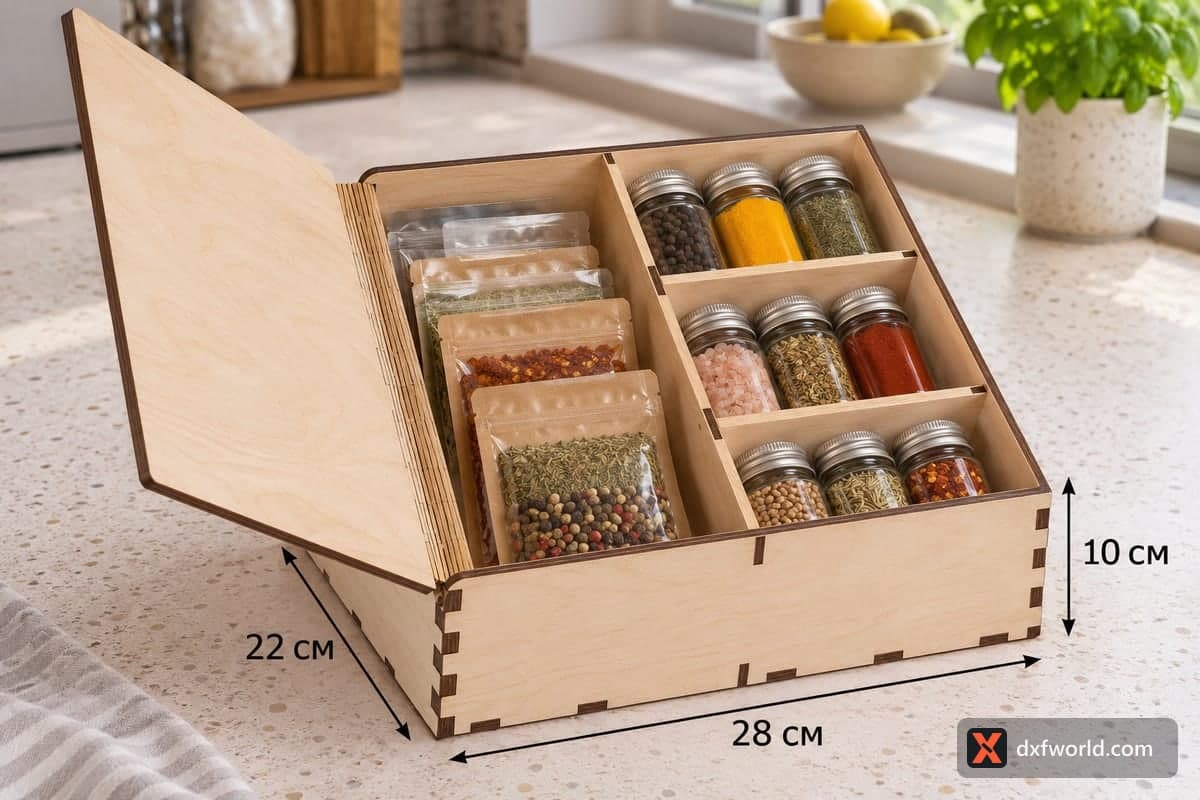
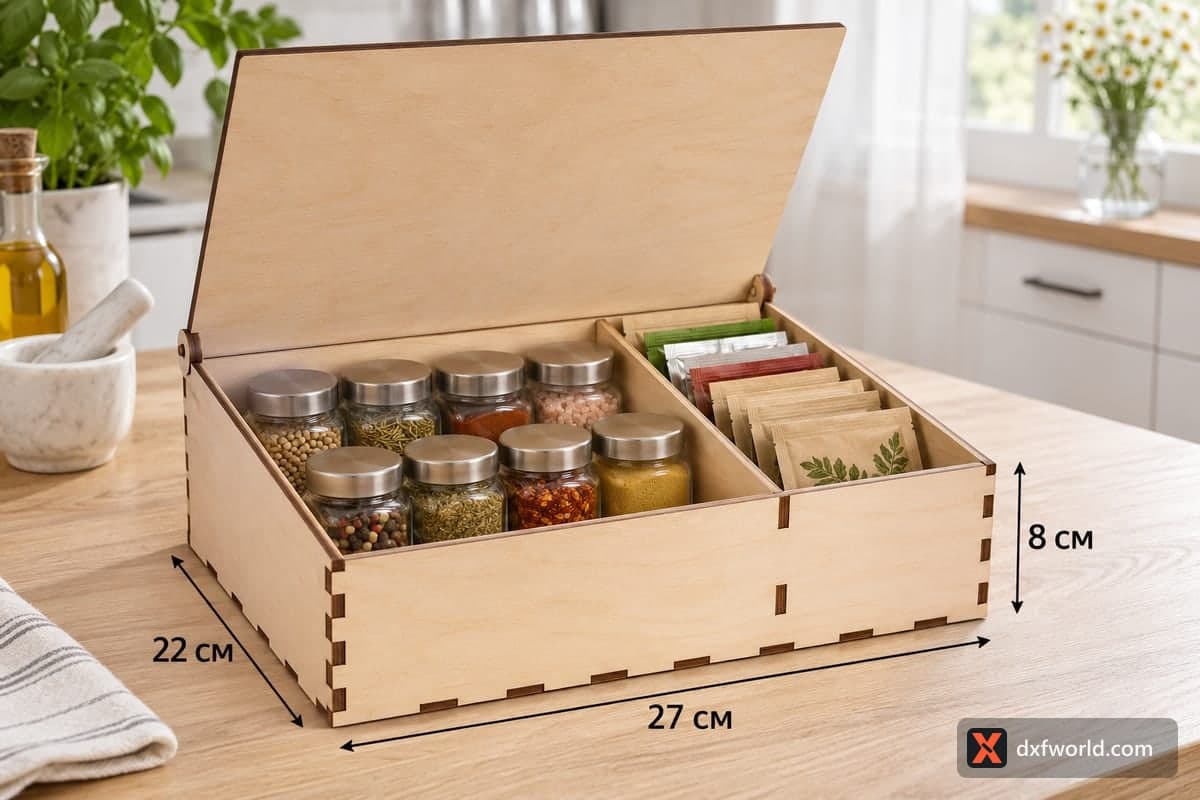
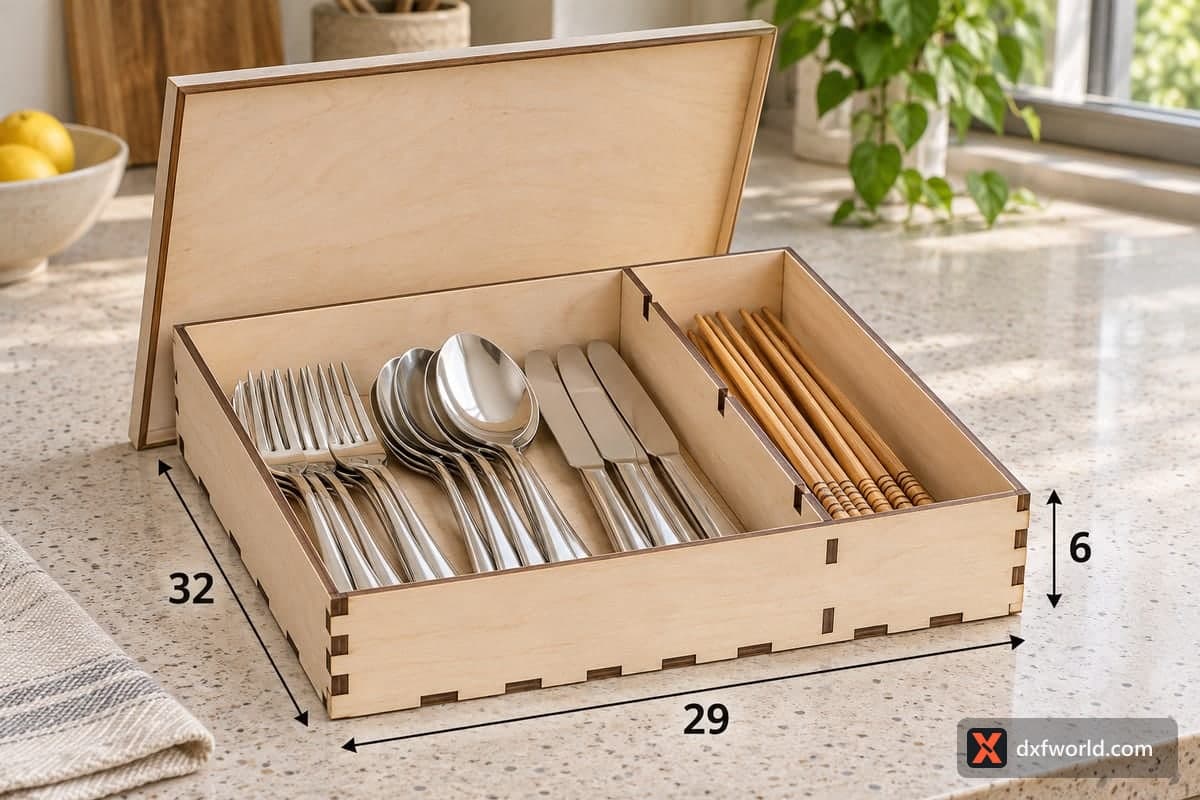
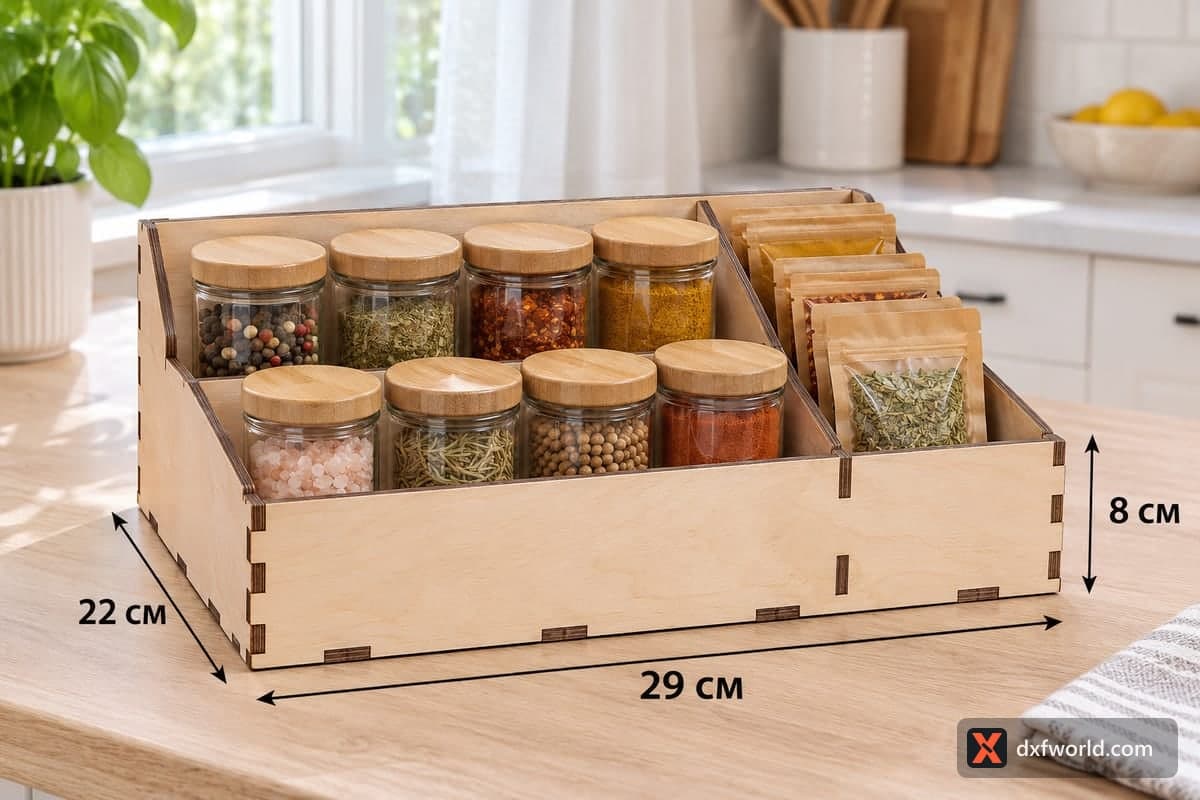
 Visualization
Wide Four Cell Spice Caddy SVG, Low Front Spice Jar Holder DXF, Kraft Pouch and Jar Sorter Laser Cut File
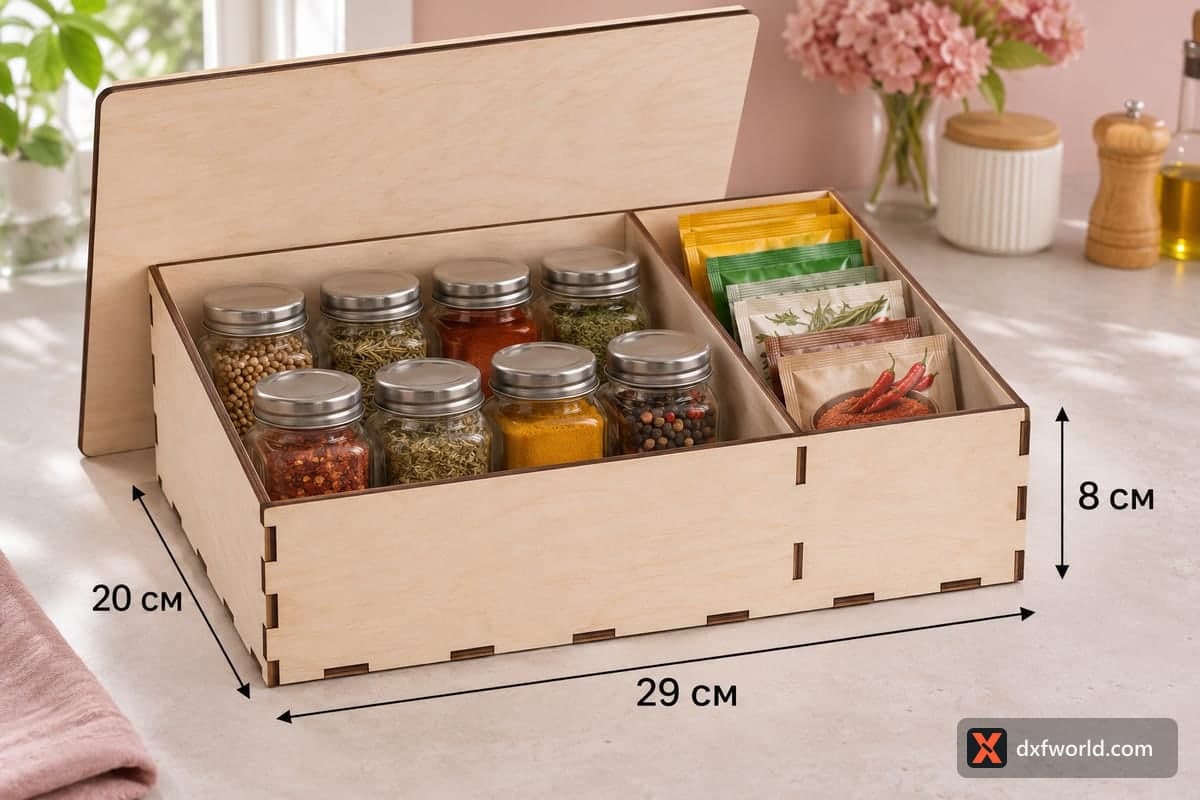
A free laser cut file for a wide, open spice caddy with four cells: a full-depth divider splits it into two sides, and a lower cross divider gives each side a front and a back cell. It measures 290 × 220 × 80 mm (11.42 × 8.66 × 3.15 in), with a 44 mm front wall and sides sloping up to the back, and is cut from 7 plywood pieces that slot together. SVG and DXF files for 3, 4, 5 and 6 mm plywood are included.
- Formats
- SVG, DXF
- Outer size (W × D × H)
- 290 × 220 × 80 mm (11.42 × 8.66 × 3.15 in)
- Parts
- 7
- Material thickness
- 3, 4, 5 or 6 mm plywood (a file for each)
- Layout size (3 mm file)
- 1,040 × 312 mm
- Cut length
- 5.66 m
- Est. time, 10 W diode (3 mm)
- 18 min 53 s
- Est. time, 40 W CO2 (3 mm)
- 7 min 52 s
- Layers
- CUT only, no engraving
Free account required to download
How to make it
- 01Open the 3, 4, 5 or 6 mm version that matches your sheet and cut one slot on an offcut to confirm the tabs seat fully.
- 02Cut the seven pieces, splitting the 1040 mm layout across sheets if your bed is short.
- 03Lock the two dividers together where they cross, set the walls around the base, then lower the divider cross into its slots.
- 04Seal the inside with food-safe oil, then put jars on one side and pouches on the other.
How the four cells are arranged
Only two dividers do all the work here. One runs front to back at the full 80 mm height. The other crosses the whole 290 mm width at 61.7 mm, so the front cells sit lower than the back ones, and the 44 mm front wall keeps them easy to reach. At 220 mm deep it needs a counter rather than a narrow shelf.
The photo fills the left side with eight glass jars topped with bamboo lids, four behind and four in front: peppercorns, oregano, chili flakes, turmeric, pink salt, rosemary, white pepper and paprika. The right side holds a run of kraft zip pouches with windows, filed front to back like index cards so each one can be pulled out by its top.
Cutting and building
For the 3 mm file the job runs about 18 min 53 s on a 10 W diode, about 7 min 52 s on a 40 W CO2 and about 3 min 47 s on a 100 W CO2. The 3 mm layout measures 1040 × 312 mm, so on a typical 400 mm diode bed you would split it across three sheets. Push the long divider and the cross divider together at their crossing slot before fitting them into the walls. A diode cuts 3 mm in one or two passes; for 6 mm plan on a CO2 or several slow passes.
Gift ideas
A caddy filled with eight jars of whole spices and a stack of refill pouches makes a generous housewarming present. Put a family name on the front panel with an engrave layer of your own to personalise each one.
Questions about this file
What goes in which side?
In the photo jars fill the left and kraft spice pouches the right. Both sides have a front and a back cell, so you can swap them around to suit your counter.
Why is the cross divider lower than the walls?
It is 61.7 mm tall against the 80 mm back, which lets the front cells sit lower so you can see over them into the back row.
Can I resize it for a deep drawer?
Change the outer lengths in a vector editor but leave the slot widths at your plywood thickness. Scaling the whole drawing would widen or shrink the slots.
Is MDF a good choice for this caddy?
MDF cuts well and takes paint nicely, but it swells when wet, so seal it fully if the caddy will sit near the sink.
Do I need glue?
No, the slotted joints are firm enough for daily use. A thin line of wood glue along the base makes it rigid if you plan to ship it.
Similar files