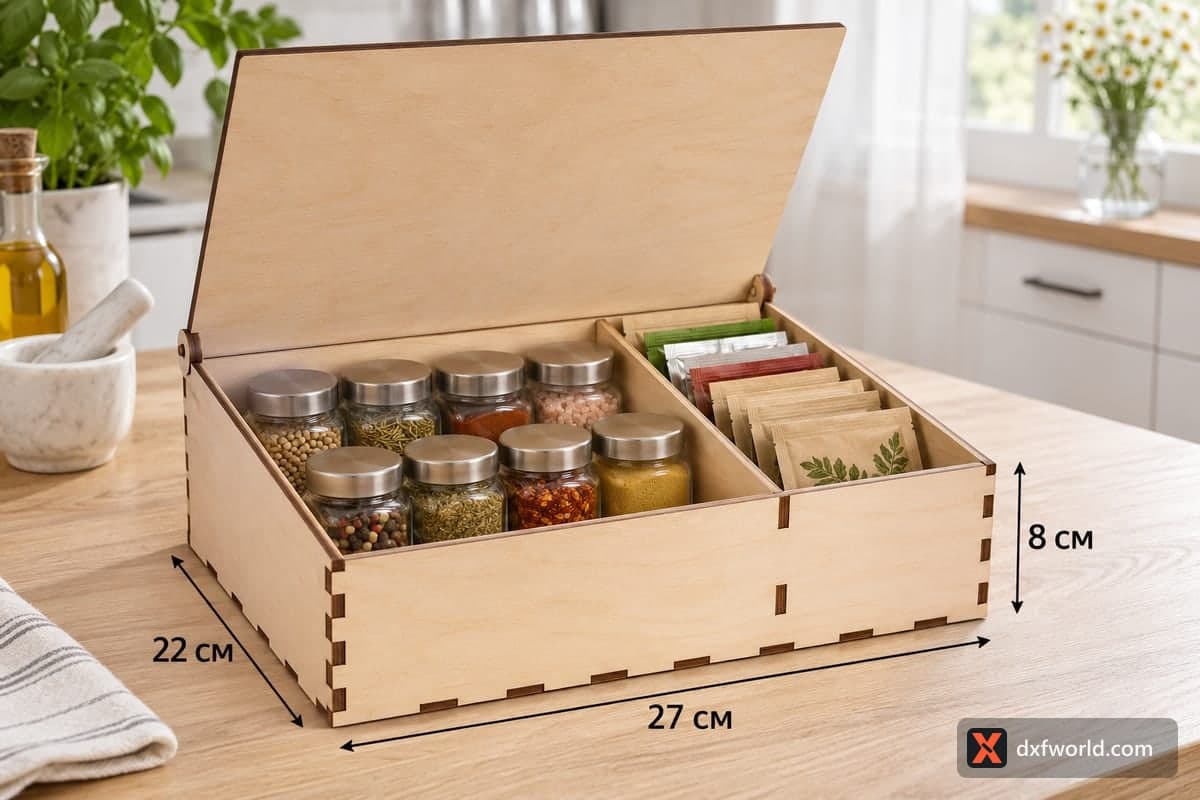
 Visualization
Hinged Lid Spice Chest for Jars SVG, Pivot Lid Seasoning Box DXF, Spice Jar and Sachet Keeper Laser Cut File
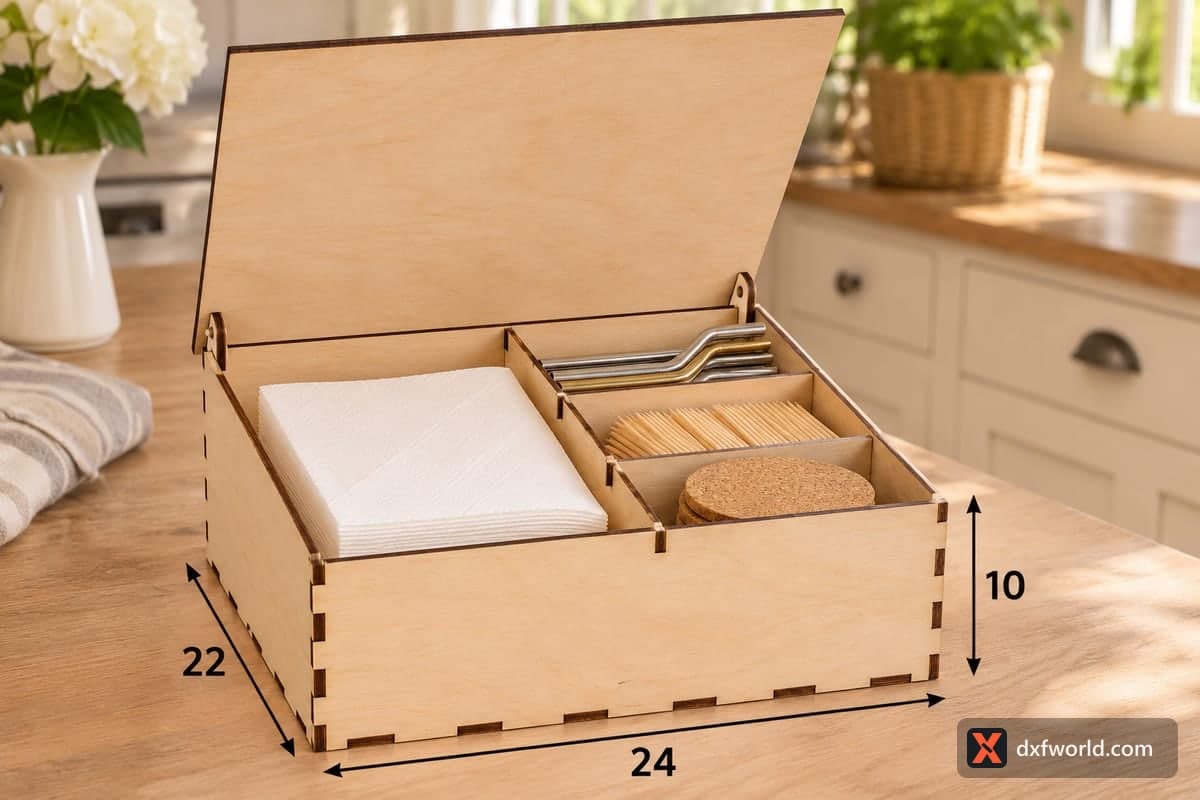
A free laser cut file for a spice chest with a lid that flips open at the back on pins cut into the plywood, and two sections inside split by a front-to-back divider. It measures 270 × 220 × 80 mm (10.63 × 8.66 × 3.15 in), is made from 7 plywood pieces with tab-and-slot joints, and comes as SVG and DXF files for 3, 4, 5 and 6 mm plywood.
- Formats
- SVG, DXF
- Outer size (W × D × H)
- 270 × 220 × 80 mm (10.63 × 8.66 × 3.15 in)
- Parts
- 7
- Material thickness
- 3, 4, 5 or 6 mm plywood (a file for each)
- Layout size (3 mm file)
- 1,000 × 316 mm
- Cut length
- 6.23 m
- Est. time, 10 W diode (3 mm)
- 20 min 45 s
- Est. time, 40 W CO2 (3 mm)
- 8 min 39 s
- Layers
- CUT only, no engraving
Free account required to download
How to make it
- 01Use the file that matches your measured plywood thickness and test one corner joint on scrap.
- 02Cut all seven pieces; the lid and base are the biggest, so give each its own sheet on a small machine.
- 03Join the front, back and divider to the base, then fit the two taller side panels so they hold the lid at its pivot, and check that it swings.
- 04Sand wherever the lid rubs, finish the outside, and place jars on one side and sachets on the other.
A lid that pivots on wooden pins
The two side panels are a little taller than the box, 84.2 mm against 80 mm, and that extra height carries the pivot for the lid at the back. The lid itself is one 270 × 216.3 mm panel. Lift the front edge and it swings up and back, out of the way while you pick out a jar. Everything is plywood: there are no metal hinges, screws or magnets to buy.
Inside the chest
One divider, 75.5 mm tall, runs from front to back and creates two sections. The photo places eight silver-lidded jars in the larger left section, two rows of four with white pepper, rosemary, pink salt, chili, peppercorns, thyme and curry powder. The right section holds a row of flat seasoning sachets standing on edge, green, red and kraft, easy to thumb through when the lid is up.
Cutting and finishing
For the 3 mm file the cut takes about 20 min 45 s on a 10 W diode, about 8 min 39 s on a 40 W CO2 and about 4 min 09 s on a 100 W CO2. Lay out 1000 × 316 mm of 3 mm plywood, or split the lid and base onto separate sheets on a smaller bed. A diode cuts 3 mm in one or two passes, while 5–6 mm takes more. Check that the lid swings freely before gluing any corners, and sand the pivot area if it rubs. Oil on the outside and a little wax on the pivots keep it moving smoothly.
As a gift, fill it with eight whole spices and a set of grinder sachets for the cook who has everything, or put a herb drawing on the lid with your own engrave layer.
Questions about this file
How does the lid stay on without hinges?
Pins cut into the plywood sit in the two side panels at the back, so the lid can only pivot. Nothing metal is needed.
How much space does it need with the lid open?
Opened, the 216.3 mm lid rises above the 80 mm box, so allow roughly 30 cm of clear height under a cupboard.
Which plywood thickness should I pick for a lidded box?
4 mm is a good middle ground: stiffer than 3 mm but still quick on a diode. Always use the file made for that exact thickness.
Could the lid carry a name or monogram?
Yes, the lid is a large flat panel, ideal for a name, monogram or herb illustration added as your own engrave layer.
Will the pivot lid stay free in a steamy kitchen?
Seal all surfaces, including the inside, with lacquer or hardwax oil so the plywood does not swell and make the lid stiff.
Similar files