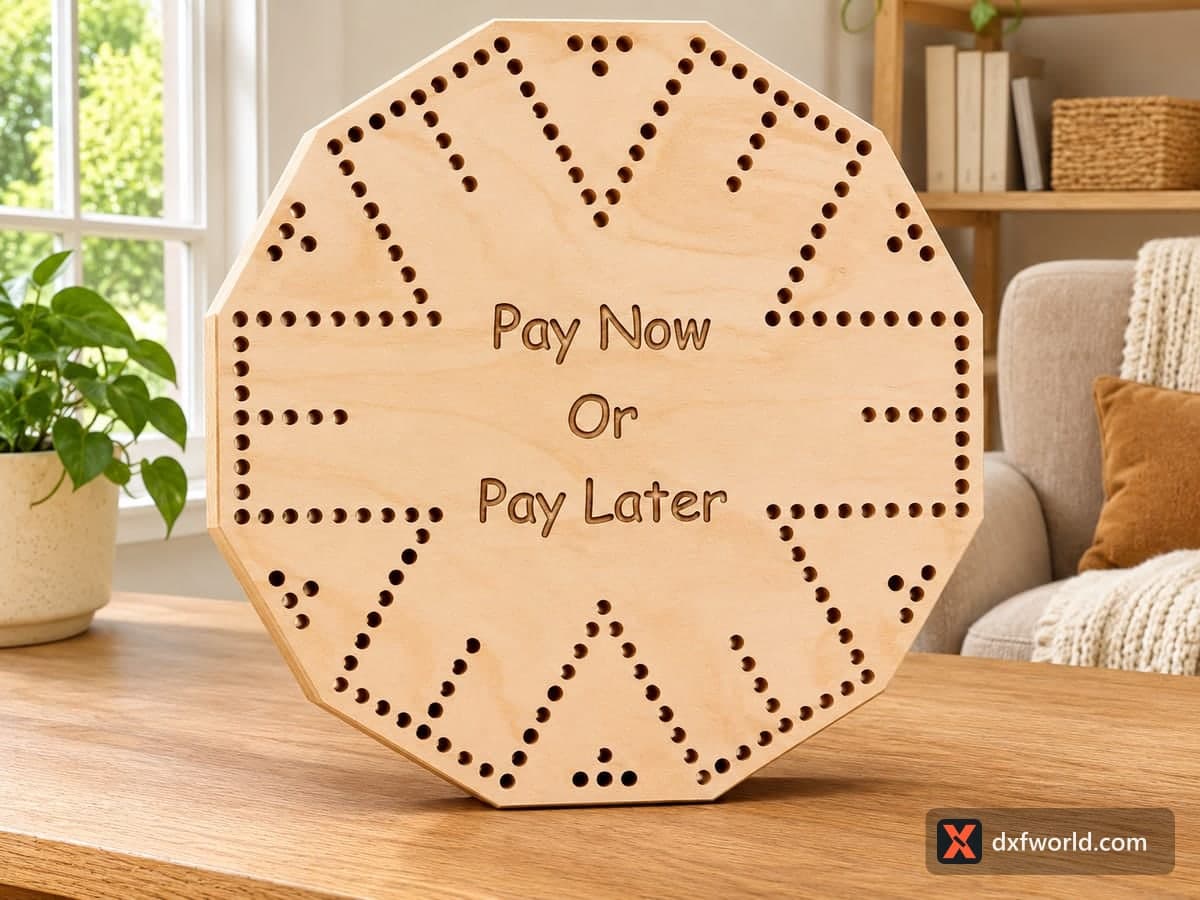
 Visualization
Peg Game Board SVG, Twelve Sided Wooden Game Laser Cut File, Dodecagon Board Game DXF, Family Game Night
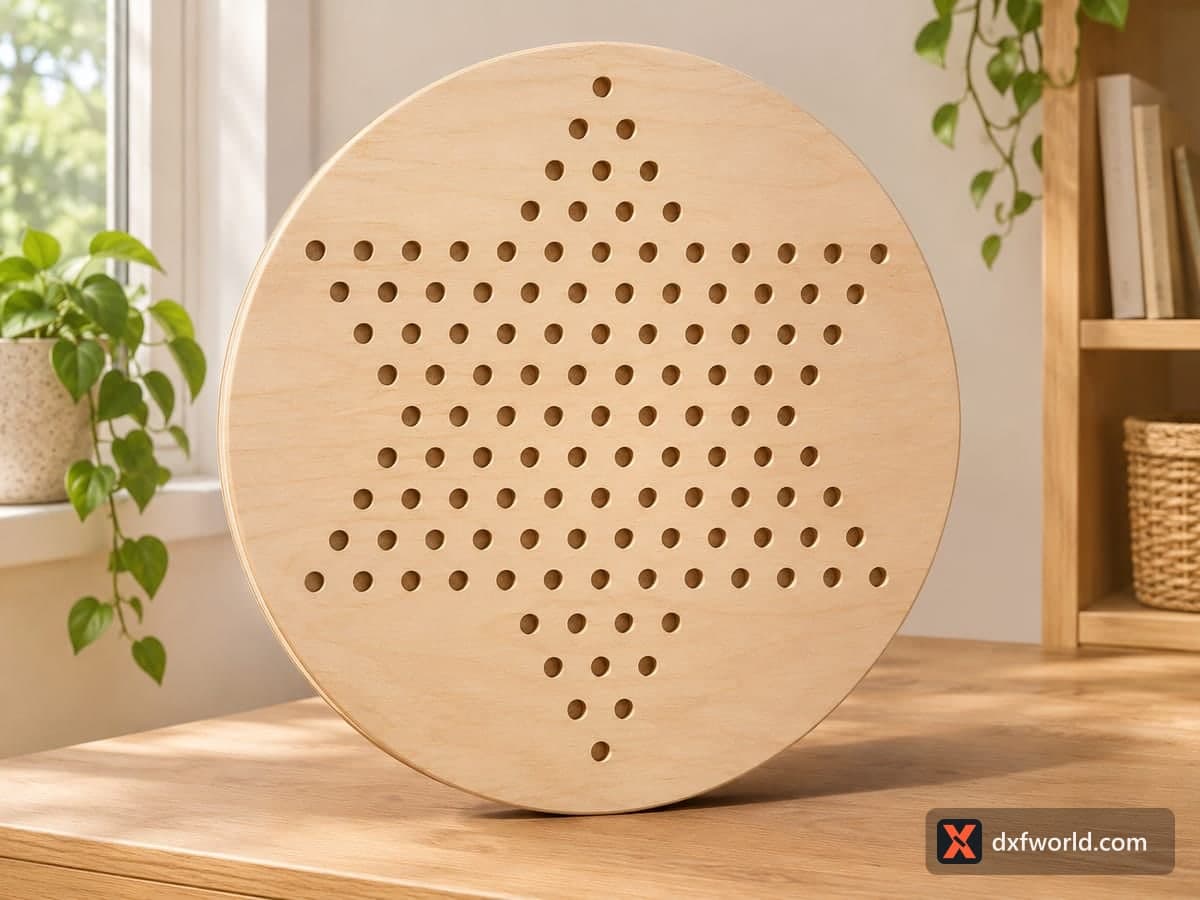
A flat twelve-sided game board with 192 round holes about 5 mm across, arranged as a loop track around the rim, V-shaped runs toward the middle and six small nests of four holes, with the words Pay Now Or Pay Later in the centre. The free download is one SVG and one DXF file, cut lines only, at 228.6 × 228.6 mm (9 × 9 in).
- Formats
- SVG, DXF
- Size
- 229 × 229 mm (9.00 × 9.00 in)
- Material
- Plywood, MDF, acrylic or metal (scale to your piece)
- Cut length
- 4.47 m
- Est. time, 10 W diode (3 mm)
- 14 min 54 s
- Est. time, 40 W CO2 (3 mm)
- 6 min 13 s
- Layers
- CUT only, no engraving
Free account required to download
How to make it
- 01Put the centre lettering on an engrave or score layer and leave the holes and outline as cuts.
- 02Cut a test strip with a few holes and check that your pegs fit, then adjust scale or kerf.
- 03Cut the board from 6 mm plywood or glue it onto a solid backer so pegs do not fall through.
- 04Sand, paint each starting nest a different colour, seal with oil or varnish and add pegs.
The layout
Every hole in the file is a small circle of roughly 5 mm, so the board is made for golf tees or short wooden pegs, not marbles. The holes run in a continuous track just inside the twelve straight edges. Four long V shapes point in from the top and bottom, two straight runs come in from the left and right, and six little triangles of four holes sit between them. Three lines of lettering fill the middle. The photo shows the board standing on a table in light birch plywood with the holes drilled clean.
Lettering and hole tips
As drawn, the centre words are outlines, so a laser would cut them right through and the closed parts of letters such as a, o and e would drop out. Most people set that layer to engrave or score instead, which is how the photo shows it. For the holes, cut a test strip first: a 5 mm hole that fits your pegs in 6 mm plywood may be too tight after a CO2 kerf. Use 6 mm or thicker plywood, or glue the cut board onto a solid backer, so the pegs have something to stop against.
Scaling and finishing
You can scale the board up for bigger pegs, but the hole size grows with it, so match the scale to your pegs and test one hole. At 150 percent the holes are about 7.5 mm, a good size for chunky dowel pegs. Sand the face lightly, then oil or varnish. Colour each starting nest in its own paint before varnishing to tell the players apart. The rules for this kind of race game vary from family to family, so write your house rules on the back.
Questions about this file
What pegs fit the holes?
As drawn the holes are about 5 mm across, which suits golf tees or thin dowel pegs. Scale the board if your pegs are thicker.
Will marbles work?
Not at the drawn size. Marbles need shallow dimples, which a cut-through file cannot make; use pegs or drill a pocketed board on a CNC instead.
Can I change the words in the middle?
Yes. Delete the lettering in your design software and type a family name or a date, then engrave it.
Why do the letters fall out when I cut them?
The text is drawn as outlines. Set it to engrave or score so the closed parts of the letters stay in place.
How many people can play?
There are six small nests of four holes around the board. How you use them depends on the rules your family plays.
Similar files