 Visualization
Eiffel Tower 3D Puzzle SVG, Paris Landmark Laser Cut Model, Wooden Tower Kit DXF, Lattice Tower Plans
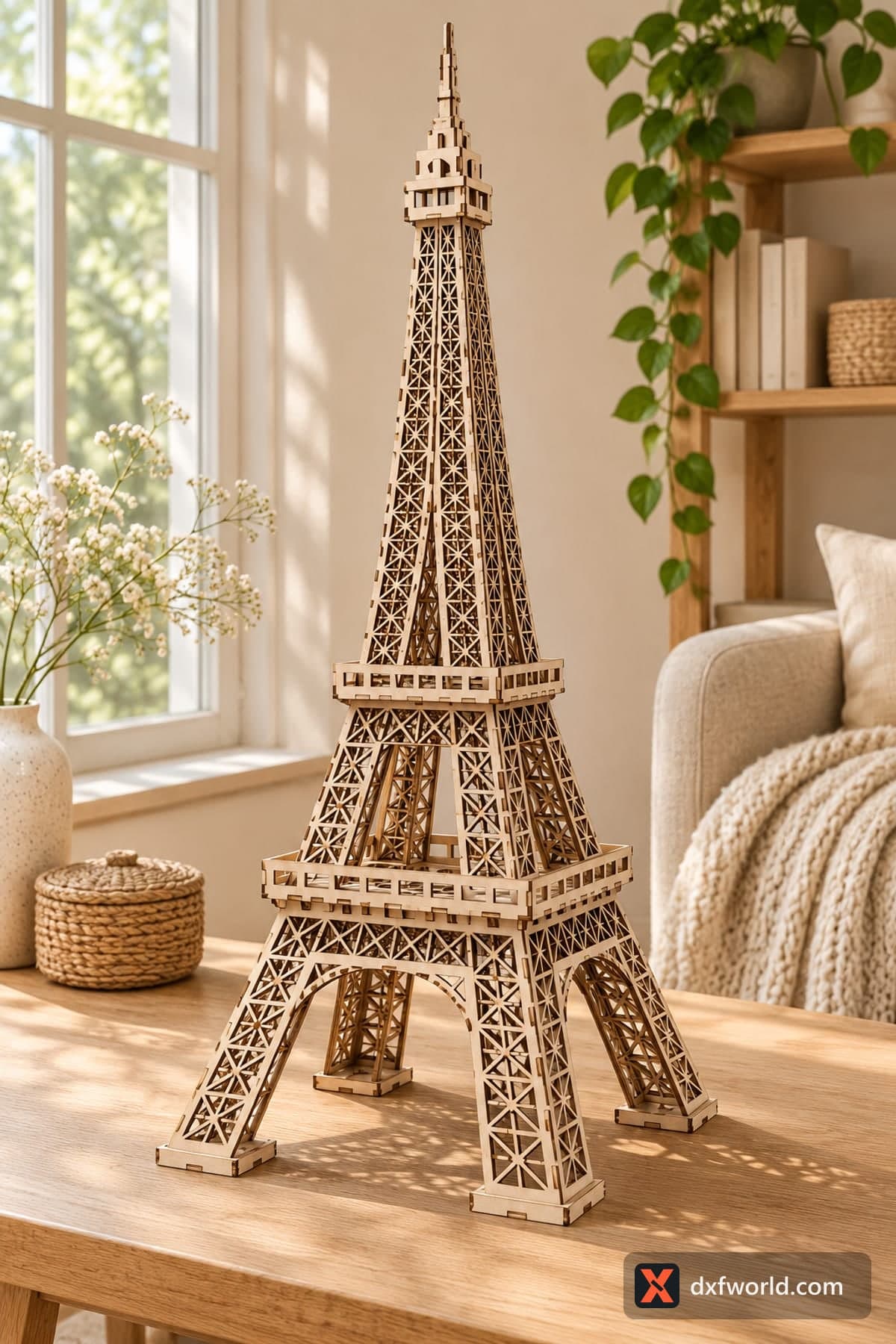
A slot-together model of the Eiffel Tower in open lattice work: tapered leg panels, curved arch sections, two square deck floors with railings and a pointed spire. The free download is one SVG and one DXF file with all parts on a 1096.5 × 272.5 mm (43.17 × 10.73 in) layout, cut lines only, with slots drawn for 3 mm plywood.
- Formats
- SVG, DXF
- Size
- 1,097 × 273 mm (43.17 × 10.73 in)
- Material
- Plywood, MDF, acrylic or metal (scale to your piece)
- Cut length
- 70.30 m
- Est. time, 10 W diode (3 mm)
- 234 min 20 s
- Est. time, 40 W CO2 (3 mm)
- 97 min 38 s
- Layers
- CUT only, no engraving
Free account required to download
How to make it
- 01Cut one tab and one deck slot from your 3 mm sheet and adjust the kerf until the joint is snug.
- 02Split the long layout over two or three sheets and cut the lattice panels with air assist on.
- 03Assemble the curved legs and arches, fit the first deck, then add the middle panels and second deck.
- 04Slide in the upper shaft and spire, glue the deck joints and finish with clear coat or bronze paint.
What is in the file
Four long tapered panels form the upper shaft of the tower. Two pairs of curved pieces make the lower legs with the big arches between them, and four trapezoid lattice panels close the middle section. Two square floors with a fine grid become the first and second decks, and narrow strips with small windows wrap around them as railings. The spire and the little top cabin come from the slim pointed parts in the middle of the sheet. Almost every part is filled with X-braced lattice, which gives the finished model its airy iron look. The photo shows it in light plywood on a living room table.
Cutting tips
The slots are drawn for 3 mm material, as the file title says. Sheets sold as 3 mm often measure 2.8 to 3.2 mm, so cut one deck corner and one leg tab first and check the fit. The lattice holds thousands of small openings, which means a long job and a lot of heat in a small area: use air assist, pin the sheet flat and let each panel finish before you lift anything. Do not scale the file down, because the thin lattice bars would break. The layout is about 1.1 m long, so spread the parts over two or three sheets on a hobby laser bed.
Assembly and display
Build the lower legs and arches first, lock them into the first deck, then add the middle panels, the second deck, the upper shaft and the spire. A thin line of wood glue at each deck joint keeps the tall shaft from wobbling. Leave it natural, or spray it dark bronze for a cast iron look. It is a fine gift for anyone who loves Paris or travel.
Questions about this file
Does the tower need glue?
The joints hold by friction, but a little wood glue at the two decks makes the tall model rigid enough to dust and move.
Can I cut it from 4 mm plywood?
Only if you scale the whole layout by the same ratio, about 133 percent for 4 mm, so the slots match the thicker sheet. Test one joint first.
Why does the cut take so long?
Every panel is filled with small lattice openings, so the laser head travels a long way. The time table on this page shows the estimate.
Will 3 mm MDF work?
Yes, MDF cuts cleanly and paints well, but its thin lattice bars are more fragile than birch plywood.
How do I keep the lattice from scorching?
Use air assist, mask the sheet with paper tape and run lower power with a second pass if the edges char.
Similar files