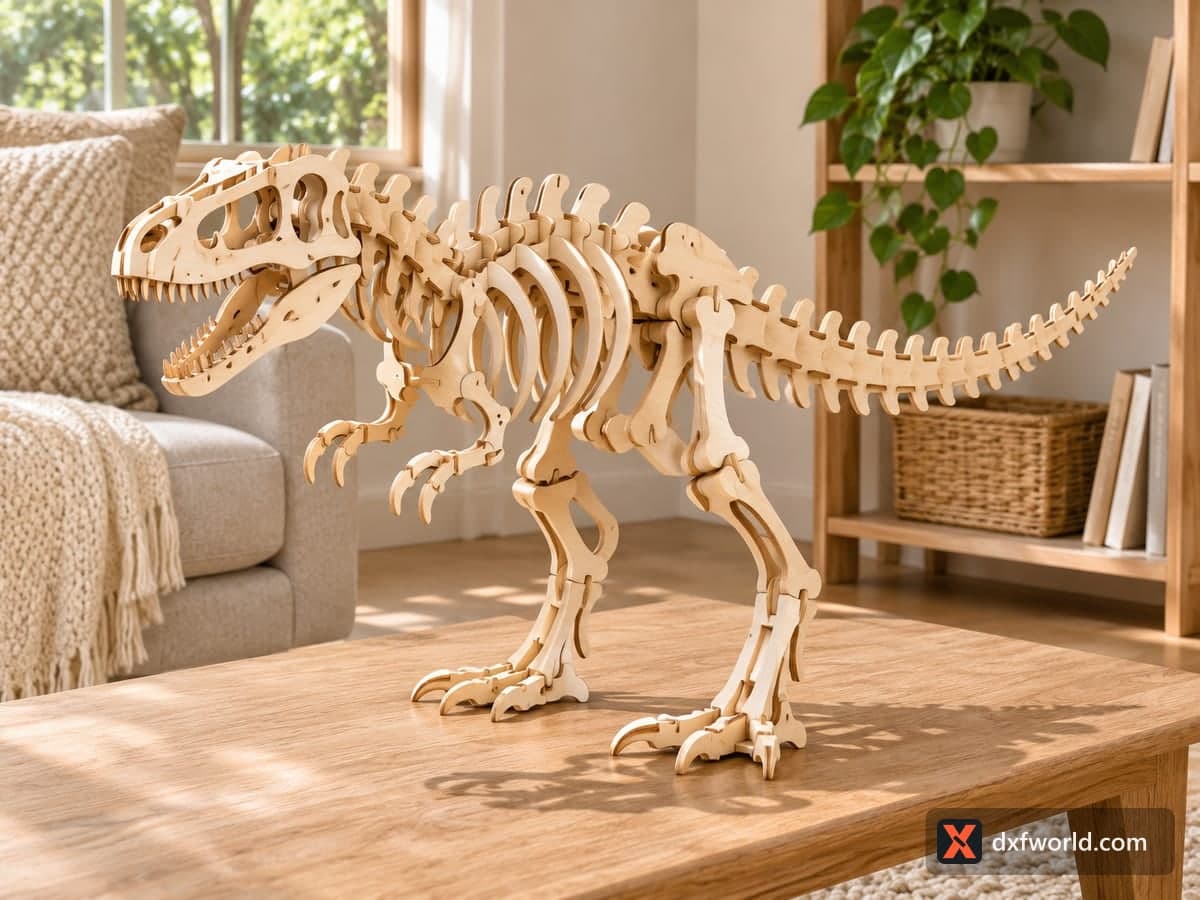
T-Rex Skeleton Puzzle SVG, Wooden Dinosaur 3D Model Laser Cut File, Tyrannosaurus Bones DXF
A slot-together 3D puzzle of a Tyrannosaurus rex skeleton with a toothed skull and open lower jaw, a long spine with tall vertebrae, curved ribs, small clawed arms, strong legs and a tapering tail. The free download is one SVG and one DXF file with all flat parts laid out on 749.3 × 596.9 mm (29.50 × 23.50 in), cut lines only; the slots are drawn for one material thickness, so check them before cutting.
- Formats
- SVG, DXF
- Size
- 749 × 597 mm (29.50 × 23.50 in)
- Material
- Plywood, MDF, acrylic or metal (scale to your piece)
- Cut length
- 24.30 m
- Est. time, 10 W diode (3 mm)
- 81 min 00 s
- Est. time, 40 W CO2 (3 mm)
- 33 min 45 s
- Layers
- CUT only, no engraving
Free account required to download
How to make it
- 01Measure a slot in the file and pick plywood that matches, or scale the file to your sheet, then test with one rib.
- 02Split the parts over sheets that fit your laser bed and cut everything, keeping the small claw parts.
- 03Join the backbone, slide the ribs and hips on, then fit both legs so the model stands.
- 04Add arms, skull, jaw and tail, glue the leg joints if needed and stain or seal the bones.
What the parts make
The sheet holds dozens of bone-shaped parts: two skull halves with jagged teeth, a separate lower jaw, a long backbone in sections with spiky vertebrae, rib loops in several sizes, hip pieces, two legs with three-toed feet, short arms with hooked claws and a tail that gets thinner towards the tip. Short slots in each part show where it meets the next one. Built up, the skeleton stands on its two feet in a striding pose with the mouth open, as in the photo on a living room coffee table.
Slots and material
No thickness is given with the file. Open it in your laser software, measure one slot and choose plywood or MDF that matches, or scale the whole file until the slot fits the sheet you have. Cut a skull piece and a rib first as a test. Birch plywood holds the thin teeth and claws better than MDF. The layout is about 75 × 60 cm, so most hobby lasers need it split over two or three sheets.
Building and display
Lay the parts out on a table by shape before you start: backbone, ribs, legs, arms, skull. Join the backbone sections, push the ribs in from the chest backwards, then add hips and legs so it can stand, and finish with arms, skull and tail. A drop of glue in the leg joints keeps it steady on a shelf. It makes a strong gift for a dinosaur-mad kid or a centrepiece for a natural history corner; a dark stain makes it look like fossil bone.
Questions about this file
What thickness is the T-rex made for?
The file does not state it. Measure a slot in your software and use matching material, or scale the file until the slots fit your sheet.
How big is the finished dinosaur?
The flat layout is 749.3 × 596.9 mm. The built skeleton is roughly as long as the longest backbone part plus the skull and tail.
Can I make a small desk version?
Yes, if you scale it to thinner sheet in the same ratio. Very small teeth and claws get fragile, so 3 mm plywood is a sensible minimum.
Does it need glue?
The slots hold it together, but glue in the legs and hips helps it stand firmly for years.
What finish looks good?
Natural plywood looks like a museum model; a brown or grey stain gives an old fossil look.
Similar files