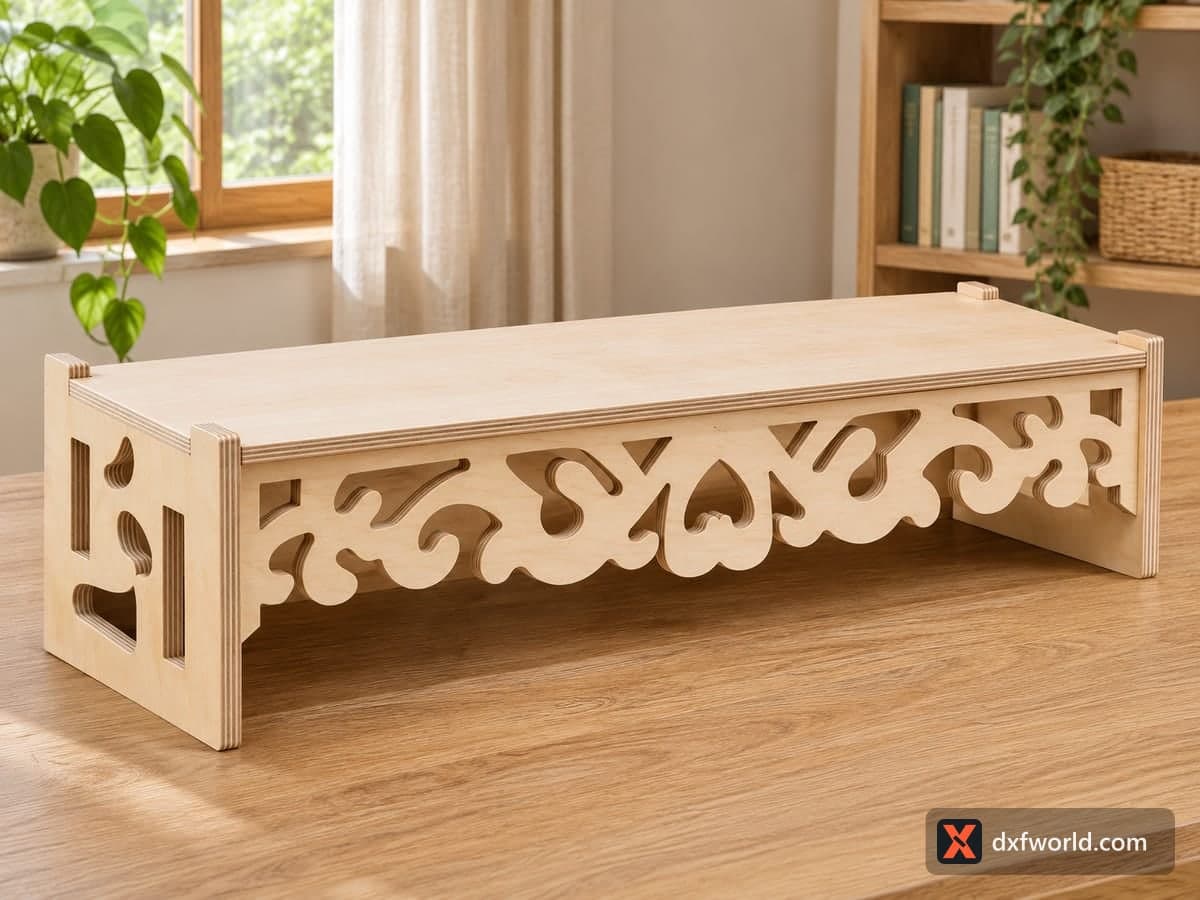
 Visualization
Wooden Monitor Stand SVG, Fretwork Desk Shelf CNC File, Monitor Riser DXF, Plywood Desk Riser Plans
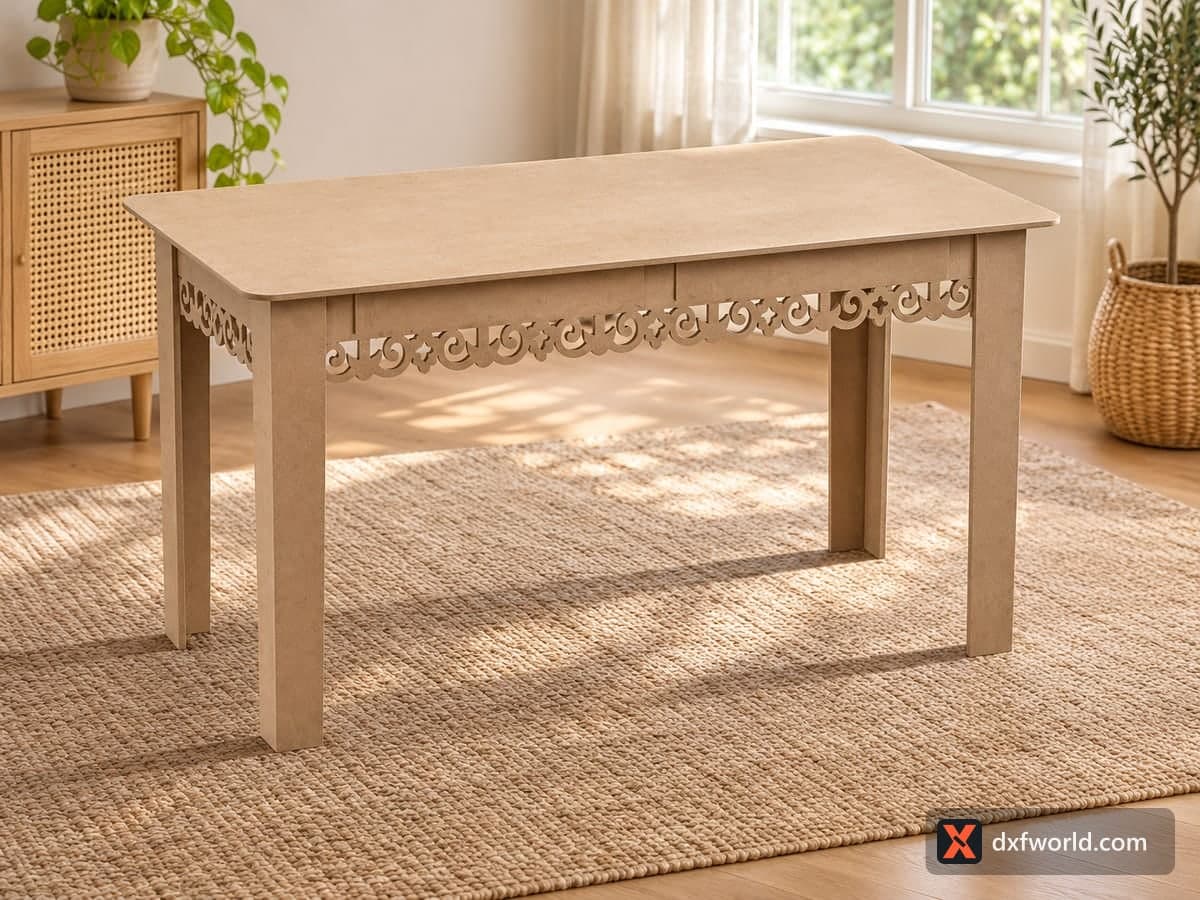
A low desk shelf or monitor riser made of four flat parts: an 800 × 200 mm top board, two 200 × 165.3 mm side legs with a rectangular slot and scroll cut-outs, and an 800 × 149.9 mm front apron with an openwork scroll and heart pattern. The free SVG and DXF files contain cut lines only on a 1069.6 × 426.3 mm (42.11 × 16.78 in) layout.
- Formats
- SVG, DXF
- Size
- 1,070 × 426 mm (42.11 × 16.78 in)
- Material
- Plywood, MDF, acrylic or metal (scale to your piece)
- Cut length
- 9.25 m
- Est. time, 10 W diode (3 mm)
- 30 min 49 s
- Est. time, 40 W CO2 (3 mm)
- 12 min 51 s
- Layers
- CUT only, no engraving
Free account required to download
How to make it
- 01Measure the leg slots in your software and choose or scale your board to match, then test one joint.
- 02Cut the top, the two legs and the fretwork apron on a large-format laser or CNC router.
- 03Fit the legs to the top, then set the apron between them at the front and glue the joints.
- 04Sand the openings and edges and finish with a clear lacquer or paint.
What you build
The two side legs stand on the desk and carry the long top board, and the decorated apron closes the front between them. The apron pattern is a symmetrical row of curls and leaves around a heart in the middle, and the legs repeat the same curls on their outer edge. The back stays open, which leaves room for cables, a keyboard pushed underneath or a row of notebooks. The photo shows it in birch plywood on a home office desk.
Material and joints
The joints are simple: small tabs at the ends of the top board and a rectangular slot in each leg. No thickness is given for the leg slots. Check their width with the measuring tool in your CAD or laser program and buy board to match, or resize the drawing until slot and sheet agree, then cut a single joint from scrap to confirm the fit. The top board is 800 mm long in one piece, so this design needs a large-format laser or a CNC router. Plywood is stiffer than MDF over that span.
Finishing and use
Round the front edge of the top slightly so wrists rest comfortably, then sand the fretwork openings with a folded strip of sandpaper. A drop of wood glue in each joint and two small screws from the top through into the legs make the stand solid enough for a monitor or a laptop. Finish with a hard-wearing clear lacquer, since a desk top gets daily wear. A painted version in white or black suits a modern office, natural oak-look plywood a cosy study.
Questions about this file
How big is the finished stand?
The top is 800 × 200 mm and the legs are about 165 mm tall, so the shelf sits roughly at that height above the desk.
What board thickness do the slots need?
Nothing in the file says. Read the slot width off the drawing in your CAD or laser program, use board of that thickness or resize to suit, and cut a trial joint.
Does it fit on a small hobby laser?
Not as drawn, because the 800 mm top and apron must be cut in one piece. Shorten them in your software if your bed is smaller, keeping the end joints unchanged.
Will it hold a monitor?
With glued joints and a few screws a plywood version holds a typical computer monitor or a laptop. Do not stand on it or use it as a step.
Is there a back panel?
No, only the front apron is decorated. The open back makes it easy to run cables or slide a keyboard underneath.
Similar files