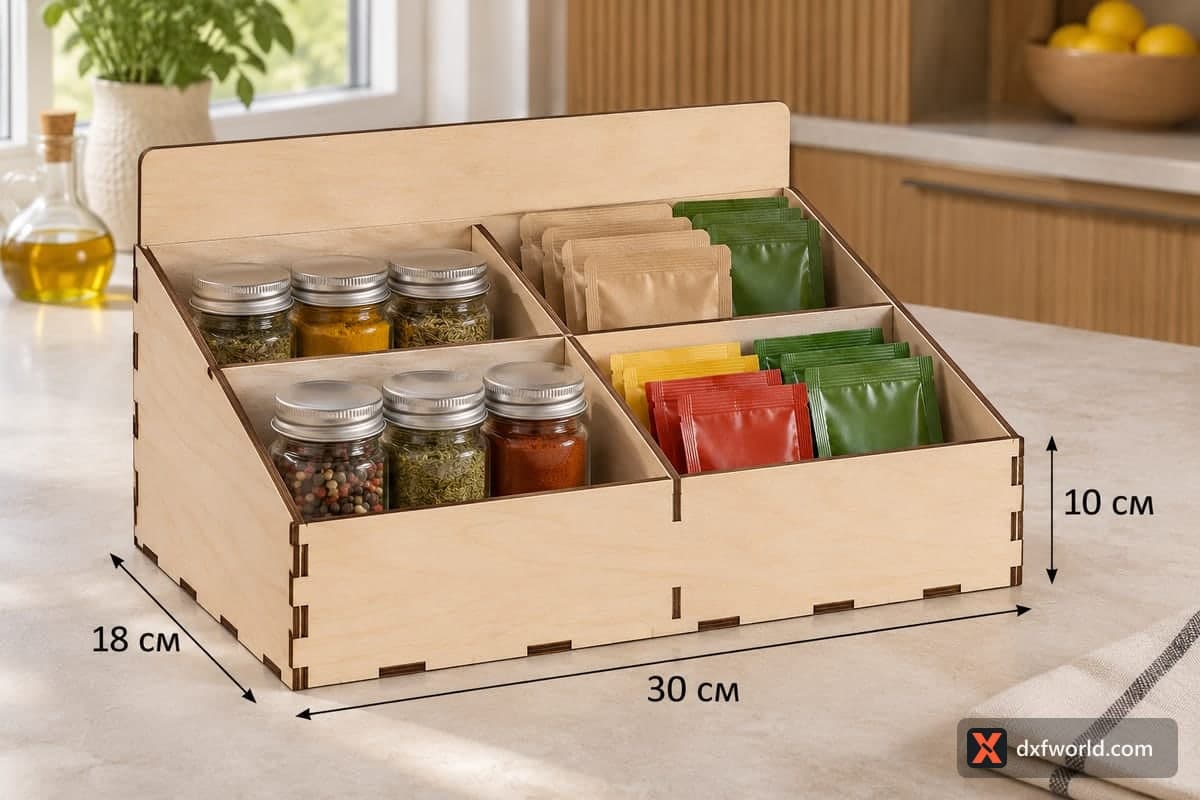
 Visualization
Four Cell Spice and Packet Organizer DXF, Tall Sloped Spice Stand SVG, Jar and Seasoning Packet Bin Laser Cut File
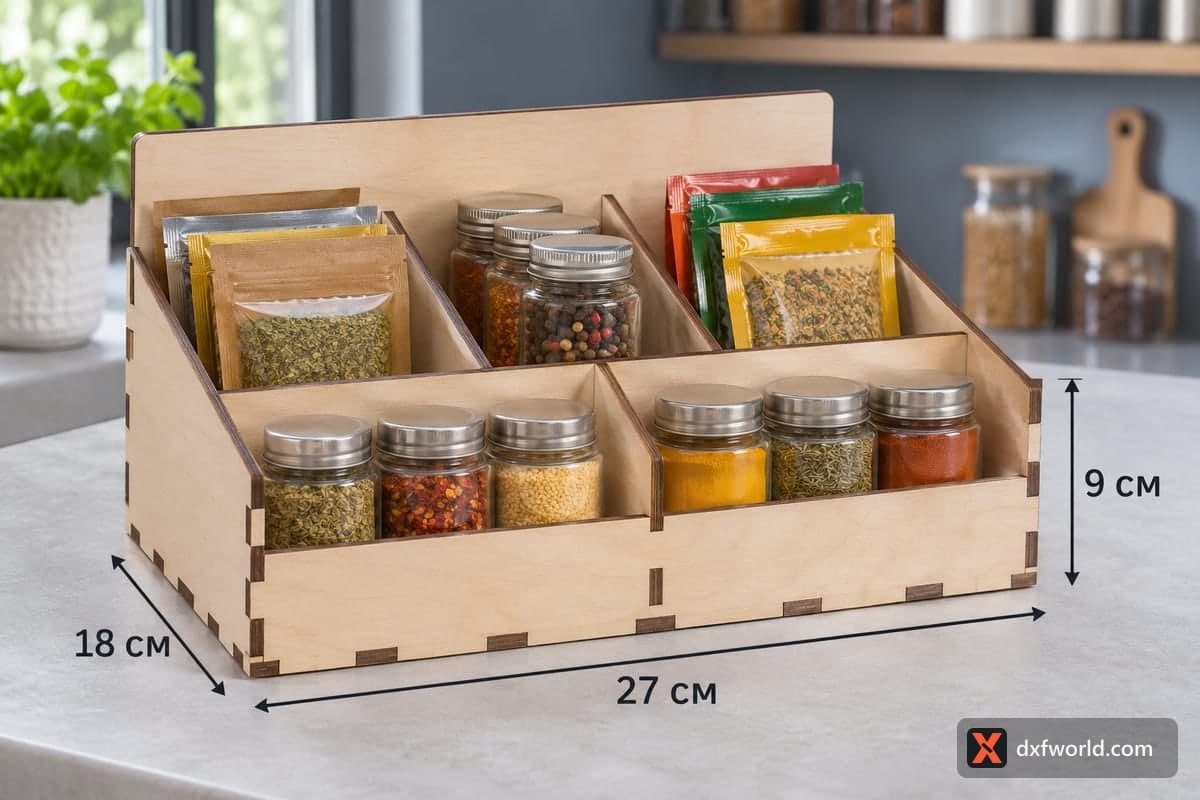
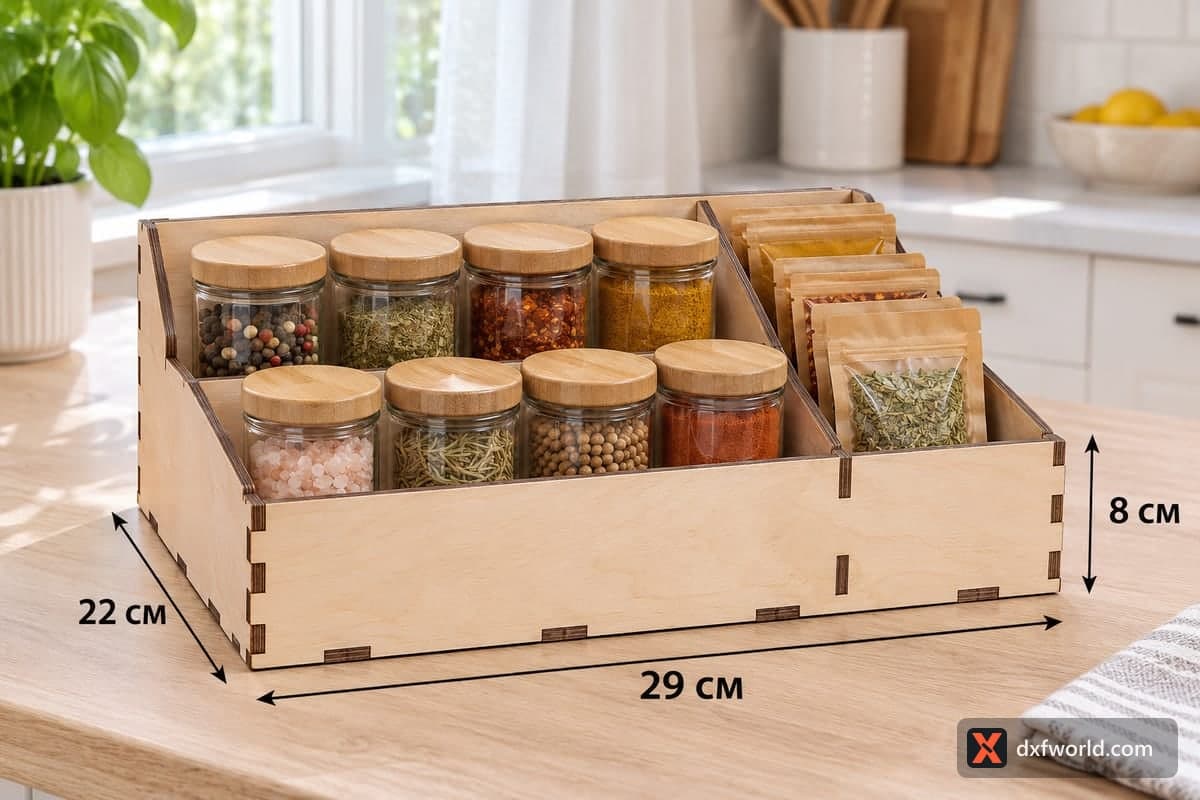
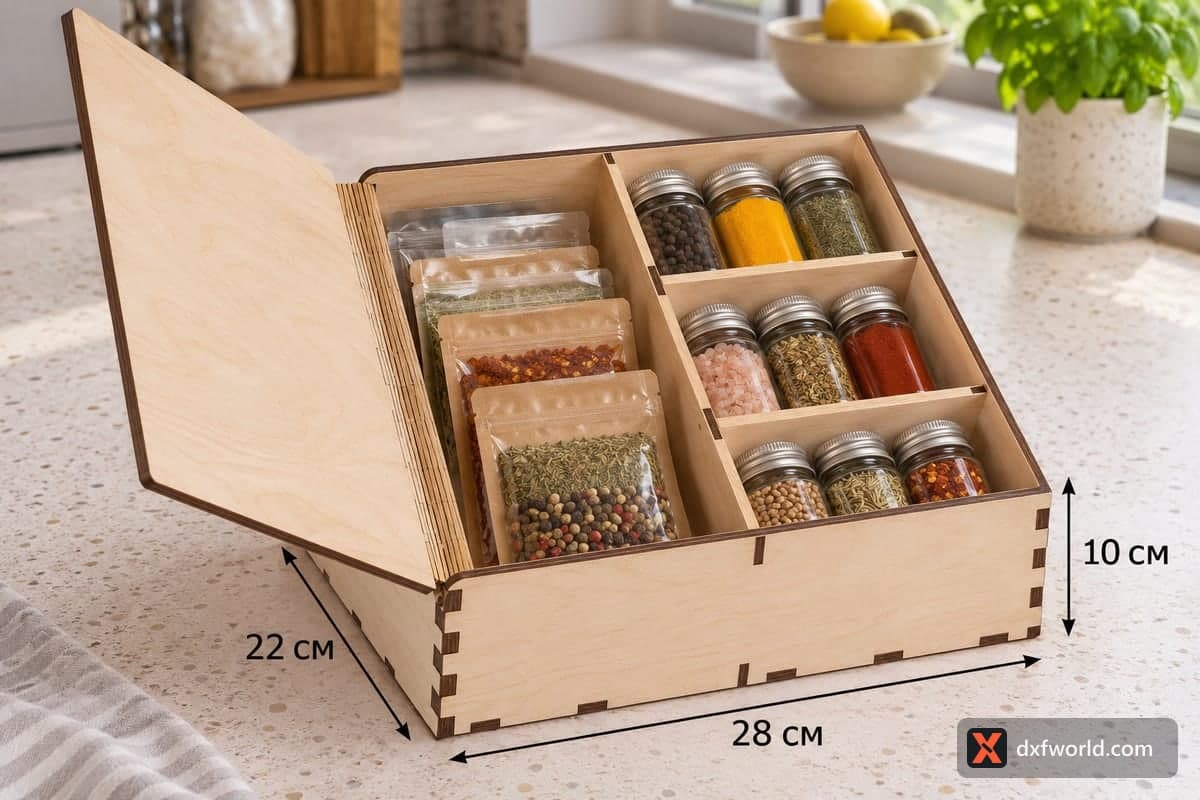
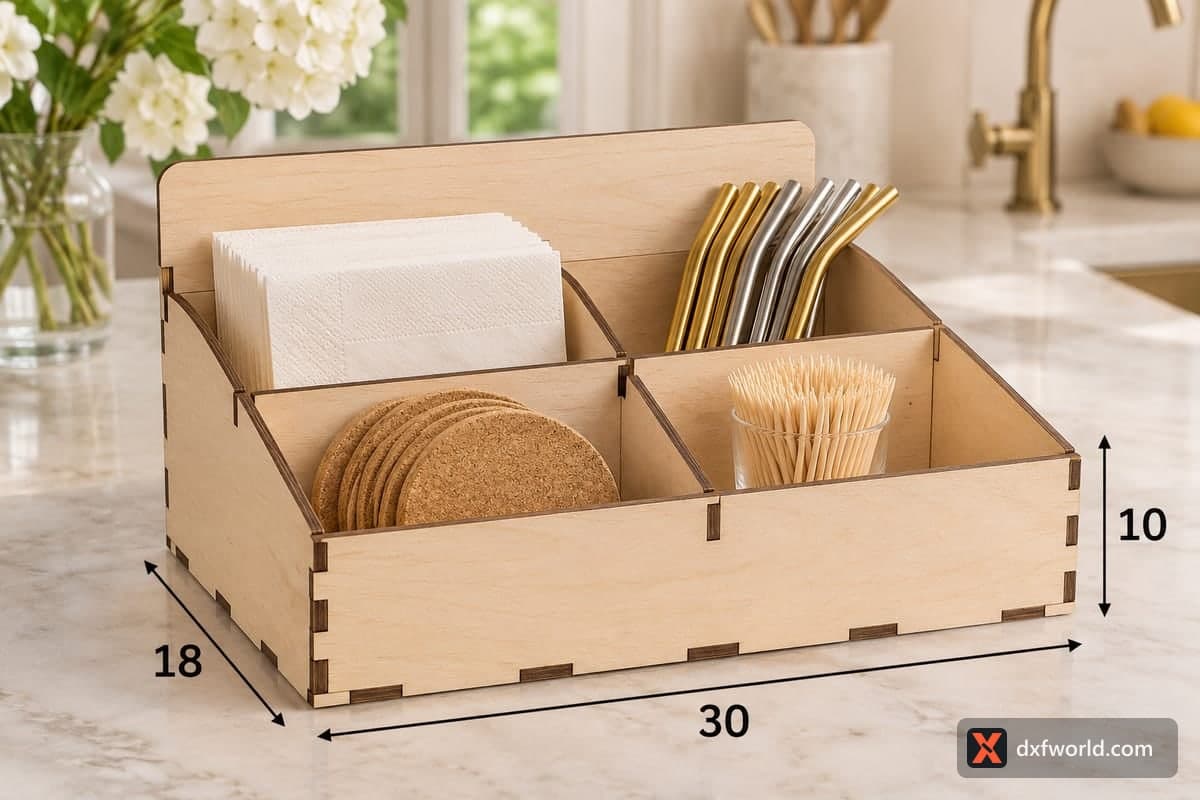
A free laser cut file for an open spice organizer with four cells in two rows, two at the back and two lower ones at the front, with a 50 mm front wall and sides that slope up to the 100 mm back. It measures 300 × 180 × 100 mm (11.81 × 7.09 × 3.94 in), is made from 8 plywood pieces with tab-and-slot joints, and comes as SVG and DXF files for 3, 4, 5 and 6 mm plywood.
- Formats
- SVG, DXF
- Outer size (W × D × H)
- 300 × 180 × 100 mm (11.81 × 7.09 × 3.94 in)
- Parts
- 8
- Material thickness
- 3, 4, 5 or 6 mm plywood (a file for each)
- Layout size (3 mm file)
- 980 × 292 mm
- Cut length
- 5.64 m
- Est. time, 10 W diode (3 mm)
- 18 min 47 s
- Est. time, 40 W CO2 (3 mm)
- 7 min 50 s
- Layers
- CUT only, no engraving
Free account required to download
How to make it
- 01Download the folder for the plywood you own and cut a single slot as a test; adjust power until the tab slides in with light pressure.
- 02Cut the eight pieces, splitting the 980 mm layout over two sheets on a small machine.
- 03Build the outer shell around the base, back wall first, then fit the cross divider and press the two short dividers into their slots.
- 04Round off sharp corners with fine sandpaper, seal with oil, and fill the left cells with jars and the right ones with packets.
Jars on the left, packets on the right
At 100 mm, the back wall is taller than on most sloped spice trays, which suits upright seasoning packets that would flop over in a shallower box. A cross divider 74.6 mm high runs the full 300 mm width and splits the depth into two rows. One short divider in each row then makes four cells.
The photo uses the left side for jars, three across in each row: herbs, turmeric and parsley behind, peppercorns, oregano and paprika in front. The right side is all packets: kraft and green sachets standing in the back cell, and yellow, red and green ones in the front cell, where the low wall lets you read them from across the counter.
Plywood and cutting time
The 3 mm layout is 980 × 292 mm. On a bed shorter than that, run the base and back on one sheet and the rest on another. For the 3 mm file expect about 18 min 47 s on a 10 W diode, about 7 min 50 s on a 40 W CO2 and about 3 min 45 s on a 100 W CO2. Thicker 5 or 6 mm sheet gives sturdier edges but asks for several passes on a diode, or a CO2 machine. The joints hold dry; glue the corners only if the box will be moved around a lot.
Ideas for gifts and stalls
Sell it as a seasoning set with four starter blends, or as a seed packet sorter for gardeners who keep their packets in the kitchen. Two of them side by side fill a deep pantry shelf neatly.
Questions about this file
Are the packet cells tall enough for standard seasoning sachets?
The back wall rises 100 mm, so most single-portion sachets stand upright with their tops showing. Taller pouches simply lean against the back.
What size jars suit the jar side?
With 3 mm plywood each cell is a little over 145 mm wide, so three round jars up to about 48 mm across fit in a row. Put taller jars in the back row where the walls are higher.
Which thickness is best for a 100 mm tall box?
3 mm keeps it light and cuts fastest; 4 mm feels noticeably stiffer at this height. Whichever you choose, use the matching file.
Will it survive spills next to the stove?
Bare plywood soaks up oil, so coat every face with hardwax oil or two coats of water-based lacquer first. Wipe spills straight away.
Can I build it without glue?
Yes, the tabs lock the walls together on their own. Add glue to the outer corners only if you want it permanent.
Similar files