 Visualization
Bee 3D Puzzle SVG, Wooden Honey Bee Laser Cut File, Insect Model Kit DXF, Garden Bug Desk Decor
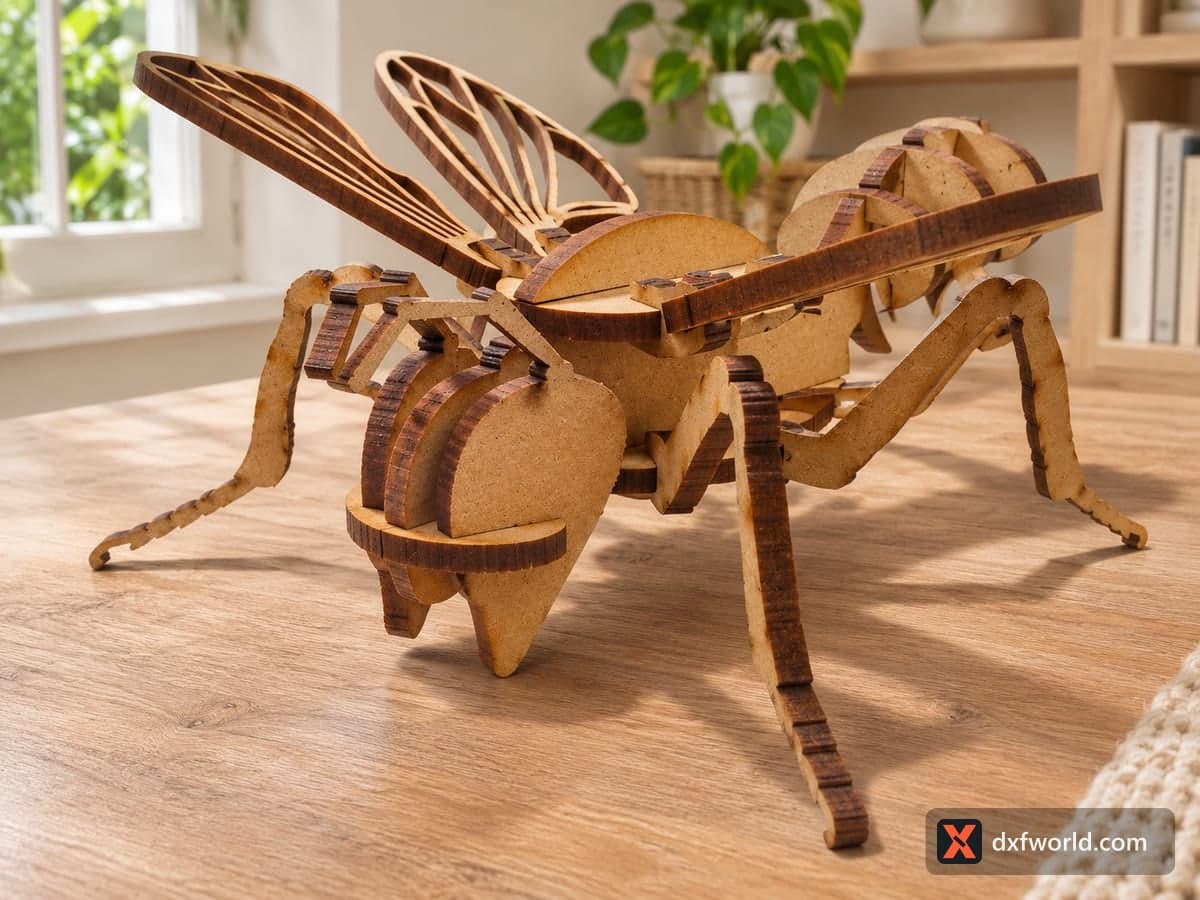
A slot-together wooden honey bee with two lattice wings, six long jointed legs, a side-profile body and crescent formers that build up the round head, thorax and abdomen. The free download is one SVG and one DXF file, cut lines only, on a 133.2 × 211.1 mm (5.24 × 8.31 in) layout, with small numbers beside the slots to show which parts meet.
- Formats
- SVG, DXF
- Size
- 133 × 211 mm (5.24 × 8.31 in)
- Material
- Plywood, MDF, acrylic or metal (scale to your piece)
- Cut length
- 7.39 m
- Est. time, 10 W diode (3 mm)
- 24 min 38 s
- Est. time, 40 W CO2 (3 mm)
- 10 min 16 s
- Layers
- CUT only, no engraving
Free account required to download
How to make it
- 01Measure one slot in your software, pick matching material or scale the file, and cut a test joint.
- 02Cut the sheet, keeping the wing piece flat so the thin veins do not snap.
- 03Slide the numbered formers onto the body profile, then fit the tail strip and the legs.
- 04Add the wings and antennae, then paint the stripes or seal the bare wood.
How the bee is built
The core is a long side-profile piece for the body, with open slots along its back. Crescent and ring-shaped formers slide onto it to round out the head, thorax and abdomen, and a curved strip with notches forms the ridged back of the tail. The two wings are cut as one mirrored pair, each with fine veins left as thin bridges. Six legs with hooked feet plug in from below, and two short antenna pieces finish the head. Small numbers sit next to the slots so you can match the parts quickly.
Size, material and slots
The layout is only 133.2 × 211.1 mm, so the slots are narrow. Measure one slot in your software before you choose the sheet: if it reads close to your material, cut it as it is; if your sheet is thicker, scale the whole file until the slots match and test one joint. The photo shows the bee in MDF at a larger scale, with dark laser-burned edges. Birch plywood is stronger for the thin legs and wing veins, while MDF gives a smooth face for paint. Avoid making the wings smaller than the original, because the veins get fragile.
Finishing ideas
Paint black and yellow bands on the body formers before assembly, or leave the bee raw for a rustic look. It suits a garden room, a beekeeper's shelf or a honey stall, and it sells well as a small kit next to jars at a farmers' market.
Questions about this file
Which material thickness does the bee need?
No thickness is given in the file name. Measure a slot width in your software and use that material, or scale the layout until the slots fit your sheet.
What do the small numbers mean?
They pair up the joints: a slot with a number meets the slot on another part with the same number.
Can I make a larger bee?
Yes, scale everything together and use thicker sheet in the same proportion so the slots stay snug.
Are the legs strong enough to stand on?
In birch plywood they hold the bee upright. In MDF, a drop of glue at each leg joint helps.
How do I paint neat stripes?
Paint the body formers flat before assembly, using masking tape to separate the yellow and black bands.
Similar files