 Visualization
Tuba Bookends SVG, Musical Instrument Book Holder Laser Cut File, Brass Band Bookend Pair DXF, Music Teacher Gift
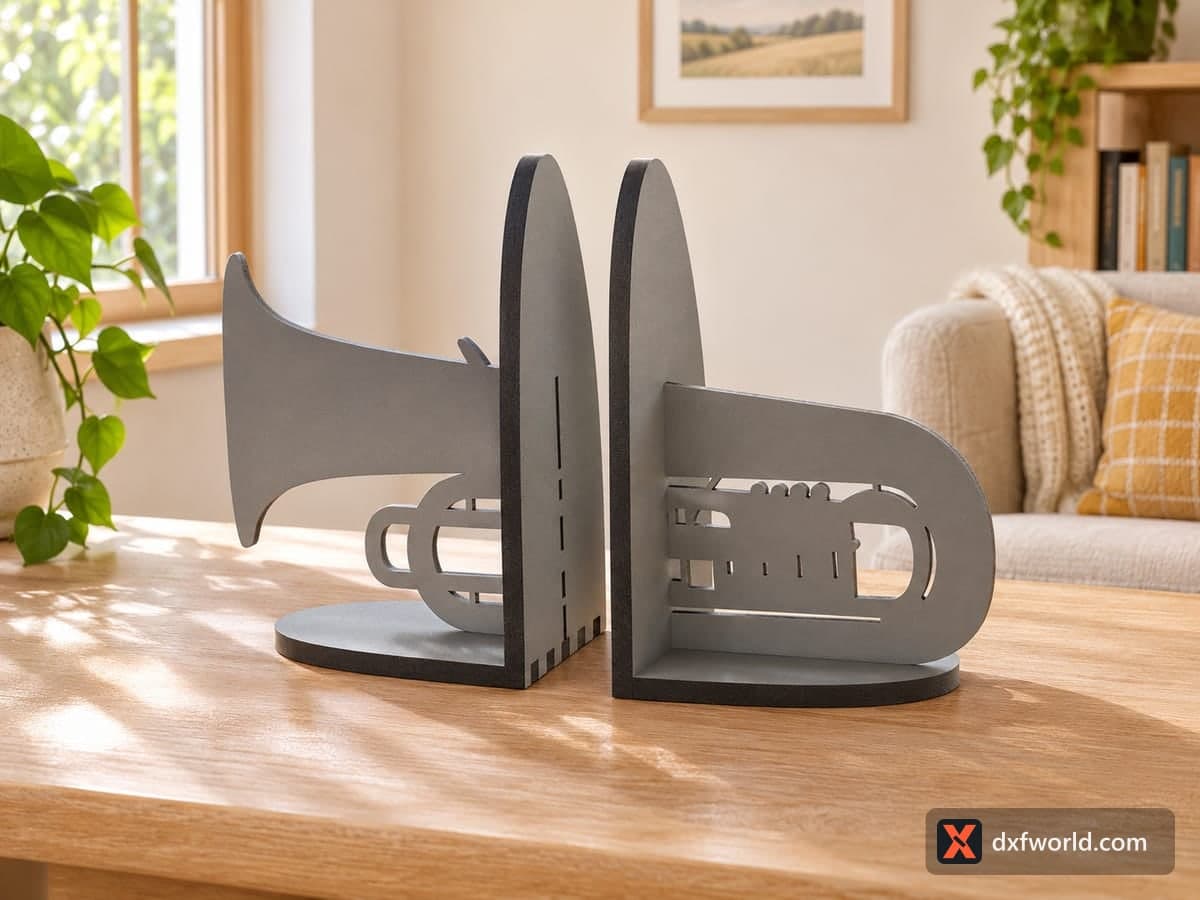
A pair of bookends that together show a tuba split in two: one carries the flared bell and the mouthpiece, the other the valves and the curved tubing, so the instrument looks whole when the books stand between them. Downloadable free as SVG or DXF, it has six parts, two tuba halves, two pointed-arch uprights and two rounded bases, laid out in 392.4 × 213.3 mm (15.45 × 8.40 in).
- Formats
- SVG, DXF
- Size
- 392 × 213 mm (15.45 × 8.40 in)
- Material
- Plywood, MDF, acrylic or metal (scale to your piece)
- Cut length
- 3.95 m
- Est. time, 10 W diode (3 mm)
- 13 min 10 s
- Est. time, 40 W CO2 (3 mm)
- 5 min 29 s
- Layers
- CUT only, no engraving
Free account required to download
How to make it
- 01Measure a finger joint, choose sheet to match and test-fit one upright into one base.
- 02Cut both tuba halves, both uprights and both bases.
- 03Join each upright to its base with the finger joints, then slot the tuba halves into the uprights and bases.
- 04Glue the joints, paint or seal the bookends and add felt pads under the bases.
The six parts
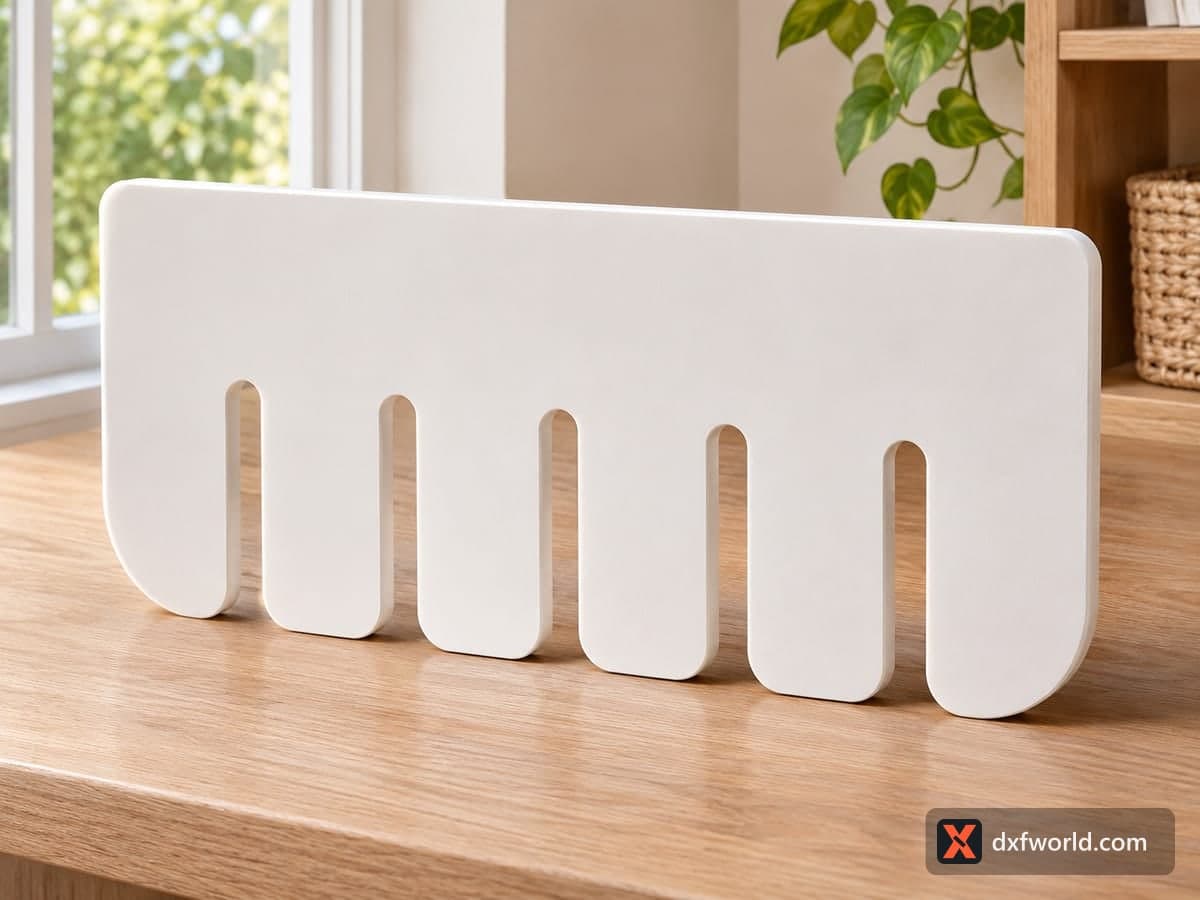
Each bookend has three pieces. The tall upright has a pointed arch top, a central vertical slot and a row of fingers along its bottom edge. The base is a rounded plate with matching fingers on its straight end and one or two short slots. The tuba half stands at a right angle to the upright: its flat edge has tabs that lock into the upright slot, and a foot tab that drops into the base. The left half shows the wide bell and the mouthpiece, the right half the valve block with its little buttons and the round coil, cut in fine slots that show the tubing.
Material and cutting
No thickness is marked for the fingers and slots, so the finger depth you read on screen decides between plywood, MDF or acrylic; join one base and one upright as a trial. Plywood of 6 mm or thicker makes the bookends heavy enough to hold a row of books; if your joints fit thinner sheet, glue a strip of felt or a steel washer under the base for grip and weight. The photo shows them in a dark grey matte finish, which hides the burnt edges.
Gift ideas
These suit a music teacher, a school band member, a tuba or sousaphone player or a shelf of sheet music. Paint the tuba halves gold and the uprights black for a brass look, or engrave a name on the base. Sold as a pair they make an easy item for a music fair stall.
Questions about this file
Which half goes on which side?
Put the bell half on the left and the valve half on the right, so the tuba reads in one piece across the books.
Will they hold heavy books?
The base sits under the books, so their weight keeps the bookend in place. For tall hardbacks, use thicker material or add weight under the base.
Can I cut them from acrylic?
Yes, gold mirror acrylic for the tuba halves and black acrylic for the uprights looks striking. Match the acrylic thickness to the joints.
What thickness do the joints need?
It is not printed. Equal to the finger depth, which you can read in any vector editor.
Can I change the instrument?
The upright and base work with any flat shape that has the same tabs, so you can draw a trumpet or a horn on the same tab positions.
Similar files