 Visualization
Square Lattice Wall Art DXF, Geometric Lens Pattern Panel SVG, Moroccan Style Tile Laser Cut File
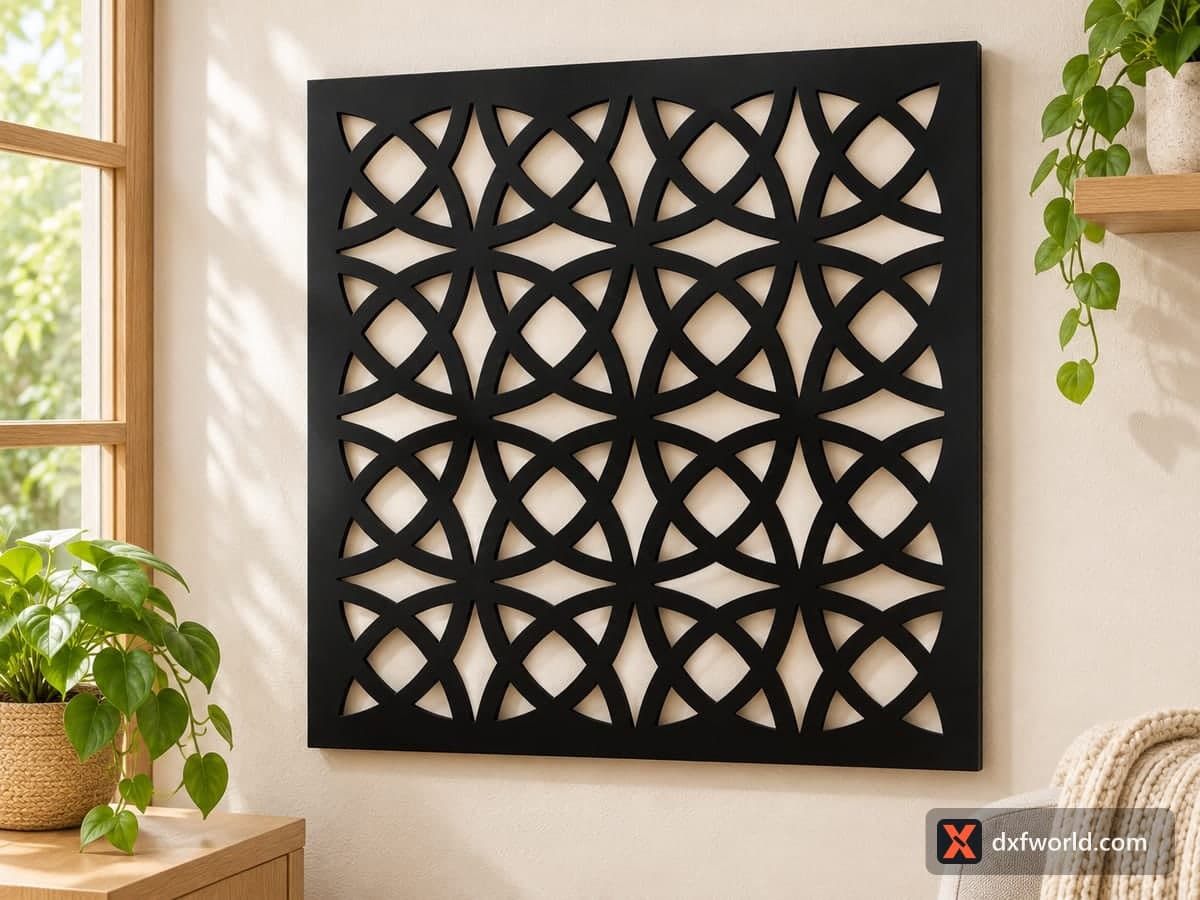
A nearly square lattice panel, 177 × 178 mm (6.97 × 7.01 in), with a solid border and a 4 × 4 grid of rounded diamonds, pointed lens shapes and small curved triangles, so the material left between them forms overlapping circles. The free download is one SVG and one DXF file with cut lines only, which you can scale or repeat as tiles for a wall panel, cabinet door or screen.
- Formats
- SVG, DXF
- Size
- 177 × 178 mm (6.97 × 7.01 in)
- Material
- Plywood, MDF, acrylic or metal (scale to your piece)
- Cut length
- 4.41 m
- Est. time, 10 W diode (3 mm)
- 14 min 42 s
- Est. time, 40 W CO2 (3 mm)
- 6 min 07 s
- Layers
- CUT only, no engraving
Free account required to download
How to make it
- 01Pick the tile size you want and scale the file evenly; 177 mm is the smallest sensible size.
- 02Cut one tile from your sheet and check that the small triangles and arcs come out clean.
- 03Cut the remaining tiles and sand the burn marks off the faces.
- 04Paint them, then fix them to the wall on spacers or set them into a door or frame.
How the pattern is built
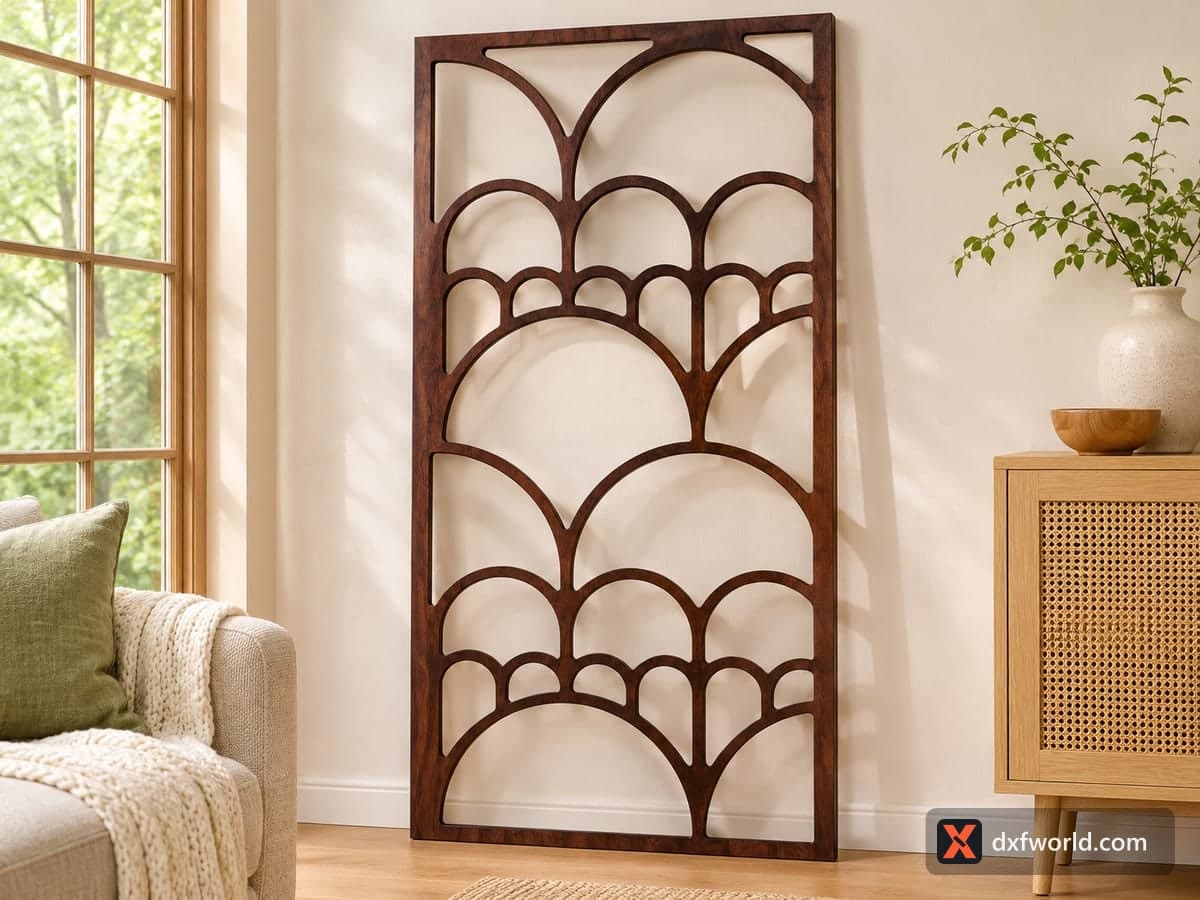
Each of the 16 cells has a rounded diamond in the middle, four small curved triangles around it and long lens shapes on the cell edges that are shared with the neighbours. Together the holes leave a web of arcs that reads as interlocking circles, a pattern often seen on Moroccan and Indian screens. The border is solid and about 5 mm wide at the drawn size. In the photo the panel is cut in black and hung flat on a cream wall like a framed tile.
Scaling and tiling
Because the panel is almost square and the pattern stops at a clean border, you can cut several and butt them together to cover a wall, a bed headboard or a large cabinet front. Scaled to 450 or 600 mm, it suits 6 to 9 mm MDF on a laser or a CNC router. Below the drawn size the small triangles get tiny and the arcs between them thin out, so keep it at 177 mm or larger.
Finishing ideas
Spray it black or deep blue and mount it 10 to 15 mm off the wall on spacers, so a shadow outline appears behind it. Raw birch plywood looks good as a cupboard door insert with fabric or cane behind it. A set of four tiles in a 2 × 2 block makes a simple, inexpensive piece to sell at craft markets.
Questions about this file
Can I join several panels into one large screen?
Yes. Each tile has a solid border, so cut as many as you need and butt them edge to edge on a backing board or frame.
Is there a maximum size for this lattice tile?
There is no real upper limit; at 600 mm or more it is ideal for a CNC router and thicker MDF.
What thickness fits the drawn size?
3 to 4 mm plywood, MDF or acrylic works well for a 177 mm tile.
Would the lens lattice work inside a cupboard door?
Yes, scale it to the door opening and set it into a rebated frame, with fabric or mesh behind it if you want to hide the contents.
Why does it look like circles when the holes are diamonds?
The material left between the lens and diamond holes forms arcs, and those arcs join into overlapping rings across the whole panel.
Similar files