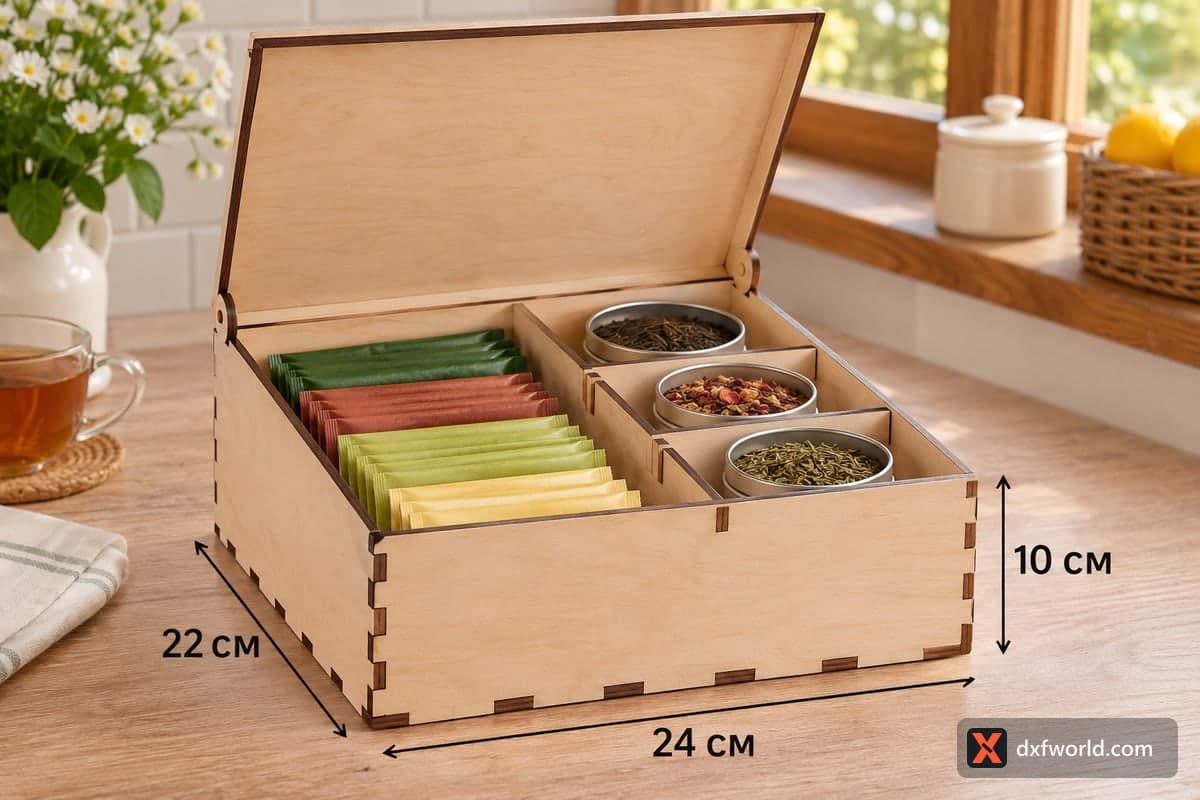
 Visualization
Two Bay Hinged Tea Box DXF, Flip Lid Tea Bag and Tin Chest SVG, Square Wooden Tea Box Laser Cut File
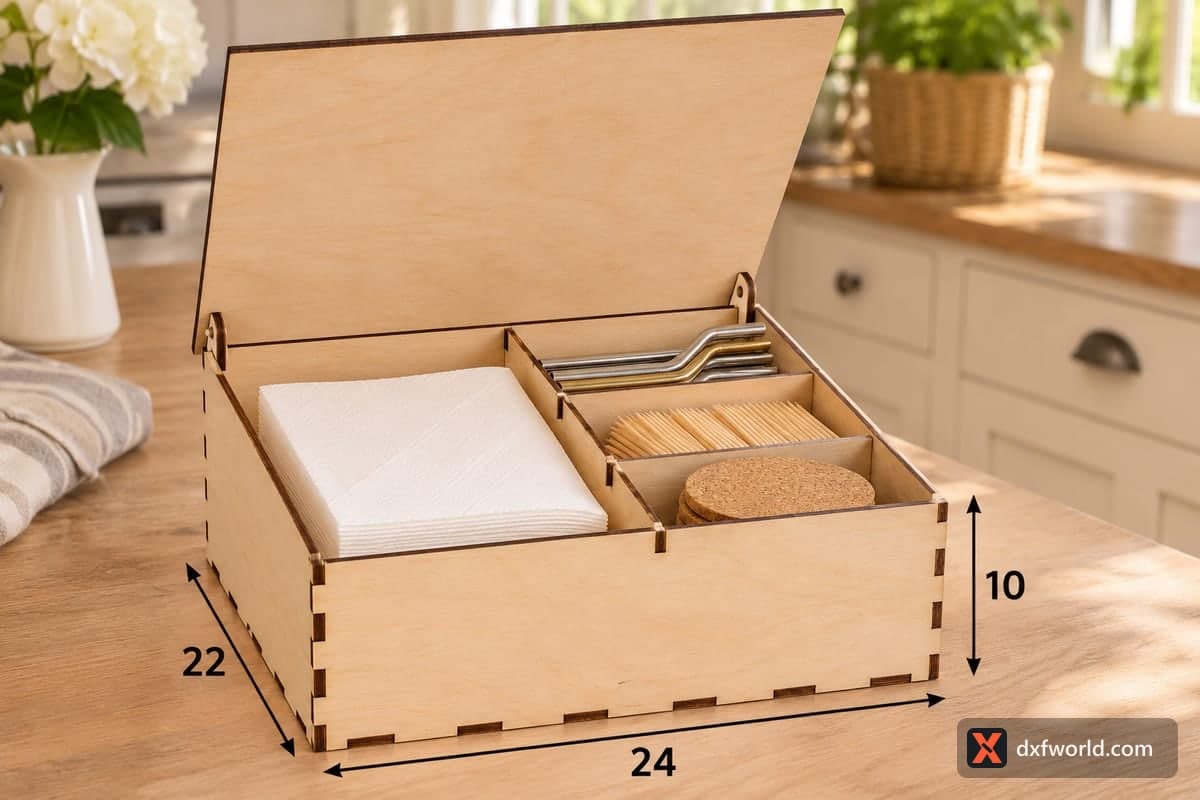
A free laser cut file for a near-square tea box with a lid that flips open, in SVG and DXF with separate versions for 3, 4, 5 and 6 mm plywood. It measures 240 × 220 × 100 mm (9.45 × 8.66 × 3.94 in) and has two compartments, one for tea bags and one for tins. The 7 pieces join with tabs and slots, and the lid pivots at the back on pins cut into the plywood.
- Formats
- SVG, DXF
- Outer size (W × D × H)
- 240 × 220 × 100 mm (9.45 × 8.66 × 3.94 in)
- Parts
- 7
- Material thickness
- 3, 4, 5 or 6 mm plywood (a file for each)
- Layout size (3 mm file)
- 940 × 336 mm
- Cut length
- 6.21 m
- Est. time, 10 W diode (3 mm)
- 20 min 42 s
- Est. time, 40 W CO2 (3 mm)
- 8 min 37 s
- Layers
- CUT only, no engraving
Free account required to download
How to make it
- 01Open the version for your plywood and cut a single pin and its matching hole on scrap to see how freely the lid will turn.
- 02Cut the 7 pieces: base, front, back, two side panels, the divider and the lid.
- 03Assemble the base and walls, slide in the divider, and add the lid last so its pivot pins seat at the back.
- 04Swing the lid open and shut a few times, sand any rubbing spot, then finish everything except the pins.
Inside the box
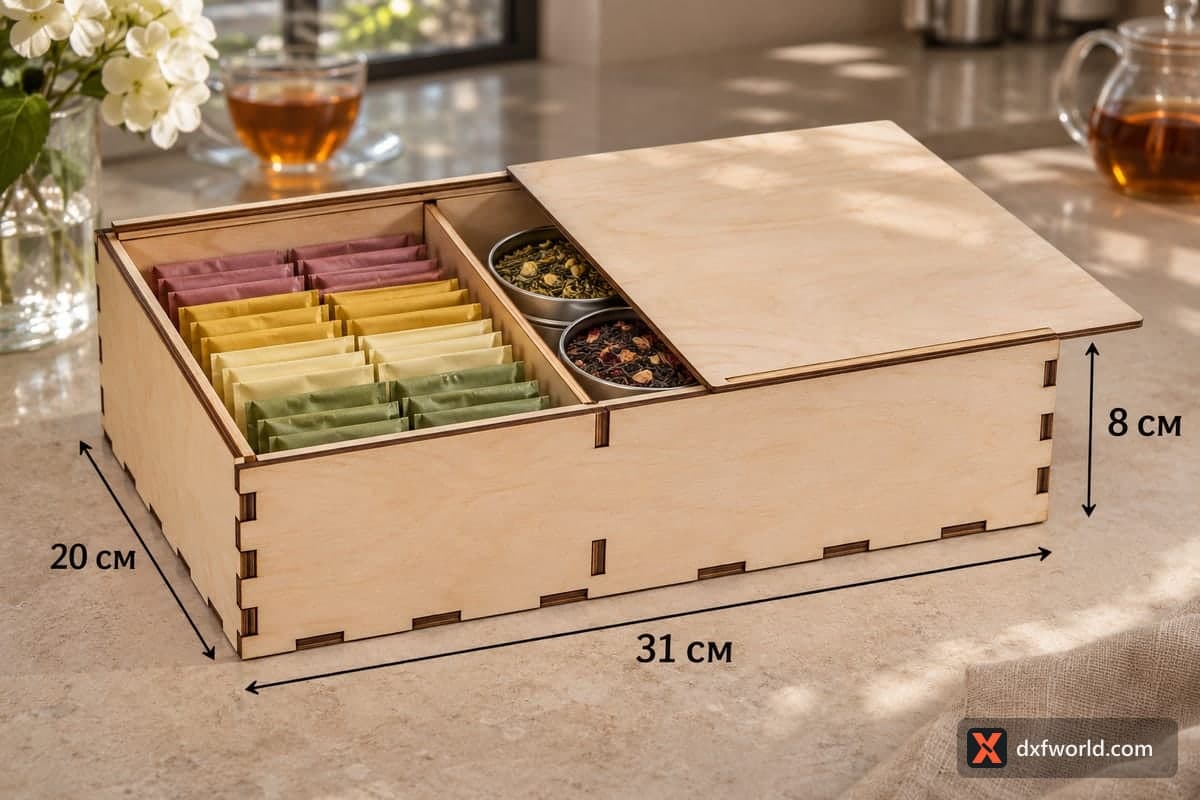
One divider splits the box into a tea bag bay on the left and a narrower column on the right. The divider is 86 mm tall, below the walls, so the lid closes flat over it. In the photo the left bay holds rows of green, red, light green and yellow tea bags, and the right column is split into three small cells, each with a tin of loose tea. Those two short cross pieces are not in the file. If you want the same three cells, cut two strips from offcuts as wide as the column and as tall as the divider, and glue them in.
The pin hinge
The lid pivots on pins cut as part of the plywood at the back, so the joint is only as good as the fit of those pins. Cut a test with your actual sheet before the full layout, keep paint and lacquer off the pivot points, and open and close the lid a few times before any glue sets. The front wall is slightly lower than the back so the lid rests on it when closed.
Cutting time and sheet size
The pieces need a 940 × 336 mm area; the base and lid can go on a separate sheet for smaller beds. For the 3 mm file it takes about 20 min 42 s on a 10 W diode, about 8 min 37 s on a 40 W CO2 or about 4 min 08 s on a 100 W CO2. Filled with three loose teas and a handful of bags, it makes a thoughtful gift for a new neighbour or a tea-loving colleague, and the plain lid takes an engraved name or date if you add one.
Questions about this file
What goes in the right-hand column?
Small round tins of loose tea; in the photo three of them sit one behind another. Add two strips from scrap if you want each tin in its own cell.
Which sheet thickness lets the pinned lid swing most freely?
3 or 4 mm birch turns most freely on its pins; 6 mm feels heavier and needs a precise test cut.
Can I store coffee pods in it instead?
Yes, the 100 mm height leaves room for capsules standing upright in the narrow column or lying in the larger bay.
How do I keep the box looking good near the kettle?
Seal it with two thin coats of water-based lacquer, but leave the pin joints bare so they keep turning.
Can the lid be engraved?
Yes, the lid is a flat 240 × 216 mm panel with room for a name, a monogram or a tea leaf motif you engrave.
Similar files