 Visualization
Six Cell Sloped Tea Organizer SVG, Low Front Tea Tin and Bag Holder Laser Cut File, Two Row Wooden Tea Rack DXF
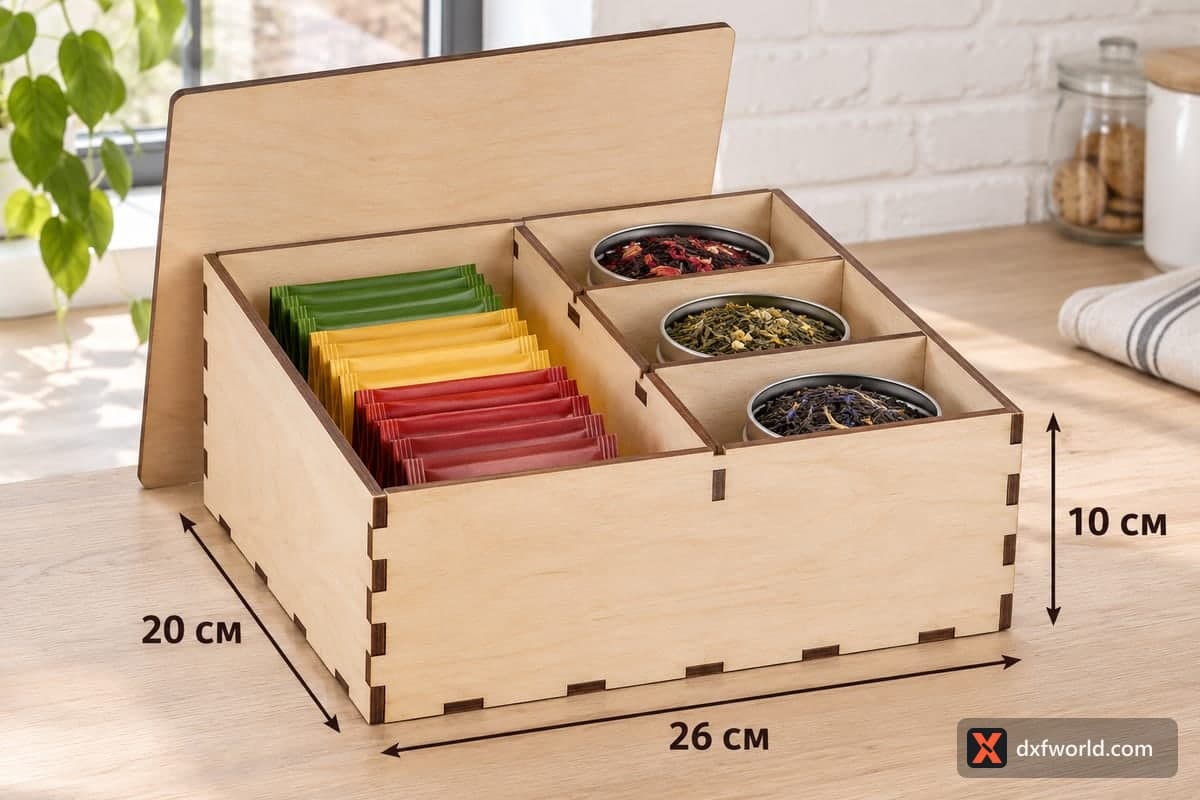
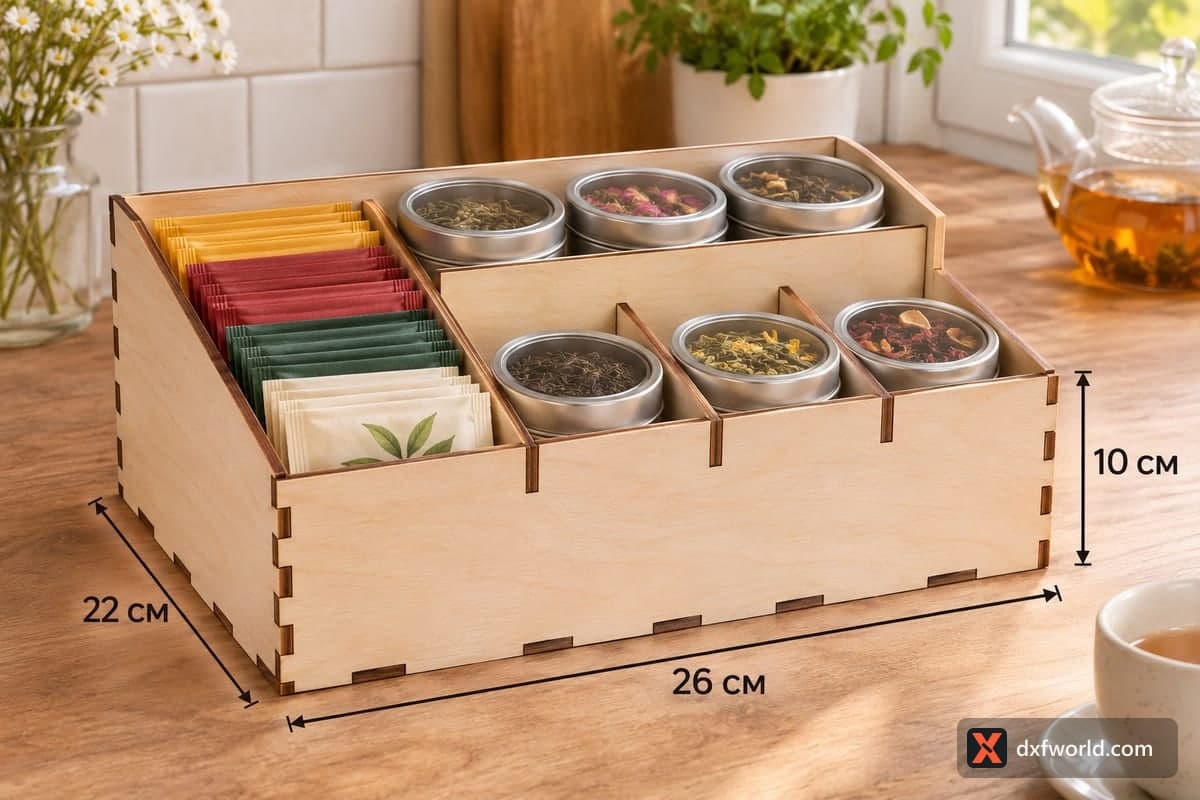
A free sloped tea organizer with six cells, given as SVG and DXF laser cut files with separate versions for 3, 4, 5 and 6 mm plywood. It measures 260 × 220 × 100 mm (10.24 × 8.66 × 3.94 in); the front wall is 60 mm high and the sides slope up to a 100 mm back, giving a low front row of three cells and a taller back row of three. It is cut as 8 pieces that assemble with tabs and slots.
- Formats
- SVG, DXF
- Outer size (W × D × H)
- 260 × 220 × 100 mm (10.24 × 8.66 × 3.94 in)
- Parts
- 8
- Material thickness
- 3, 4, 5 or 6 mm plywood (a file for each)
- Layout size (3 mm file)
- 980 × 332 mm
- Cut length
- 6.60 m
- Est. time, 10 W diode (3 mm)
- 22 min 00 s
- Est. time, 40 W CO2 (3 mm)
- 9 min 10 s
- Layers
- CUT only, no engraving
Free account required to download
How to make it
- 01Load the cut file sized for your sheet thickness and run a test slot on a strip of scrap first.
- 02Cut the 8 pieces: base, back, low front, two sloped sides, two long dividers and the full-width cross divider.
- 03Stand the back and sides in the base, slot the long dividers in, add the cross divider over them, then fit the front.
- 04Sand the sloped edges, finish with clear lacquer, and put tins in the back row and bags where they are easiest to grab.
Two rows, three columns
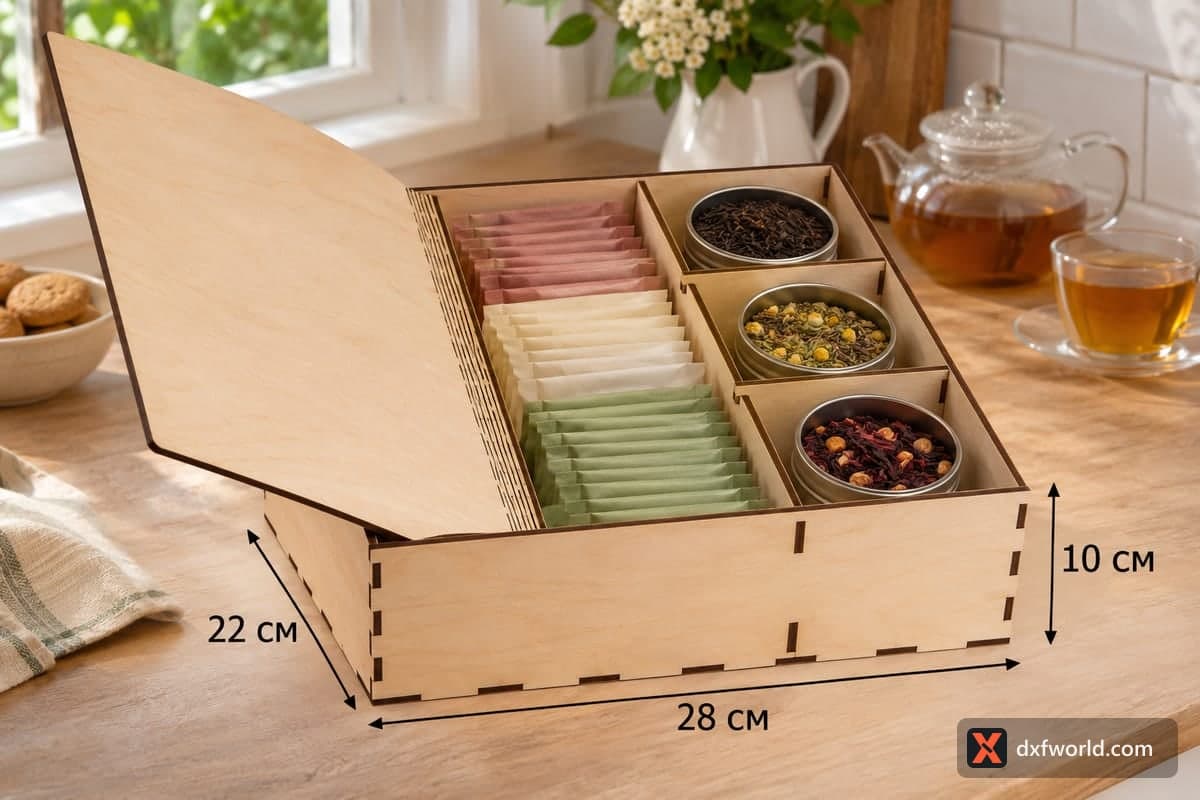
Two long dividers run from front to back and one cross divider spans the full width, so the box is split into three columns, each with a front and a back cell. The cross divider is about 78 mm tall, lower than the back wall, which lets the back row show over the front one. In the photo a tall stack of yellow, red, green and white tea bags fills the left side while six round tins of loose tea sit in two rows to the right. The file is simpler than that: three columns, each cut in two by the cross divider, so use the left pair of cells for bags and the other four for tins or sachets.
Getting a clean slope
The sides are cut as sloped panels, and the front wall is 40 mm shorter than the back. Assemble the back and sides first, then the long dividers, then the cross divider, and close with the low front. For the 3 mm file allow about 22 min 00 s on a 10 W diode, about 9 min 10 s on a 40 W CO2 or about 4 min 24 s on a 100 W CO2. The full layout measures 980 × 332 mm; on a 400 × 400 mm bed, cut the base by itself and spread the walls over two more sheets.
Where it works well
A tea shop can use it as a tasting counter with six blends on show. At home it sits under the kettle shelf with the daily tea bags in front. Sell it as a set with a matching coffee pod tray, or engrave a name on the back wall for a personal gift.
Questions about this file
What is the difference between the front and back cells?
The front cells sit behind a 60 mm wall, so short items are easy to see; the back cells have the 100 mm back wall and suit taller tins or upright bags.
Can I make the left column one long bay like the photo?
The cross divider spans all three columns, so you would have to shorten it in your design software before cutting.
Is it sturdy enough for a cafe?
In 5 or 6 mm plywood with a drop of glue in each joint it copes with daily use on a busy counter.
Can the organizer be sealed against spills?
Two coats of water-based polyurethane protect it from tea drips; wipe spills quickly, since plywood edges soak up liquid.
Will it hold coffee capsules?
Yes, the cells take standard capsules lying down or stacked, so one column can hold coffee while the others keep tea.
Similar files