 Visualization
Upright Napkin Caddy With Straw Pocket SVG, Sloped Table Caddy Laser Cut File, Three Compartment Organizer DXF
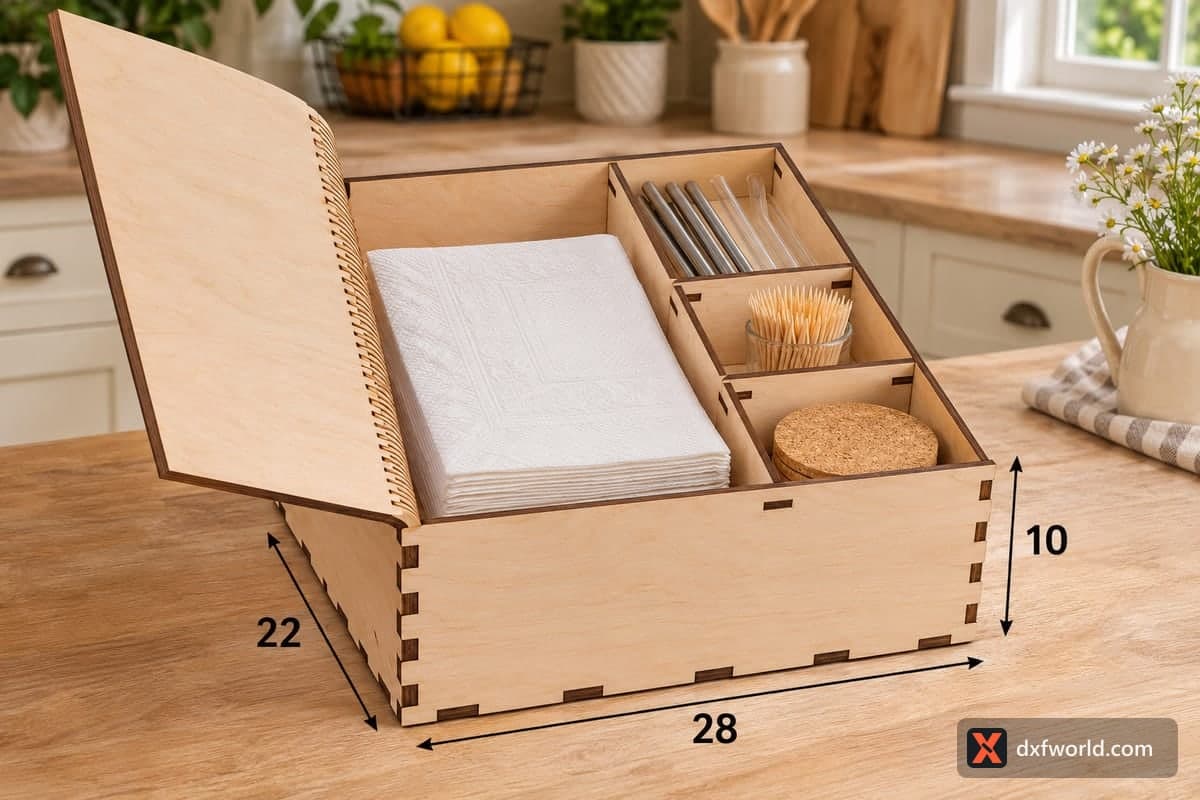
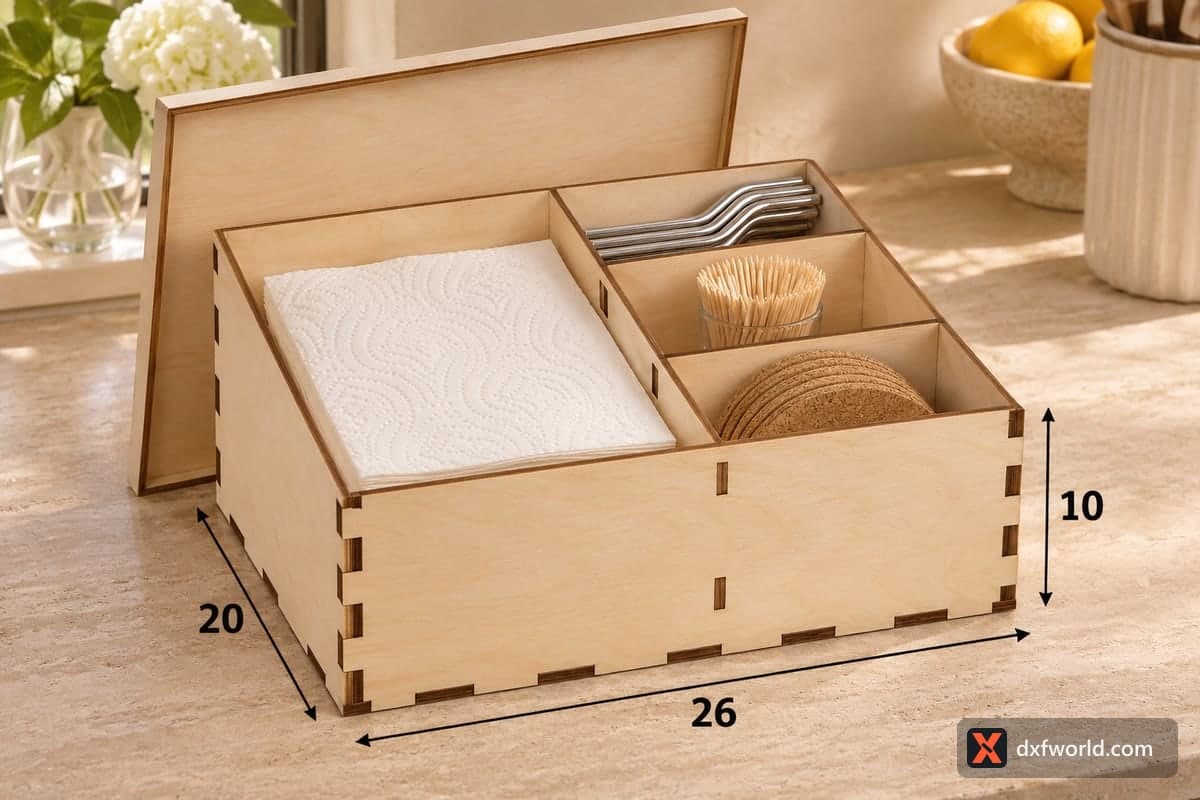
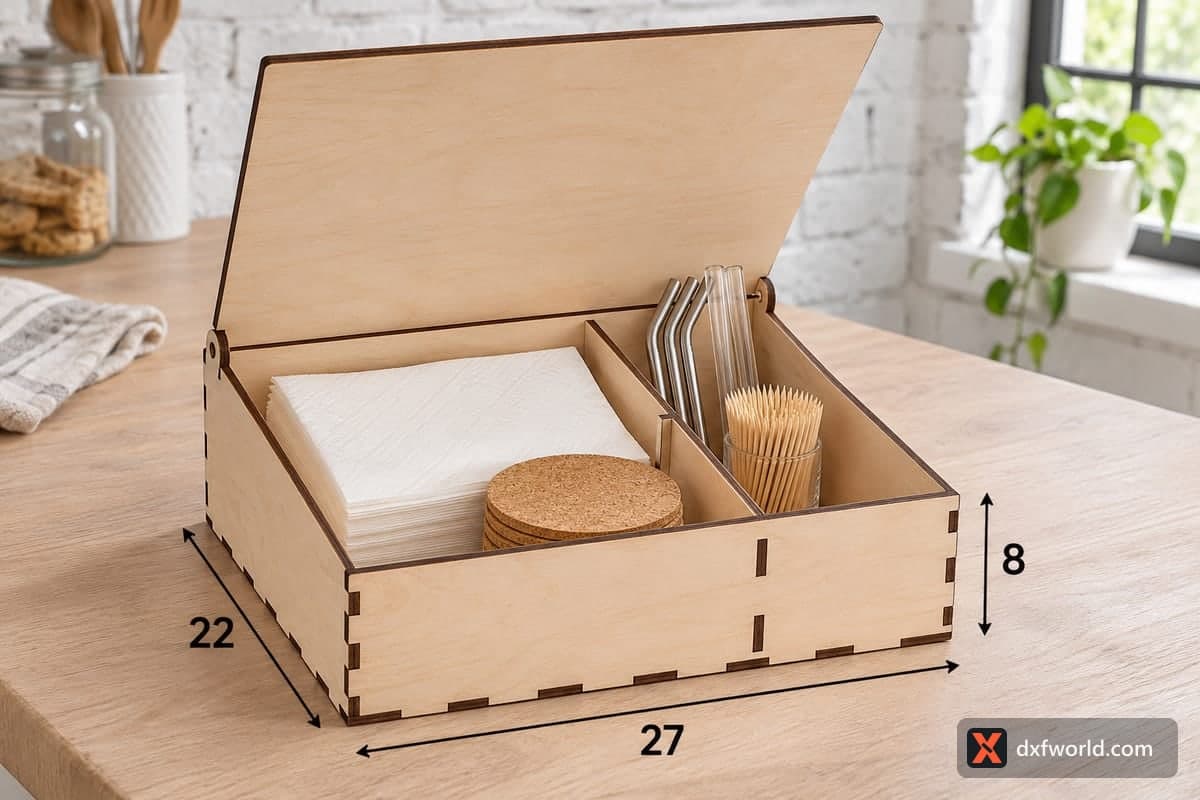
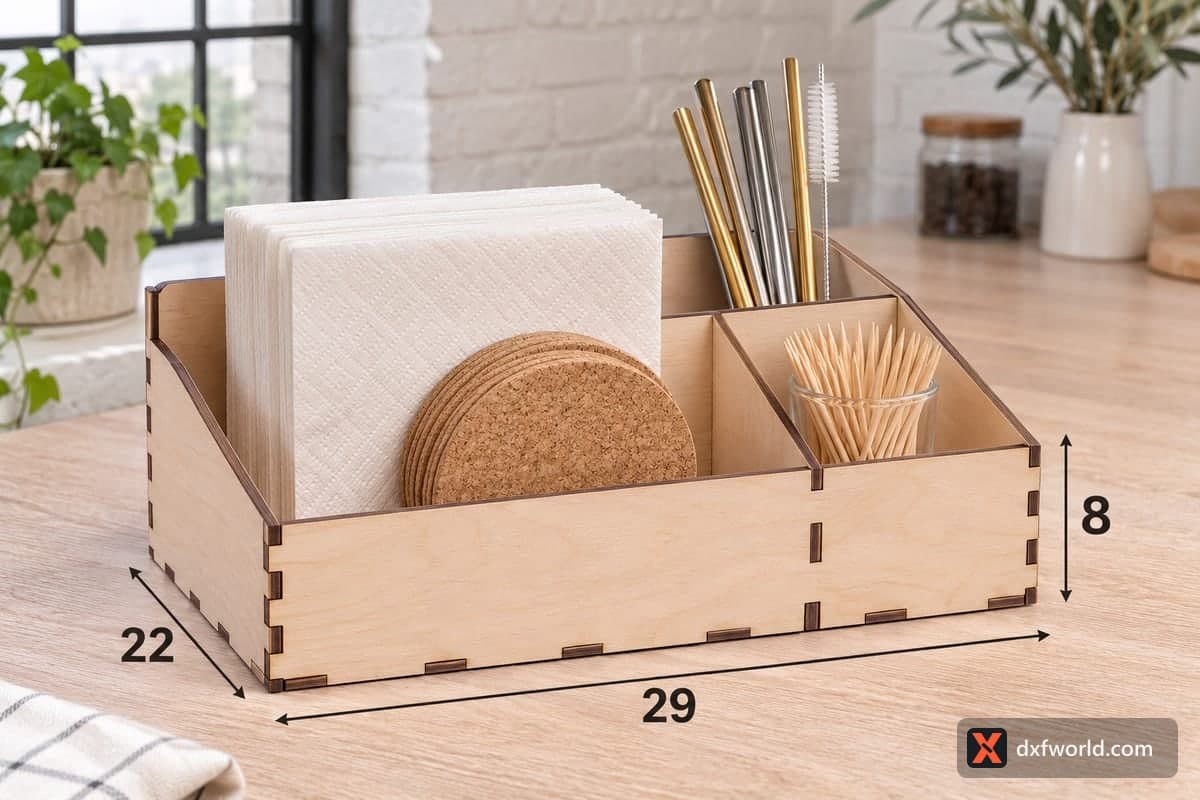
A free sloped table caddy with three compartments: a wide bay where napkins and coasters stand upright, and a right side split into a back pocket for straws and a front pocket for toothpicks. The download has SVG and DXF files for 3, 4, 5 and 6 mm plywood; the caddy measures 290 × 220 × 80 mm (11.42 × 8.66 × 3.15 in), has a 56 mm front with sloped sides, and goes together from 7 tab-and-slot pieces.
- Formats
- SVG, DXF
- Outer size (W × D × H)
- 290 × 220 × 80 mm (11.42 × 8.66 × 3.15 in)
- Parts
- 7
- Material thickness
- 3, 4, 5 or 6 mm plywood (a file for each)
- Layout size (3 mm file)
- 1,040 × 312 mm
- Cut length
- 5.16 m
- Est. time, 10 W diode (3 mm)
- 17 min 12 s
- Est. time, 40 W CO2 (3 mm)
- 7 min 10 s
- Layers
- CUT only, no engraving
Free account required to download
How to make it
- 01Pick the file that matches your plywood, cut a test slot and check the tab fit before the full job.
- 02Cut the 7 pieces, using two sheets on a bed shorter than 1040 mm.
- 03Set the back, sloped sides and low front into the base, slide in the long divider, then the short cross divider on the right.
- 04Ease the sloped edges with sandpaper, oil the caddy, and stand napkins upright in the wide bay.
Layout of the three compartments
A full-depth divider separates a wide left bay from a narrower right side, and a short cross divider, 67.8 mm tall and lower than the walls, splits that right side into a back and a front pocket. In the photo, white napkins stand on edge in the left bay with cork coasters leaning in front of them, gold and steel straws and a straw brush stand in the back pocket, and a glass of toothpicks sits in the front pocket. The front wall is 56 mm against an 80 mm back, and the sides slope down between them, so everything stays visible from a chair.
Machine time and sheet size
The pieces fill a 1040 × 312 mm layout, so on a 400 × 400 mm bed cut the base with one long wall and send the rest in a second job. For the 3 mm file: about 17 min 12 s on a 10 W diode, about 7 min 10 s on a 40 W CO2, about 3 min 26 s on a 100 W CO2. Choose 4 mm plywood if the caddy will be moved around a lot; 6 mm makes it heavy enough not to tip when napkins are pulled, but a diode then needs several passes. Glue is optional, since the tabs lock firmly.
Finishing and ideas
Round over the sloped side edges with fine sandpaper, then oil the whole caddy. Sell it as a set with reusable straws, make a matched pair for a long dining table, or engrave a cafe logo on the back wall as your own extra layer. Off the table it works on a desk too, with notepads in the wide bay and pens and clips in the two pockets.
Questions about this file
Do napkins stand or lie in this caddy?
They stand on edge in the wide bay, as in the photo, which saves counter space and lets guests pull out one at a time.
What is the point of the short cross divider?
At 67.8 mm it fits under the sloping side edges. The front pocket stays open and easy to reach.
Could the caddy be scaled for full-size dinner napkins?
Scale the whole drawing and then reset the slot widths to your actual plywood thickness, or the tabs will not lock.
Is acrylic a good material for this caddy?
Yes, 3 mm cast acrylic cuts cleanly on a CO2 laser; use the file that matches the measured sheet. A diode beam passes through clear acrylic without cutting it.
Will drinks stain it?
Seal it with water-based polyurethane or hardwax oil and wipe spills quickly. Unsealed plywood marks easily from coffee and soda.
Similar files