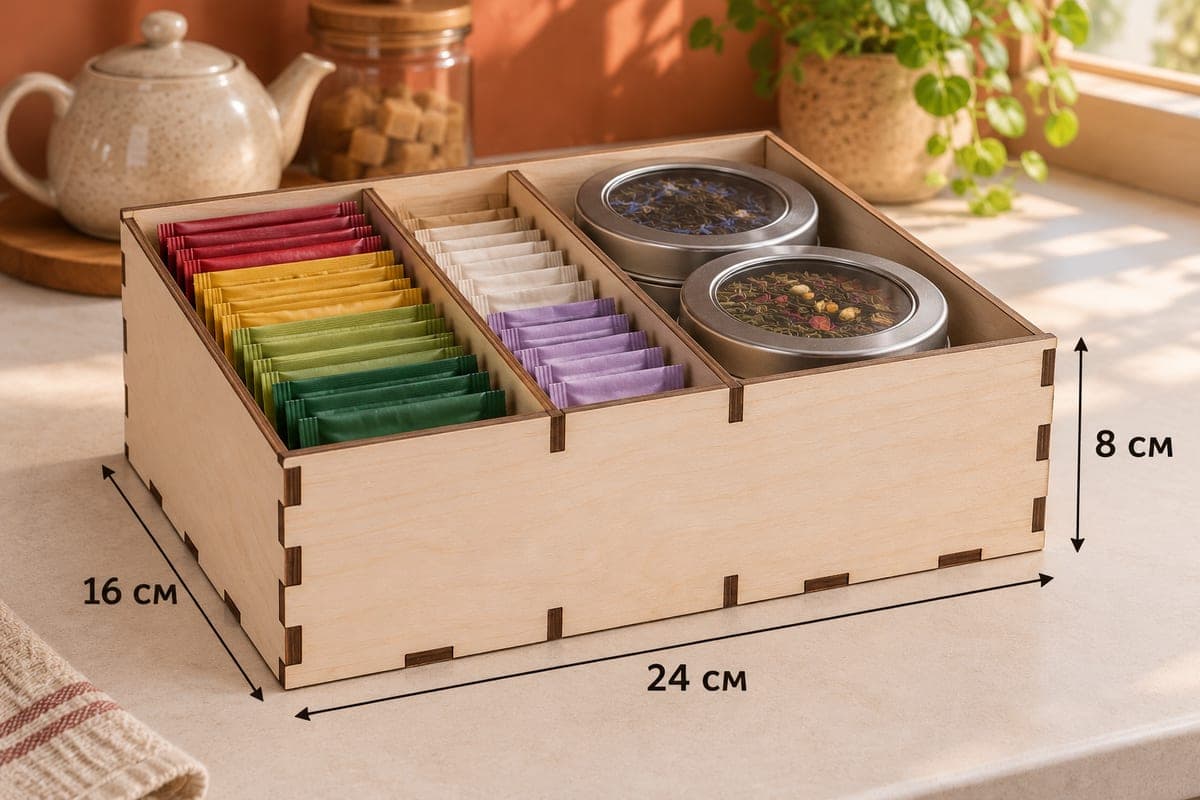
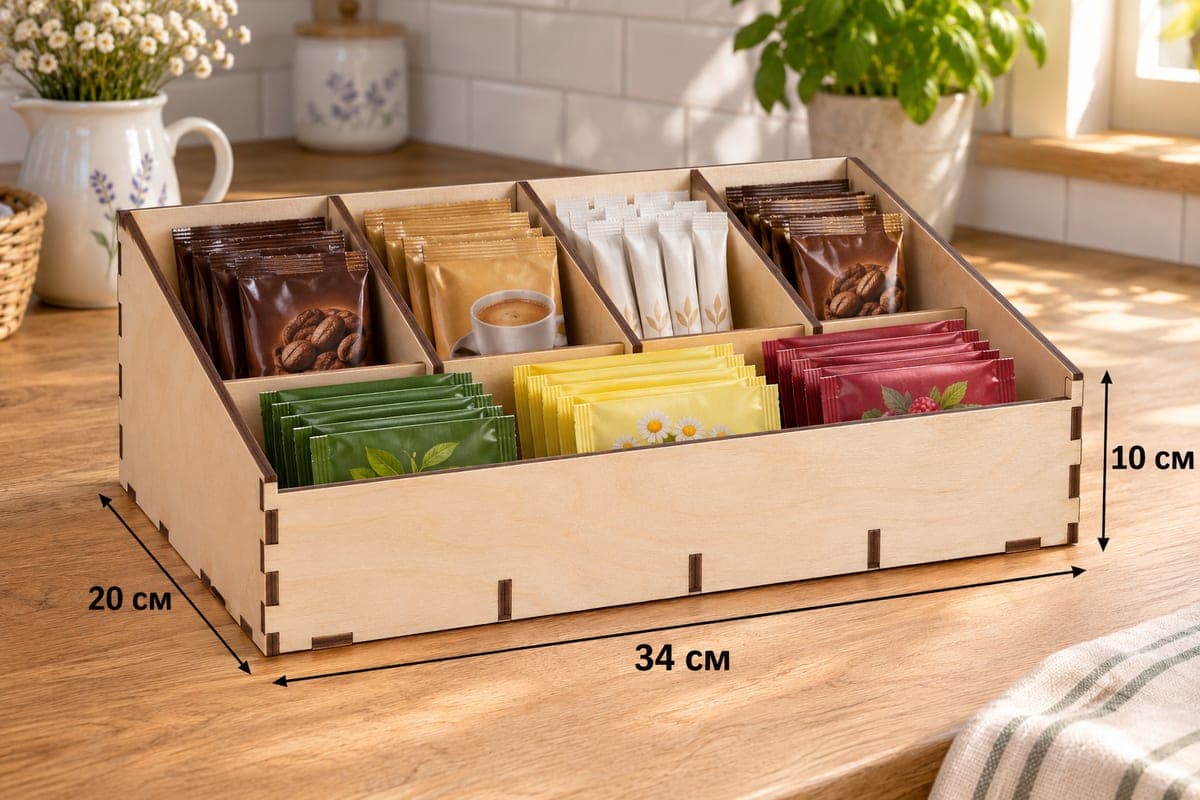
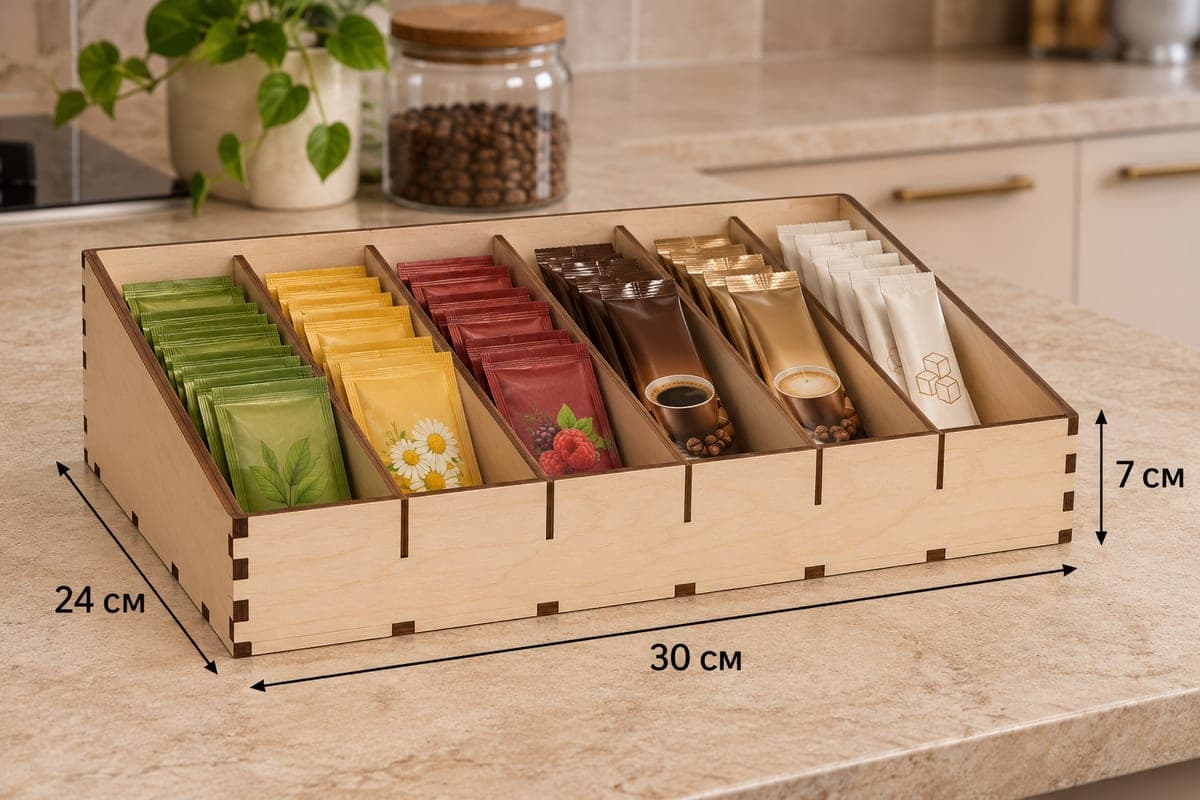
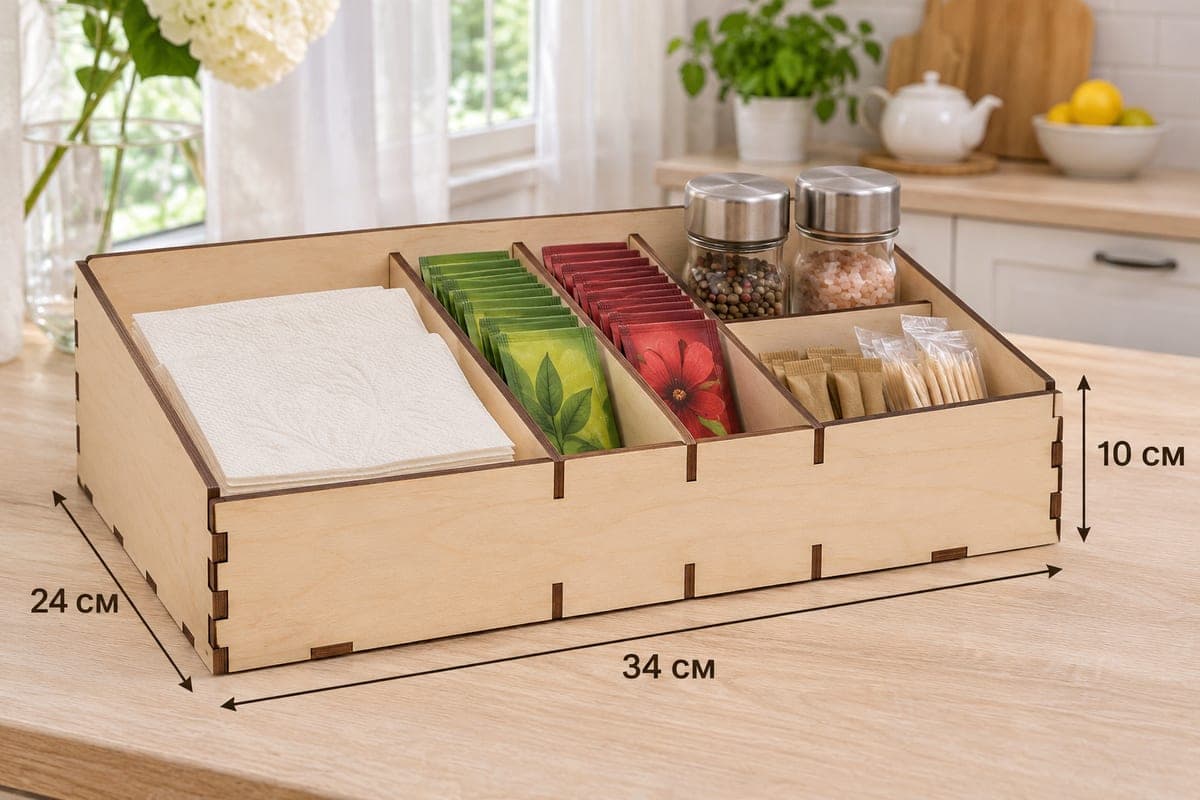
 Visualization
Tea Jar Organizer SVG, Five Compartment Tea Caddy Laser Cut File, Loose Leaf and Tea Bag Box DXF, Tea Station Tray
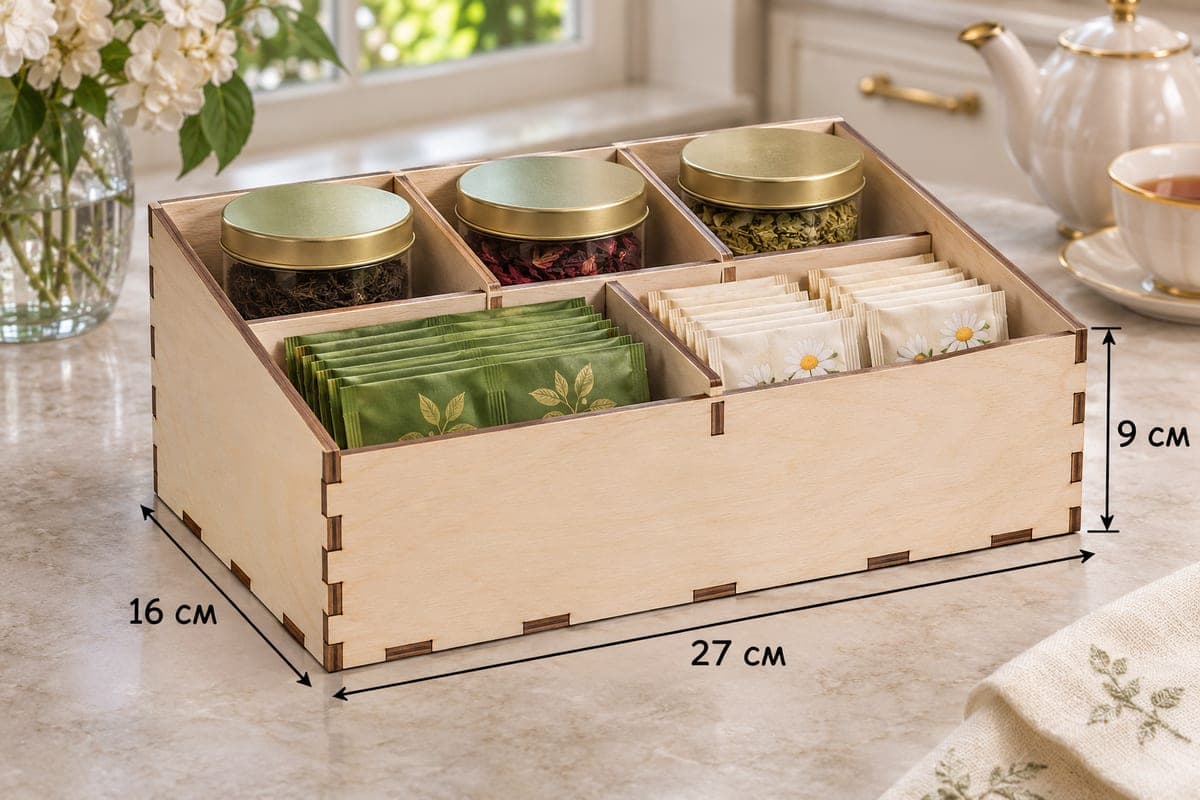
A free open tea organizer with a lower front and sloped sides and 5 compartments in two rows: three at the back for loose-leaf jars and two at the front for tea bags. It is supplied as SVG and DXF with separate files for 3, 4, 5 and 6 mm plywood, measures 270 × 160 × 90 mm (10.63 × 6.30 × 3.54 in) and goes together from 9 pieces with tabs and slots.
- Formats
- SVG, DXF
- Outer size (W × D × H)
- 270 × 160 × 90 mm (10.63 × 6.30 × 3.54 in)
- Parts
- 9
- Material thickness
- 3, 4, 5 or 6 mm plywood (a file for each)
- Layout size (3 mm file)
- 880 × 262 mm
- Cut length
- 5.63 m
- Est. time, 10 W diode (3 mm)
- 18 min 46 s
- Est. time, 40 W CO2 (3 mm)
- 7 min 49 s
- Layers
- CUT only, no engraving
Free account required to download
How to make it
- 01Choose the folder for your plywood thickness and cut a single test slot to check that tabs go in snug but not forced.
- 02Cut the base, low front, tall back, two sloped sides, the long cross divider, the short front divider and the two taller back dividers.
- 03Slot the three short dividers onto the cross divider, set the grid in the base, then add the back, sides and finally the low front.
- 04Sand and seal, then place jars in the three back cells and tea bags in the two front bays.
Jars at the back, bags at the front
A cross divider runs the full 270 mm width and splits the box into two rows. The back row is divided into three square-ish cells, each about 80 mm deep, which in the photo hold glass jars with gold lids: dark leaf, dried hibiscus and green tea. The front row has a single divider and two wider bays, one stacked with green tea envelopes and the other with white chamomile sachets. The front wall drops to 54 mm against the 90 mm back, so the sides slope and the bags in front never block the jar labels behind them.
The cross divider and the front-row divider are about 72 mm tall, while the two back dividers rise to the full 90 mm, keeping the jars well separated.
Making the five-compartment version
The 9 pieces fit on an 880 × 262 mm layout; a 500 mm bed handles it in two sheets with the base on its own. The 3 mm file cuts in about 18 min 46 s on a 10 W diode, about 7 min 49 s on a 40 W CO2 and about 3 min 45 s on a 100 W CO2. At 5 and 6 mm, a diode needs slow repeated passes, so a CO2 is the faster route for the thicker files.
Start by locking the short dividers onto the long cross divider, then lower that grid into the base. Walls go on last. Glue is optional.
Ideas
- Sell it with three matching jars as a loose-leaf starter set.
- Hotels and B&Bs use this kind of tray for in-room tea.
- Engrave the tea names on the cross divider yourself for a labelled look.
Oil or lacquer protects it from the occasional wet spoon.
Questions about this file
What size jars fit in the back row?
Each back cell is roughly 80 mm square inside, so round jars up to about 75 mm across fit, like the gold-lid jars in the photo.
Can the jars be taller than the box?
Yes. The box is open, so tall jars simply stand above the 90 mm back wall.
Is the front row deep enough for tea bags?
The front bays sit between the low front and the cross divider and hold standard wrapped bags lying back at a slight angle.
Can I make it from 3 mm acrylic for a hotel?
Use the 3 mm file and acrylic of the same thickness. Clear acrylic shows off the jars nicely, and a little acrylic cement locks the joints.
Which thickness should I pick?
Three or four millimetre plywood is plenty for jars and bags. Use 5 or 6 mm if you want a heavier piece for a shop counter.
Similar files