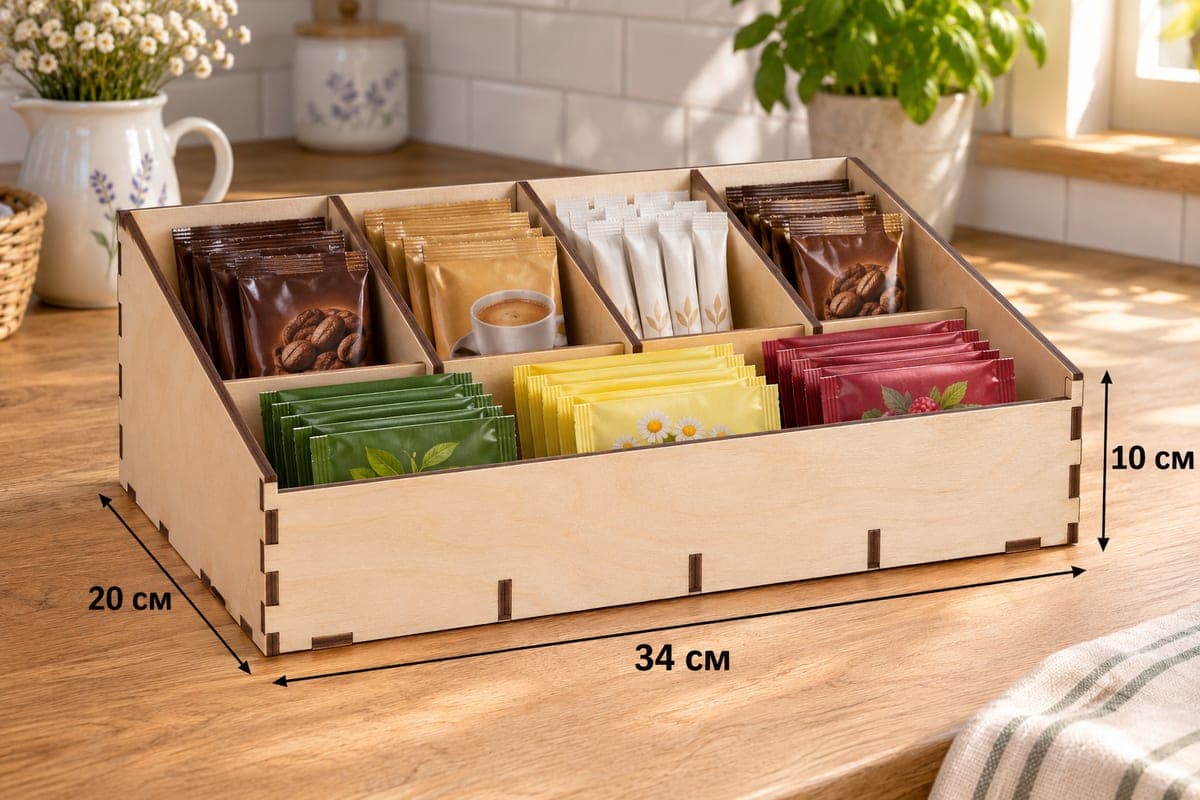
 Visualization
Coffee and Tea Caddy SVG, Seven Section Coffee Sachet Organizer Laser Cut File, Wide Tea Box DXF, Coffee Bar Storage
A wide coffee and tea caddy with seven sections: four upright slots at the back for coffee sachets and sugar sticks and three larger sections at the front for tea bags. The free download includes SVG and DXF files for 3, 4, 5 and 6 mm plywood; the caddy measures 340 × 200 × 100 mm (13.39 × 7.87 × 3.94 in), is made of 11 pieces joined with tabs and slots, and slopes from a 100 mm back to a 60 mm front.
- Formats
- SVG, DXF
- Outer size (W × D × H)
- 340 × 200 × 100 mm (13.39 × 7.87 × 3.94 in)
- Parts
- 11
- Material thickness
- 3, 4, 5 or 6 mm plywood (a file for each)
- Layout size (3 mm file)
- 1,229 × 312 mm
- Cut length
- 7.77 m
- Est. time, 10 W diode (3 mm)
- 25 min 55 s
- Est. time, 40 W CO2 (3 mm)
- 10 min 48 s
- Layers
- CUT only, no engraving
Free account required to download
How to make it
- 01Choose the file for your plywood thickness and cut a test slot to check that the dividers press in by hand.
- 02Cut all 11 parts across two or three sheets, keeping the three tall and two short dividers apart.
- 03Assemble base, back, sides and the 60 mm front, insert the cross divider, then the three tall back dividers and the two short front dividers.
- 04Sand the edges, apply clear lacquer, put coffee and sugar in the four back slots and tea in the three front sections.
Coffee behind, tea in front
At 340 mm this is the widest box in the tea and coffee set, and it uses the extra width for an odd number of sections. A full-width cross divider, 77.7 mm tall, splits it into two rows. The back row is the deeper one, about 111 mm, with three tall dividers and four slots; the front row is about 92 mm deep with two short dividers and three sections, so the front sections are wider than the back slots.
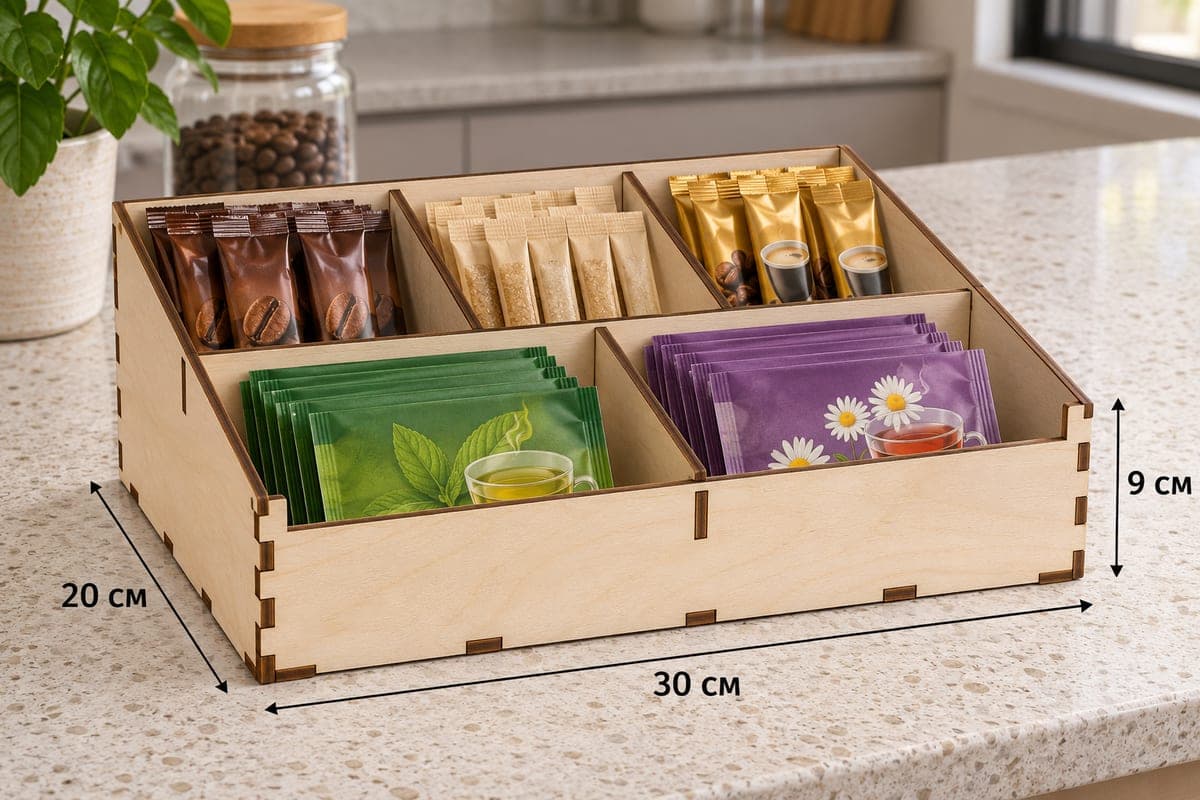
That fits the way most people stock a coffee corner. In the photo the four back slots hold dark coffee sachets, latte sachets, white sugar sticks and a second coffee, all standing tall against the 100 mm back wall. The three front sections hold green tea, chamomile and a red berry tea, whose square envelopes need the extra width.
Cutting and assembly
In the 3 mm file the pieces are arranged on 1229 × 312 mm. On most hobby lasers that means two or three sheets: the 340 mm base, back and front are the long parts, the rest are short. On the 3 mm file a 10 W diode spends about 25 min 55 s, a 40 W CO2 about 10 min 48 s and a 100 W CO2 about 5 min 11 s. With a diode, 3 mm plywood is the practical limit for a clean edge; 5–6 mm is a CO2 job.
Build the shell, drop in the cross divider, then add the three 100 mm dividers at the back and the two 77.7 mm ones at the front. Tabs hold it dry; a little glue at the base makes it permanent.
Finishing and gift ideas
Sand, then coat it with clear lacquer, which copes better than oil with coffee drips. It makes a good host gift filled with three teas and four coffees, a welcome tray for a holiday rental, or a counter box for a small office kitchen.
Questions about this file
Why does the back row have more slots than the front?
Coffee and sugar sticks are narrow and need little width each, while tea envelopes are square and need wider sections.
Will it fit next to a coffee machine?
It needs 340 × 200 mm of counter; check that the machine's steam outlet does not blow onto the box.
Can I make it narrower?
You can shorten the base, back, front and cross divider, but redraw any slots so they stay exactly your plywood thickness.
Plywood or acrylic for a cafe?
Plywood looks warmer; black or smoked 3 mm acrylic cut with the 3 mm file on a CO2 laser is easier to keep spotless.
How thick should the plywood be?
4 mm is a good middle ground for a box this wide: stiffer than 3 mm, and still quick on a 40 W CO2.
Similar files