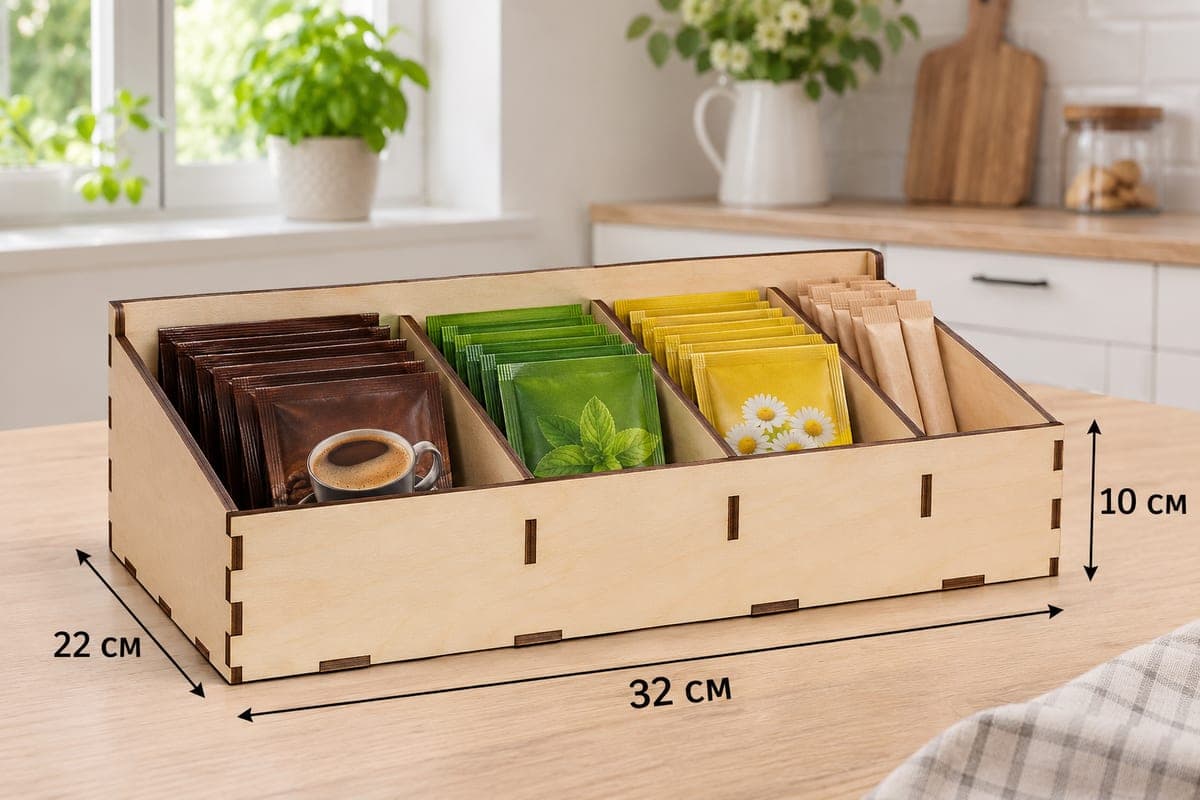
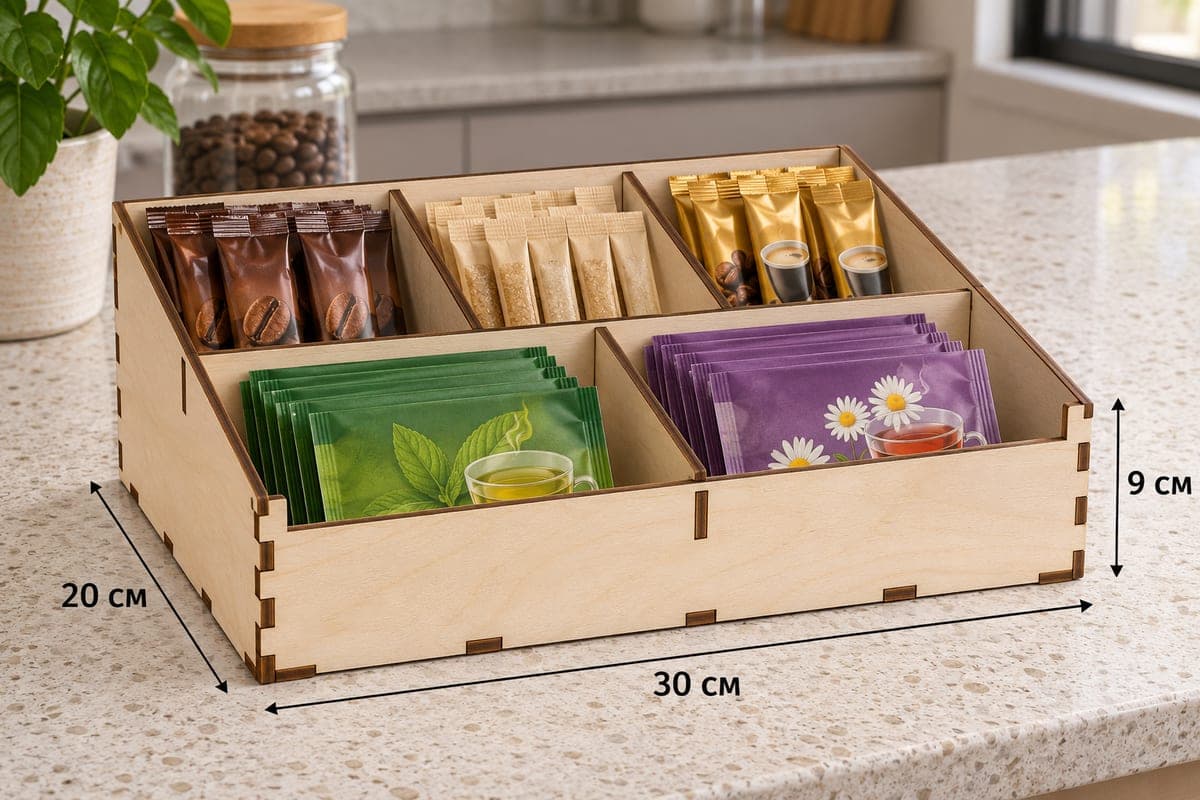
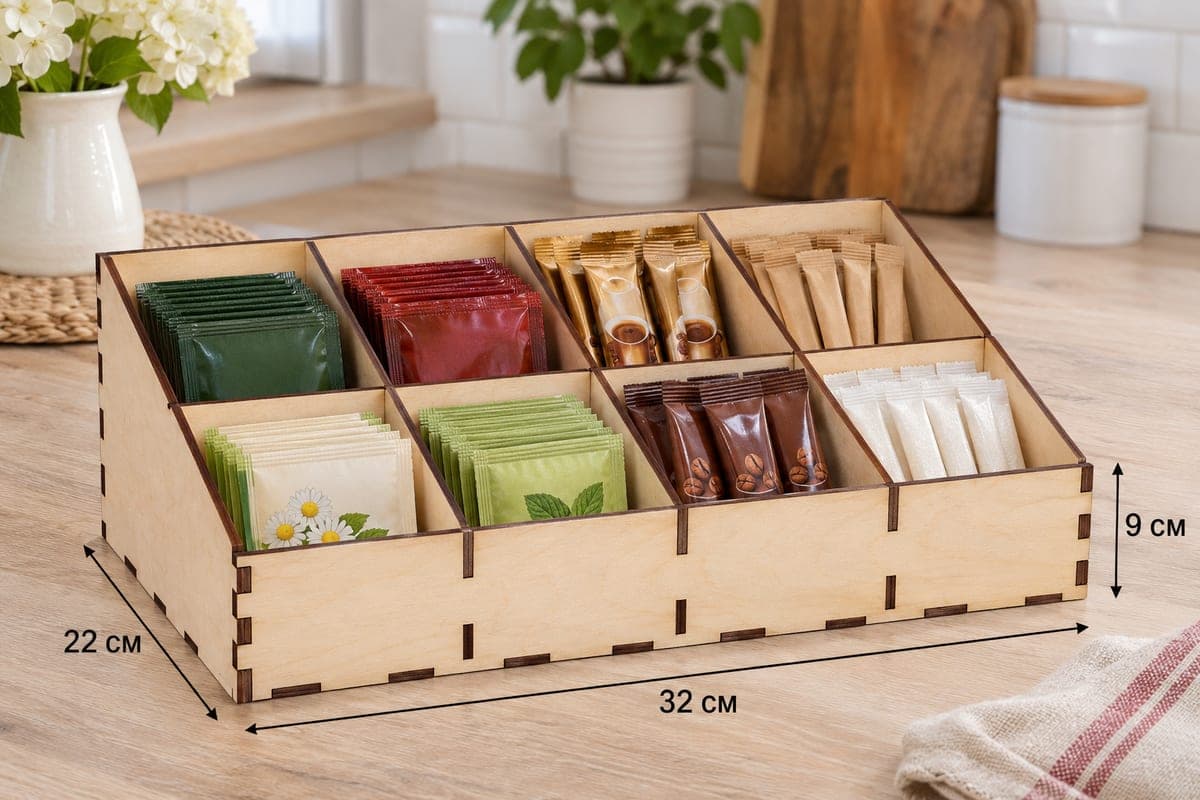
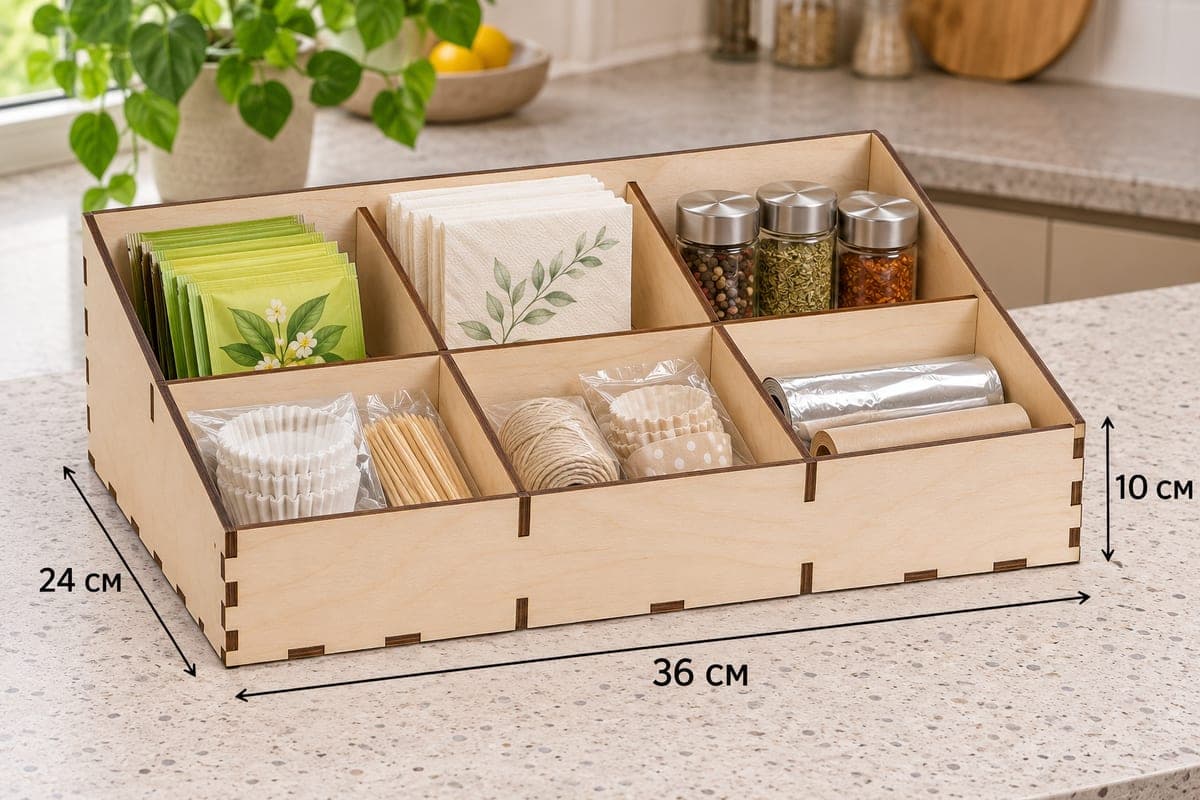
 Visualization
Tea Bag Drawer Organizer SVG, Low Six Lane Tea Box Laser Cut File, Tea Drawer Insert DXF, Wooden Tea Sachet Tray
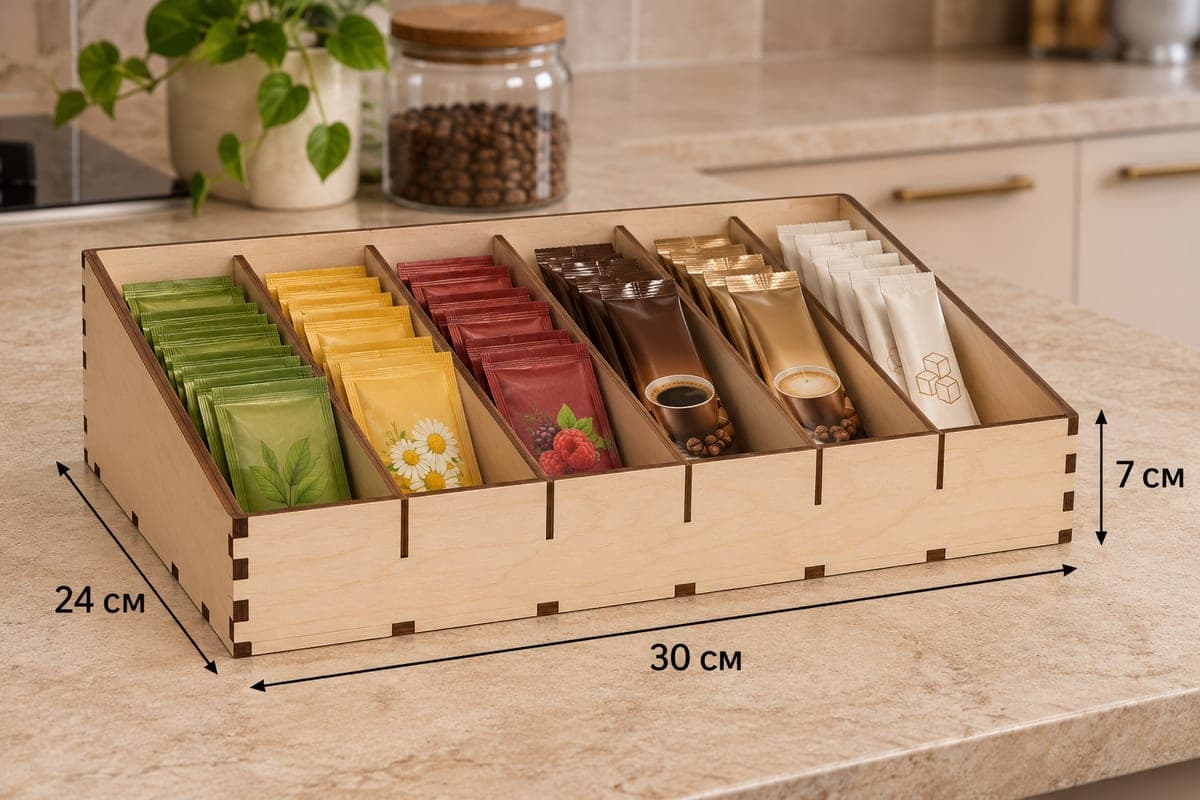
A low, deep tea bag organizer with six lanes running front to back, only 70 mm tall so it can go inside a kitchen drawer as well as on the counter. The free download has SVG and DXF files for 3, 4, 5 and 6 mm plywood; it measures 300 × 240 × 70 mm (11.81 × 9.45 × 2.76 in), is built from 10 pieces with tabs and slots, and slopes from a 70 mm back to a 42 mm front.
- Formats
- SVG, DXF
- Outer size (W × D × H)
- 300 × 240 × 70 mm (11.81 × 9.45 × 2.76 in)
- Parts
- 10
- Material thickness
- 3, 4, 5 or 6 mm plywood (a file for each)
- Layout size (3 mm file)
- 1,100 × 396 mm
- Cut length
- 8.10 m
- Est. time, 10 W diode (3 mm)
- 27 min 01 s
- Est. time, 40 W CO2 (3 mm)
- 11 min 15 s
- Layers
- CUT only, no engraving
Free account required to download
How to make it
- 01Measure your drawer, pick the file for your plywood thickness and cut one test slot to confirm the fit.
- 02Cut the 10 parts: base, back, front, two sloped sides and five identical 240 mm dividers.
- 03Glue the five dividers into the base slots, add the 70 mm back and both sides, and close it with the 42 mm front.
- 04Sand, oil the inside faces, set the organizer in the drawer and file one tea or coffee per lane.
Made for a drawer
At 70 mm this is the lowest box in the tea and coffee set, and at 240 mm it is also the deepest. That combination is what a kitchen drawer needs: tea bags stand on edge in long rows and the drawer still closes over them. Five dividers, each 240 mm long and 70 mm tall, divide the 300 mm width into six narrow lanes.
The photo shows a full row of six: green tea, chamomile, berry tea, dark coffee sachets, gold coffee sachets and white sugar sticks. Envelopes stand upright and lean back slightly toward the rear wall, so you read them like a card index. No other tea box here has a front as low as this 42 mm one; even on the counter you can see the faces of the first envelopes.
Fitting and cutting
Measure your drawer first: you need 300 × 240 mm of floor and enough height for the tallest sachets, which will stand above the 70 mm walls. The 3 mm layout is 1100 × 396 mm, so cut it in two or three jobs on a desktop machine. Set aside about 27 min 01 s for the 3 mm file on a 10 W diode, or about 11 min 15 s on a 40 W CO2 and about 5 min 24 s on a 100 W CO2. For a drawer insert, 3 mm keeps the lanes as wide as possible; 5 and 6 mm need more laser power or extra passes and narrow each lane.
The five dividers are identical. Glue them along the base so they stay parallel when the drawer slams.
Ideas for selling
- Sell it as a custom drawer insert, adjusting the outline to the buyer's drawer.
- Offer it with six teas as a housewarming set.
- Pitch it to tidy-kitchen fans who already buy drawer dividers.
Finish with a thin oil so the inside stays smooth for sliding envelopes in and out.
Questions about this file
Will it fit my kitchen drawer?
The drawer needs at least 300 mm of width and 240 mm of depth inside, with room above the 70 mm walls for your sachets.
Can I resize it for a different drawer?
Yes, change the outline in your software but keep each slot equal to your plywood thickness so the dividers still lock.
Which thickness should I cut for a drawer?
3 mm leaves the most room in each of the six lanes; thicker plywood is sturdier but makes every lane narrower.
Is MDF fine for a drawer insert?
MDF works for a drawer insert where it stays dry; check its real thickness first and choose the matching file.
Can I engrave labels for each lane?
The file has cut lines only; add small engraved names on the front panel above each lane if you like.
Similar files