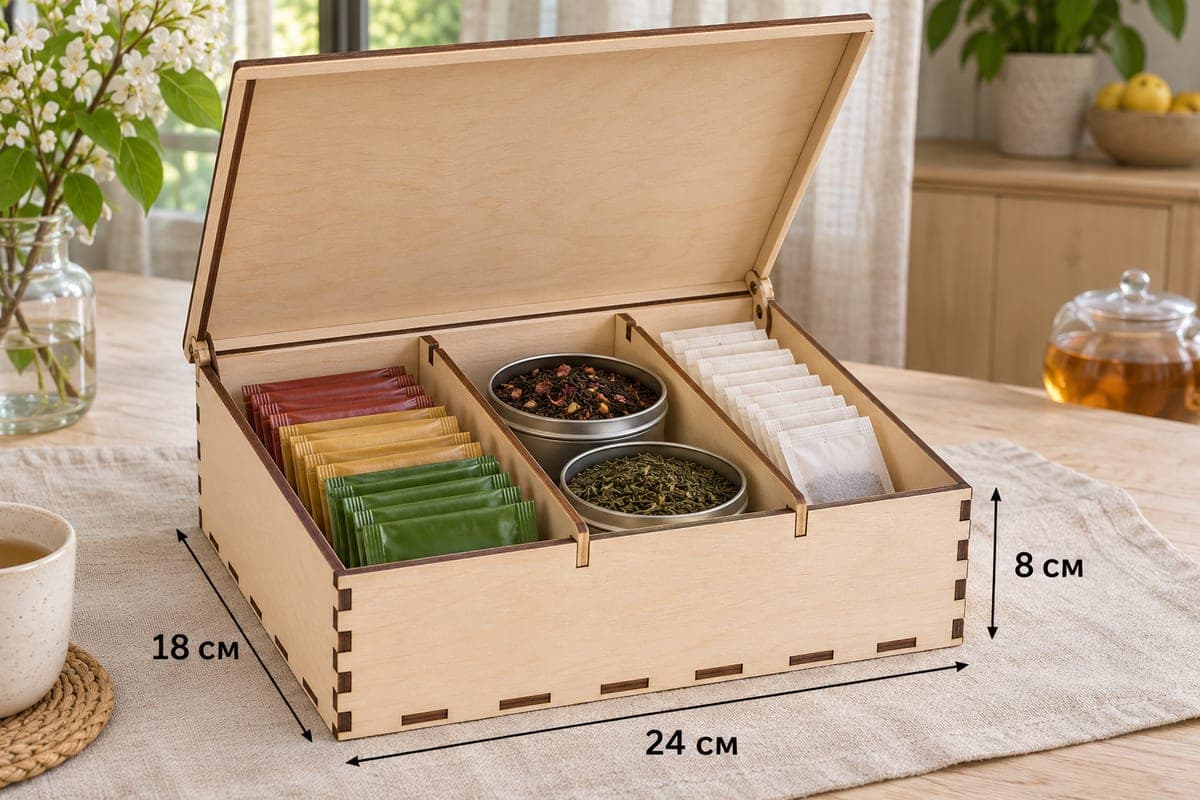
 Visualization
Hinged Tea Box SVG, Wooden Tea Chest Laser Cut File, Tea Bag Box With Flip Lid DXF, Tea Gift Box Pattern
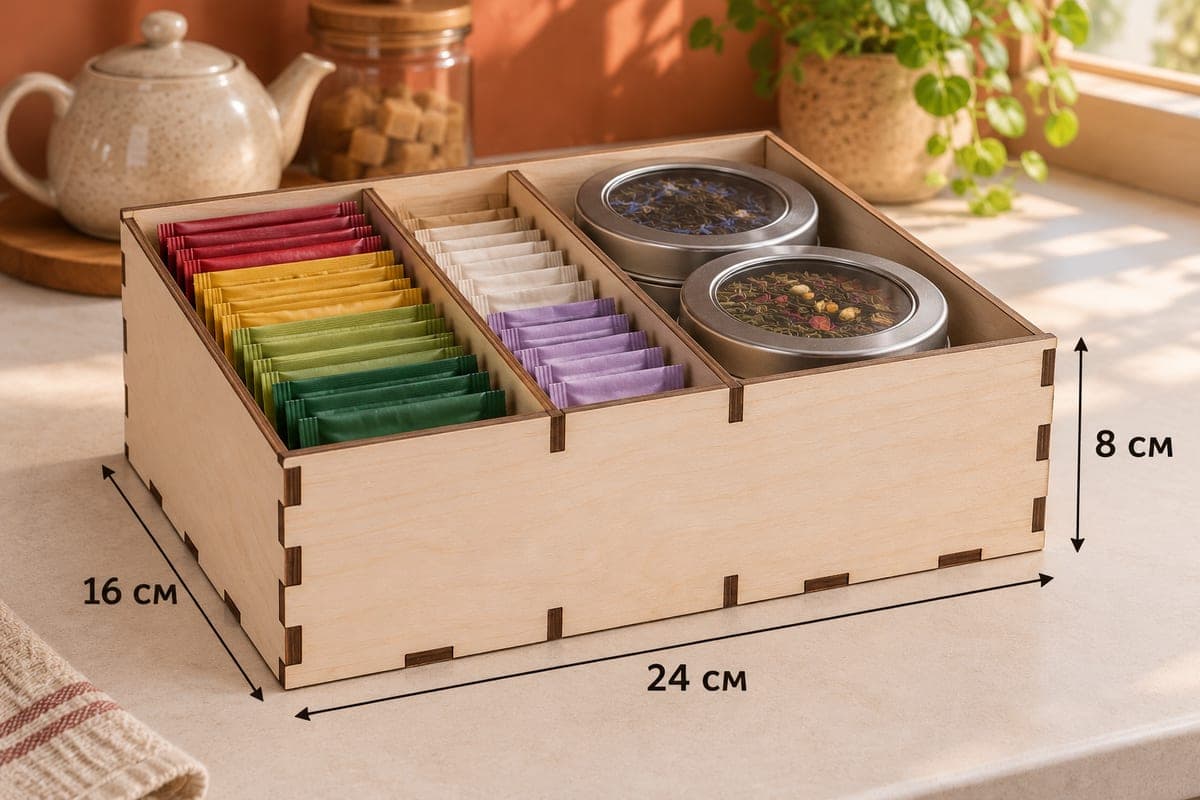
A free hinged tea chest whose lid flips open at the back on pins cut into the plywood, with 3 sections inside from left to right for tea bags and tins. Files come in SVG and DXF for 3, 4, 5 and 6 mm plywood; the chest measures 240 × 180 × 80 mm (9.45 × 7.09 × 3.15 in) and is assembled from 8 pieces with tabs and slots, with no metal hardware.
- Formats
- SVG, DXF
- Outer size (W × D × H)
- 240 × 180 × 80 mm (9.45 × 7.09 × 3.15 in)
- Parts
- 8
- Material thickness
- 3, 4, 5 or 6 mm plywood (a file for each)
- Layout size (3 mm file)
- 860 × 276 mm
- Cut length
- 6.21 m
- Est. time, 10 W diode (3 mm)
- 20 min 42 s
- Est. time, 40 W CO2 (3 mm)
- 8 min 37 s
- Layers
- CUT only, no engraving
Free account required to download
How to make it
- 01Grab the file made for your plywood thickness and cut one test slot first; the pivot works best when the tabs fit without force.
- 02Cut the base, front, back, two taller side walls, two dividers and the lid.
- 03Assemble the base and walls, add the dividers, then fit the lid so its pins sit in the side walls and test the swing.
- 04Ease any tight spot with sandpaper, finish the outside, and fill the three sections with bags and loose-leaf tins.
A lid that pivots on wood
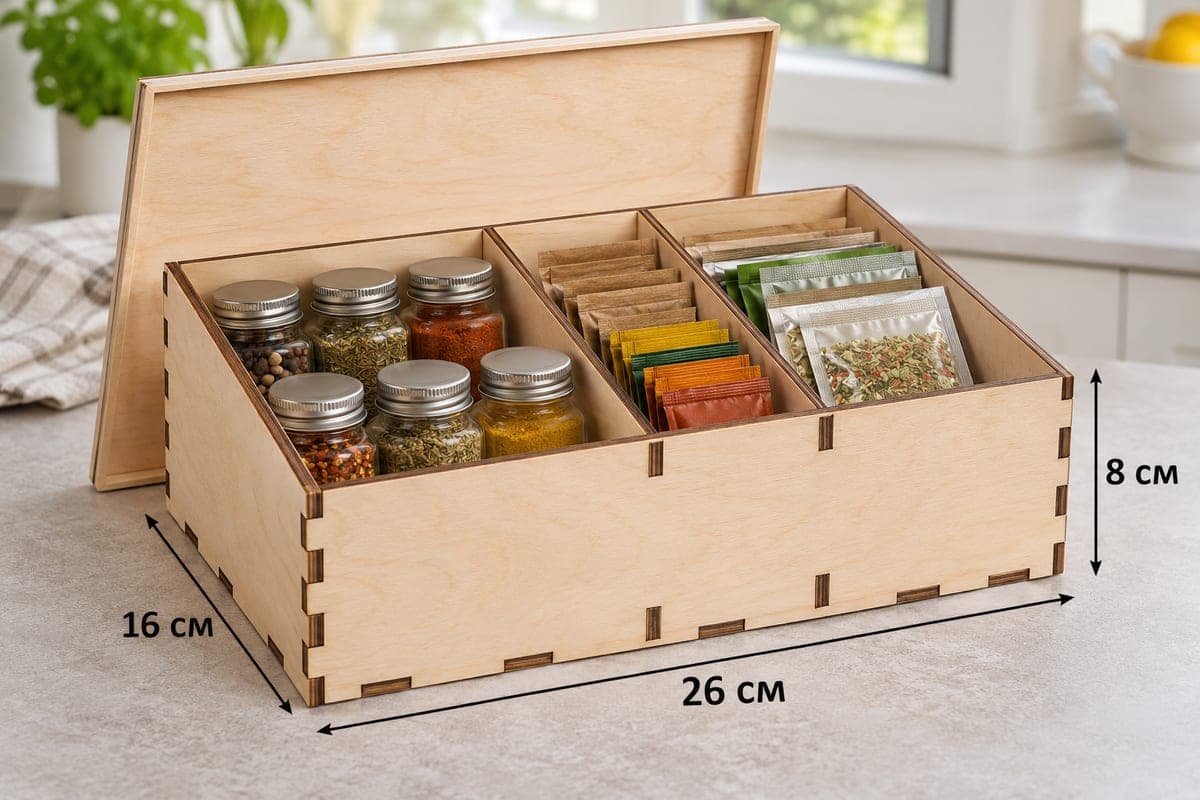
The two side walls are slightly taller at the back, and the lid turns on small pins that are part of the cut pieces, so the hinge is all plywood. Lift the front edge and the lid swings up and rests open, as in the photo, ready for someone to pick a tea. Close it and you have a tidy chest that looks good on a dining table or a sideboard.
Inside the chest
The photo shows red, yellow and green wrapped bags in the left section, two open tins of loose black and green tea in the middle and a row of white string-and-tag bags on the right. The dividers stand at about 90% of the wall height, low enough that the lid closes over them without rubbing.
Cutting and assembling
The 3 mm layout measures 860 × 276 mm; on a smaller bed cut the lid and base separately from the walls. The 3 mm file cuts in about 20 min 42 s on a 10 W diode, about 8 min 37 s on a 40 W CO2 and about 4 min 08 s on a 100 W CO2. Diode owners will find 3 and 4 mm the easiest; the 5 and 6 mm files need a lot more passes or a CO2.
Put the box together without glue first and check that the lid swings freely. If it binds, sand the back edge of the lid a touch. Once it moves well, glue the corners if you want, but keep glue away from the pivot.
A few gift ideas:
- A wedding or anniversary tea chest with initials you engrave on the lid.
- A teacher's gift filled with three favorite blends.
- A guest-room tea set for a holiday rental.
Finish with clear lacquer or oil so the lid stays smooth to the touch.
Questions about this file
Does the hinge need metal parts or screws?
No. The lid pivots on pins cut from the plywood itself, so everything you need comes off the laser.
Can the tea chest lid stay open while I pick a bag?
It swings up past vertical and leans back, staying open on its own while you choose a tea, as shown in the photo.
Will tins with a domed top still let the lid close?
Inside height is a little under 80 mm, so check your tins. Flat-topped tins around 70 mm tall fit comfortably.
Could the chest be cut from acrylic instead?
It is possible with the 3 mm file, but acrylic pins are brittle. Plywood gives a stronger, quieter hinge.
Should I glue the hinge?
Never glue the pins or the lid. Glue only the fixed corner joints, and only if you want the chest permanent.
Similar files