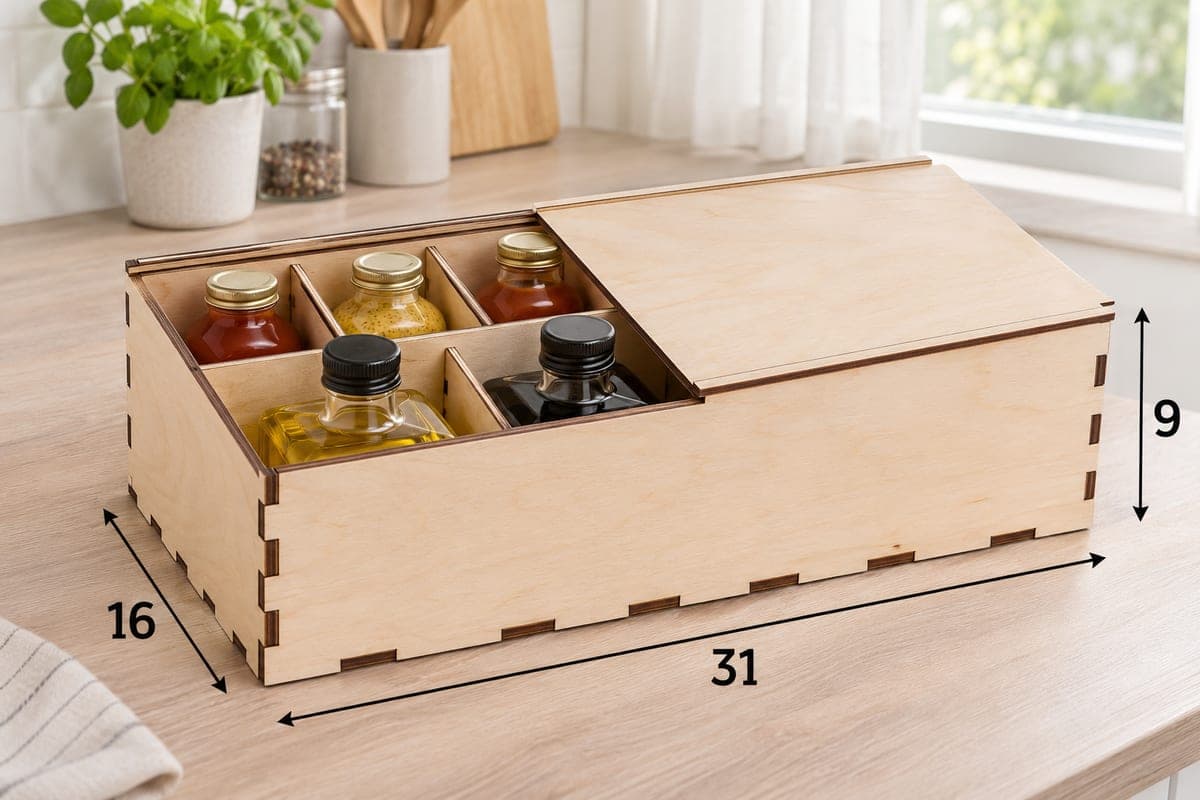
 Visualization
Condiment Box with Sliding Lid SVG, Sauce Jar Storage Laser Cut File, Wooden Hot Sauce Gift Box DXF
A free laser cut file for a six-section condiment box with a sliding lid, laid out as two rows of three for sauce jars, mustard and small oil bottles. It comes as SVG and DXF in separate versions for 3, 4, 5 and 6 mm plywood, and its 11 pieces, including two rails and the lid, assemble with tabs and slots into a 310 × 160 × 90 mm (12.20 × 6.30 × 3.54 in) box.
- Formats
- SVG, DXF
- Outer size (W × D × H)
- 310 × 160 × 90 mm (12.20 × 6.30 × 3.54 in)
- Parts
- 11
- Material thickness
- 3, 4, 5 or 6 mm plywood (a file for each)
- Layout size (3 mm file)
- 1,103 × 426 mm
- Cut length
- 8.80 m
- Est. time, 10 W diode (3 mm)
- 29 min 20 s
- Est. time, 40 W CO2 (3 mm)
- 12 min 14 s
- Layers
- CUT only, no engraving
Free account required to download
How to make it
- 01Open the file for your sheet thickness and cut the two rails with a short strip of scrap to test how the lid will run.
- 02Cut the 11 parts on two sheets, base and lid on one, walls, dividers and rails on the other.
- 03Fit base, back and sides, cross the long divider with the two short ones, add the rails, slide the lid in, and close up with the front wall.
- 04Smooth the lid edges, lacquer everything and load the back row with jars and the front row with bottles.
Six pockets under one lid
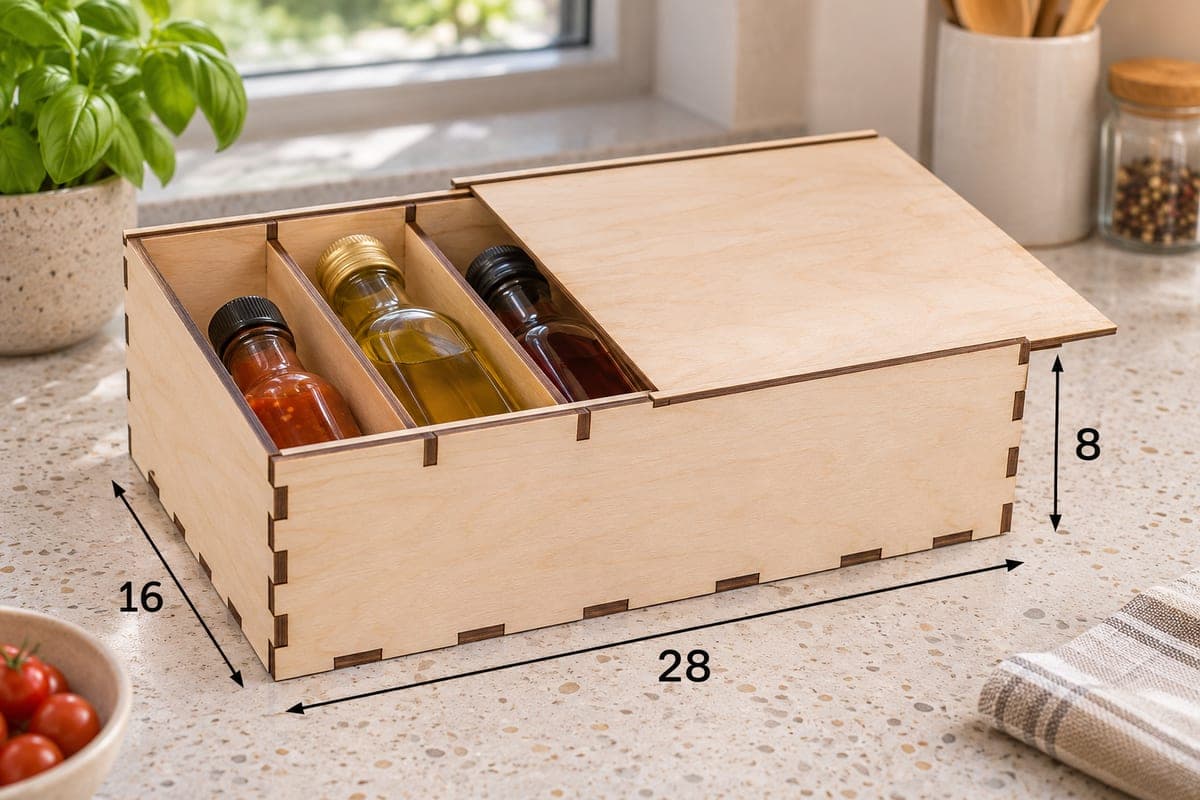
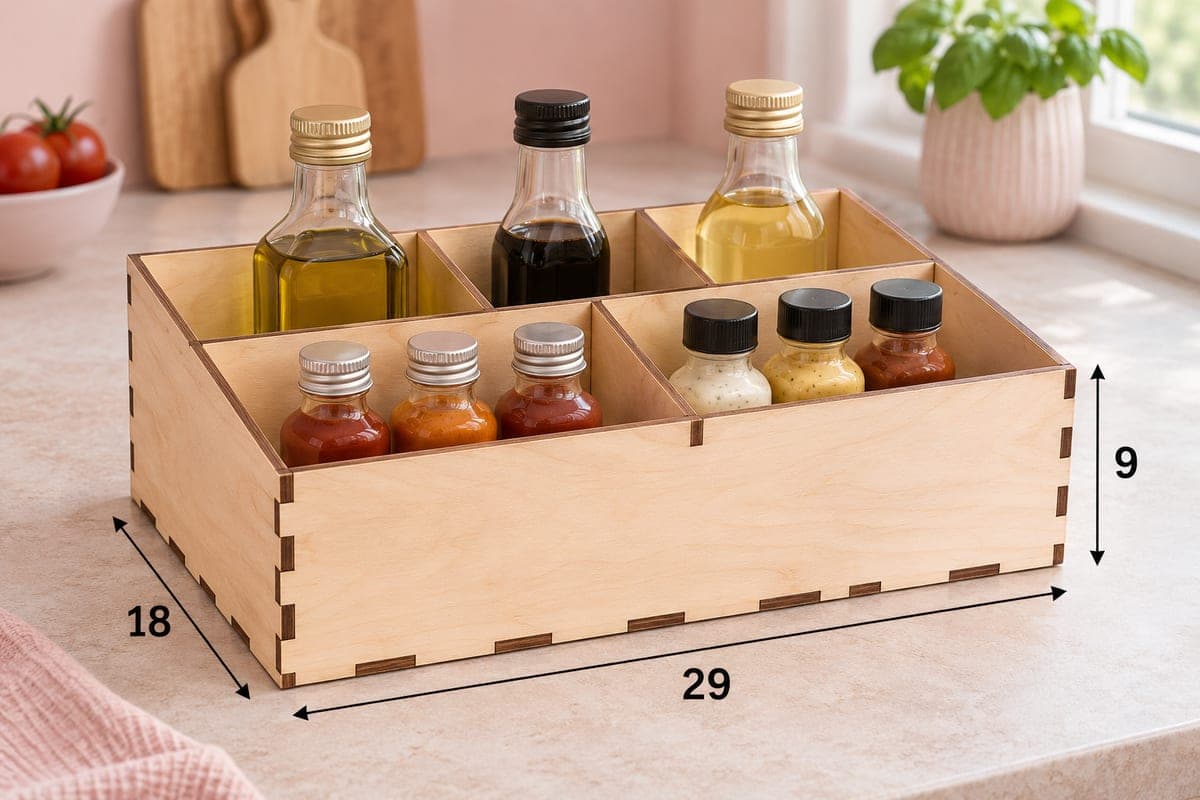
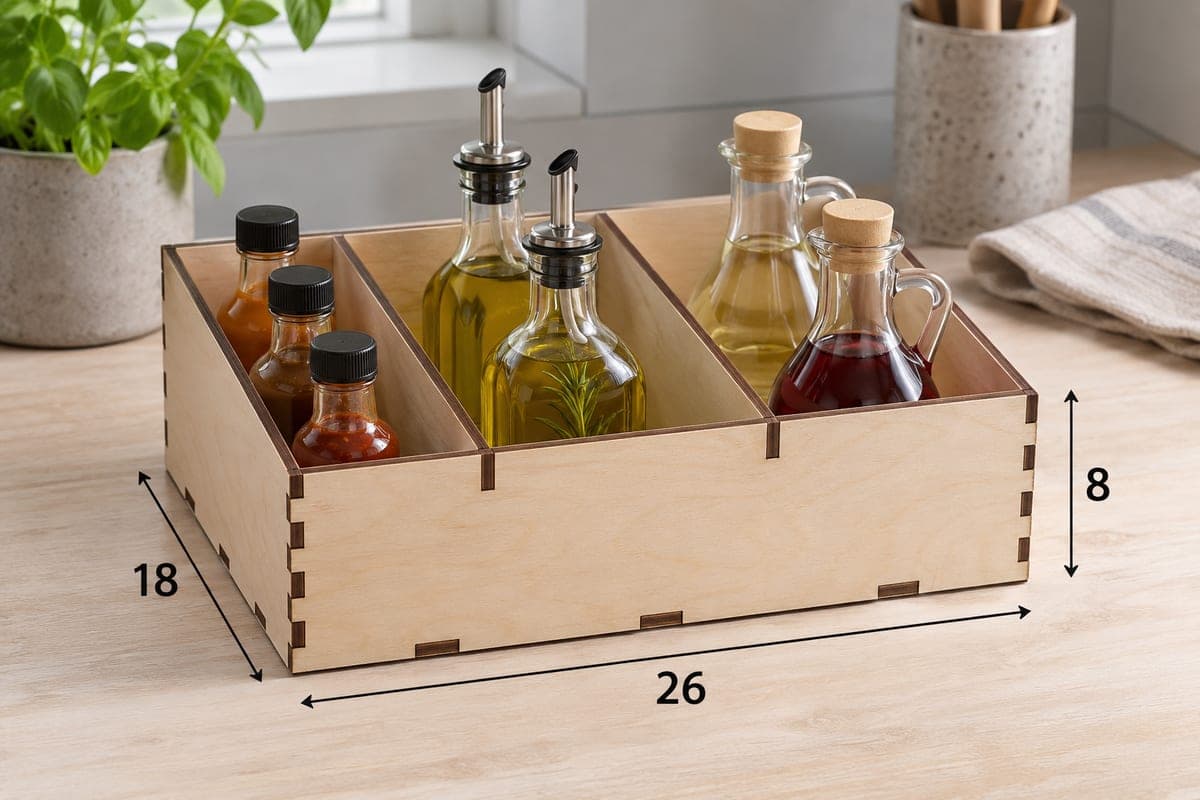
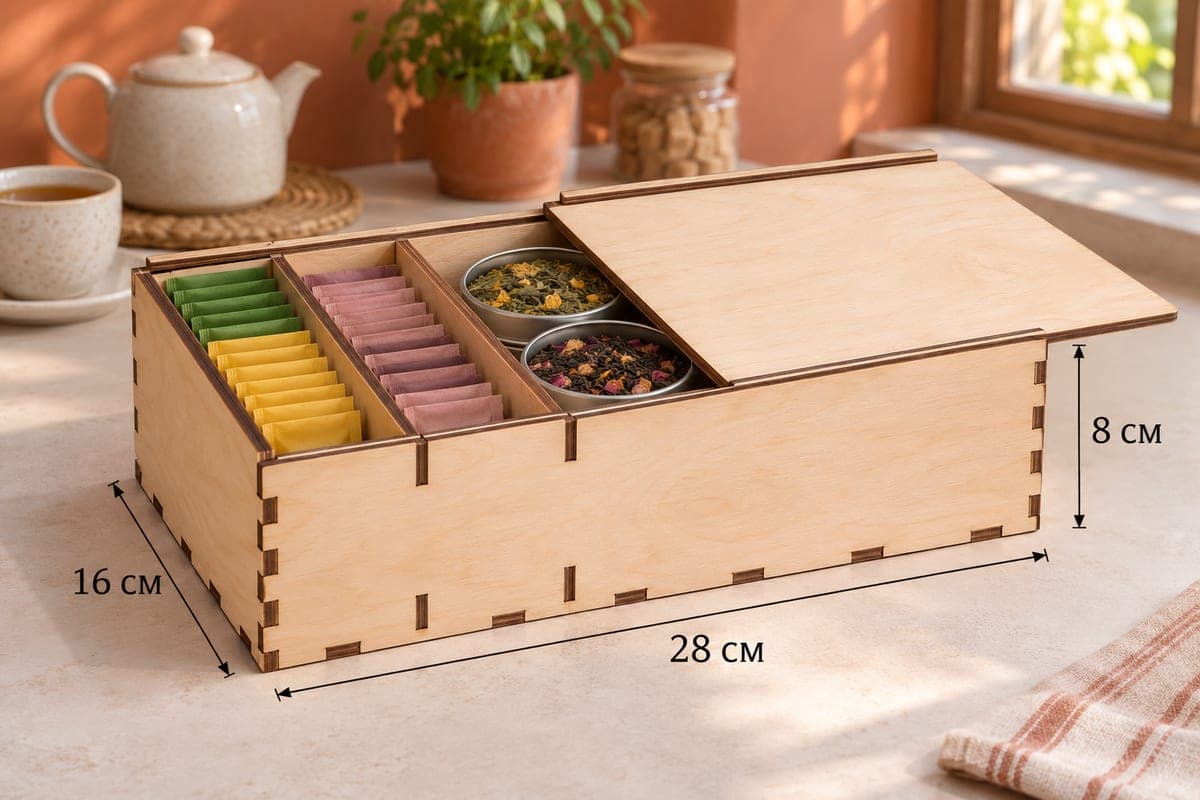
One long divider runs the full 310 mm length and two short ones cross it, giving a grid of three columns in two rows. In the photo the back row holds a red pepper sauce, a mustard and a chilli sauce in squat jars with gold lids, while the front row carries a bottle of olive oil and a dark soy sauce. The lid is shown pushed back over the right part of the box; it slides in on two rails and comes right out when you want open access. There is no hinge and no catch, which keeps the build simple.
Before you press start
Cutting time for the 3 mm file is about 29 min 20 s on a 10 W diode, about 12 min 14 s on a 40 W CO2 and about 5 min 52 s on a 100 W CO2. The 3 mm layout is 1103 × 426 mm, wider than most desktop beds, so place the 303.4 × 159.7 mm lid and the 310 mm base on separate sheets and nest the walls, dividers and rails around them. On a diode, 3 mm goes through in one or two passes; 5 and 6 mm need a CO2 or a lot of patience. Check the slide with the rails and lid before you fit the 83.7 mm front wall, since the lid passes over it.
Who buys a box like this
Hot sauce fans collect small bottles, and a lidded box turns a shelf of them into a display. Sell it filled with six local sauces as a tasting gift, or brand the lid for a farmers market stall. At home, finish it with clear lacquer and it lives on the counter without collecting dust.
Questions about this file
How big are the six sections?
The grid divides a 310 × 160 mm footprint into three columns and two rows, so each pocket is roughly 100 mm wide and 75 mm deep after the walls. That is right for a 200 ml jar or a small sauce bottle.
Can the lid come off completely?
Yes, it slides out of the rails at the open end. Lift it off to fill the box, then slide it back when you are done.
My plywood is 3.2 mm. Which file should I use?
Start with the 3 mm file and test one rail and slot on scrap. If the lid binds, sand its edges rather than switching files.
Can it stand near the sink?
Only once sealed. Coat all faces with polyurethane or a hardwax oil, and avoid standing it in water.
Can I engrave each pocket's contents on the lid?
You can add an engraving layer with six small labels in your laser software; the file itself only has cut lines. Engrave before the cut pass so nothing shifts.
Similar files