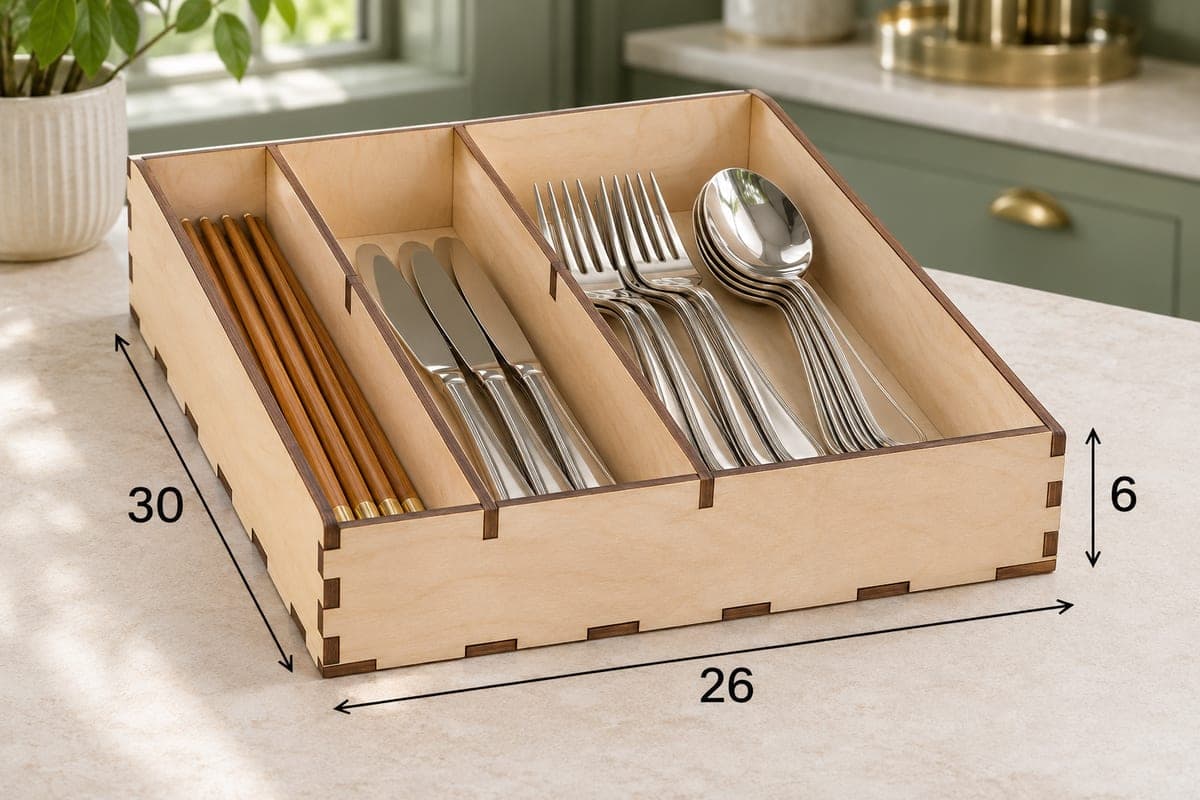
 Visualization
Flatware Organizer Box SVG, Wooden Silverware Drawer Box Laser Cut File, Three Compartment Utensil Tray DXF
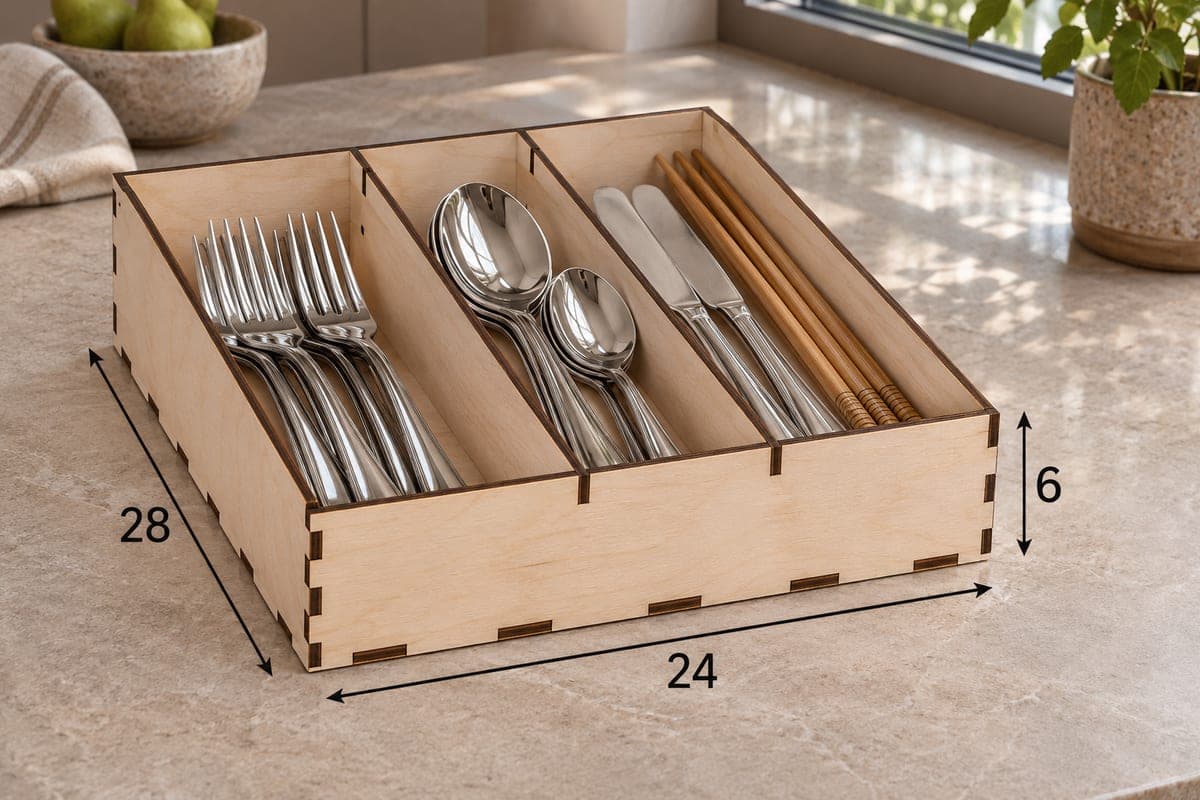
An open flatware box with three bays whose two dividers slot into the walls and base, made for knives, forks, spoons and chopsticks. It measures 260 × 300 × 60 mm (10.24 × 11.81 × 2.36 in), is cut from 7 plywood pieces that assemble with tabs and slots, and is a free SVG and DXF download with separate files for 3, 4, 5 and 6 mm plywood.
- Formats
- SVG, DXF
- Outer size (W × D × H)
- 260 × 300 × 60 mm (10.24 × 11.81 × 2.36 in)
- Parts
- 7
- Material thickness
- 3, 4, 5 or 6 mm plywood (a file for each)
- Layout size (3 mm file)
- 1,140 × 372 mm
- Cut length
- 7.17 m
- Est. time, 10 W diode (3 mm)
- 23 min 54 s
- Est. time, 40 W CO2 (3 mm)
- 9 min 57 s
- Layers
- CUT only, no engraving
Free account required to download
How to make it
- 01Open the folder for your plywood thickness and cut one divider slot on a scrap strip to confirm the tab fit.
- 02Cut the base, front, back, two sides and the two long dividers, moving the base to its own sheet if the bed is small.
- 03Join the four walls around the base, then press the two dividers down into their slots from above.
- 04Sand, oil or lacquer the box, and decide which bay gets knives, forks, spoons or chopsticks.
How the bays are used
Two full-depth dividers create three bays in this 300 mm long box. The photo shows a practical split: chopsticks in the left bay, table knives in the middle, and forks and spoons sharing the right bay. You can just as easily give each utensil its own bay and keep chopsticks elsewhere. The length takes dinner knives without tilting them, and the 60 mm walls stay below the height of most drawer runners. Because the box is open, it also works on the counter as a caddy for a weekly set of everyday cutlery.
Thickness and cutting time
Choose the file by what your laser can handle. A 10 W diode gets through 3 mm plywood in one or two passes, and the 3 mm file takes about 23 min 54 s on it. A 40 W CO2 needs about 9 min 57 s, a 100 W CO2 about 4 min 47 s. For 5 or 6 mm stock a diode needs several slow passes, so a CO2 is the better tool there. The 3 mm parts sit on a 1140 × 372 mm area; on a smaller bed, put the base alone on one sheet and the six strips on another.
The dividers hold by their own slots, so you can leave them unglued and lift them out to wash the box. Glue only the outer corners if you want a firm shell with removable dividers.
Make it a set
Cut a second box in the same depth for kitchen utensils and line them up in a wide drawer. A matching chopstick rest or napkin tray makes a tidy gift bundle for someone moving into a new flat.
Questions about this file
Can the dividers be taken out for washing?
Yes, they slot in from above and come out again if you leave them unglued. That makes it easy to wipe crumbs out of the corners.
Do chopsticks fit along the 300 mm length?
Standard 230 to 240 mm chopsticks lie flat with room left over. Very long cooking chopsticks over about 290 mm will not fit.
Would MDF hold up in a flatware box?
MDF cuts cleanly and the joints fit just as well, but it swells if it gets wet. Seal every surface well if it will hold freshly washed cutlery.
Why should I keep the slot width the same when resizing?
Each slot is drawn to the thickness of your sheet. If you resize the whole drawing, the slots grow or shrink with it and the dividers no longer fit.
Which thickness should a beginner pick?
Start with 3 mm. It cuts fastest, forgives small focus errors and is stiff enough for a 60 mm high flatware box.
Similar files