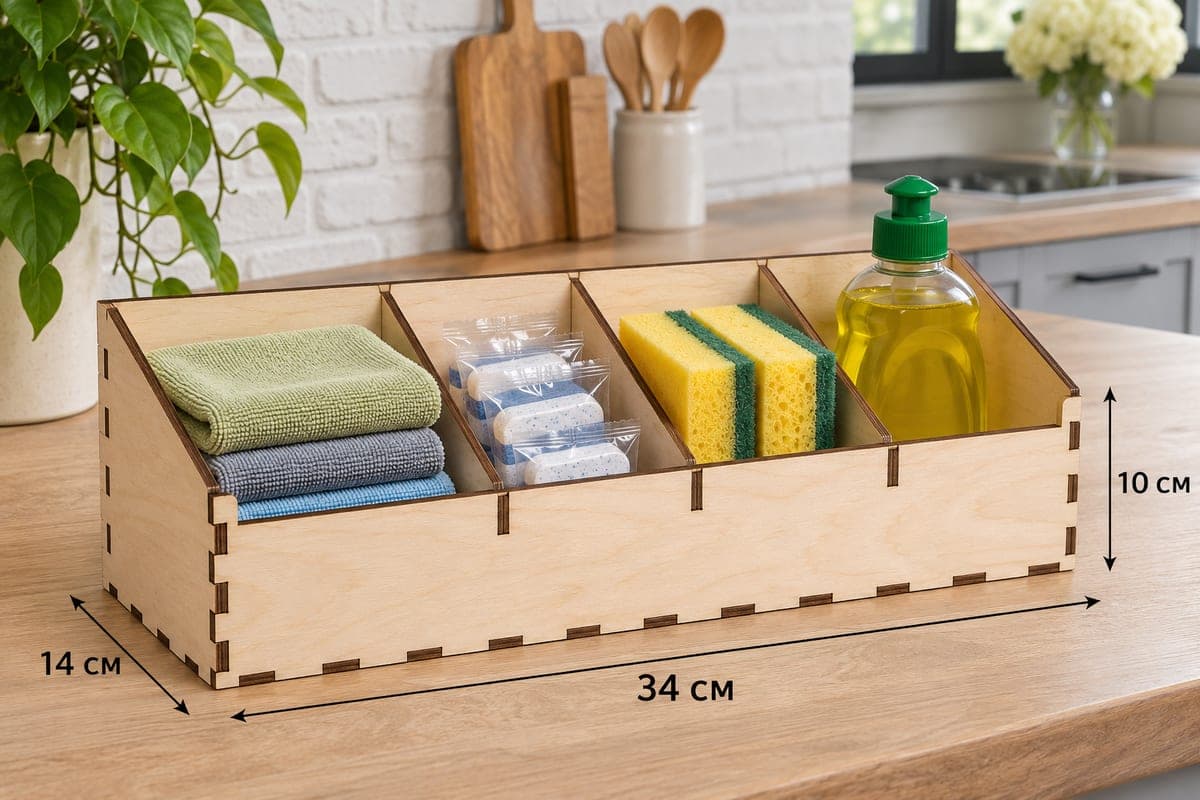
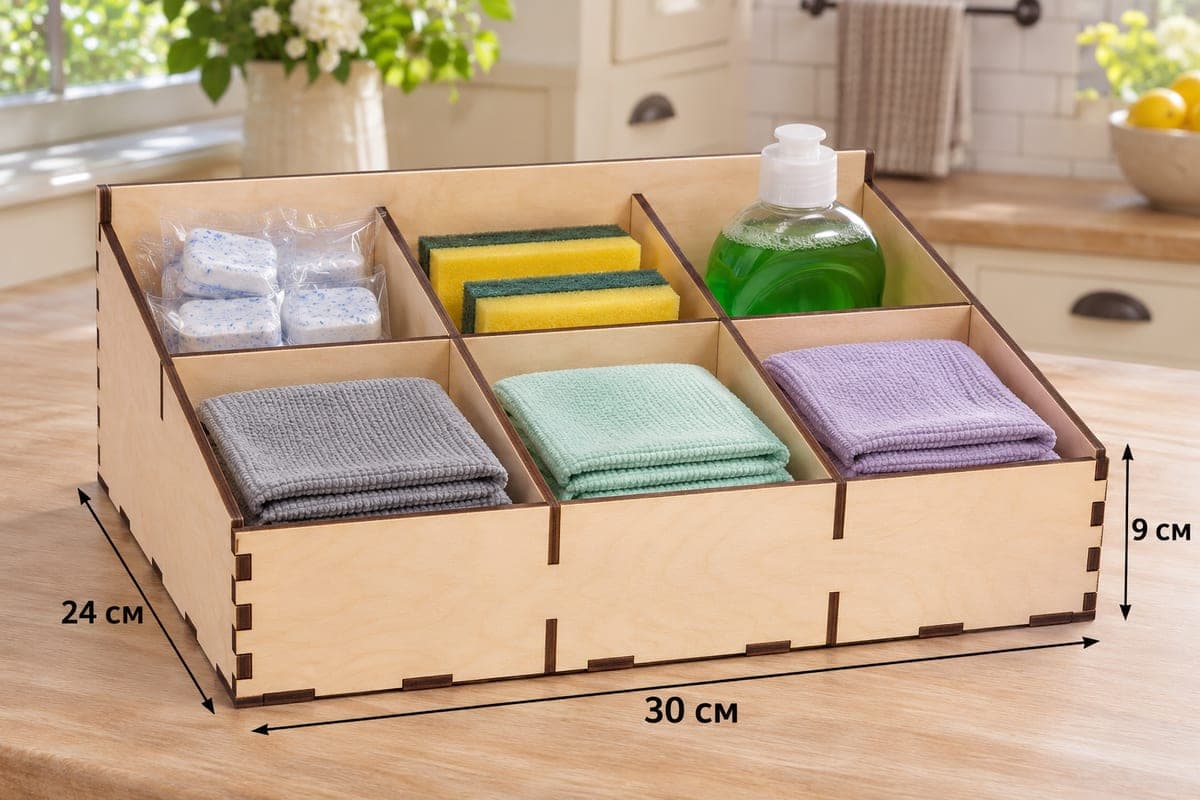
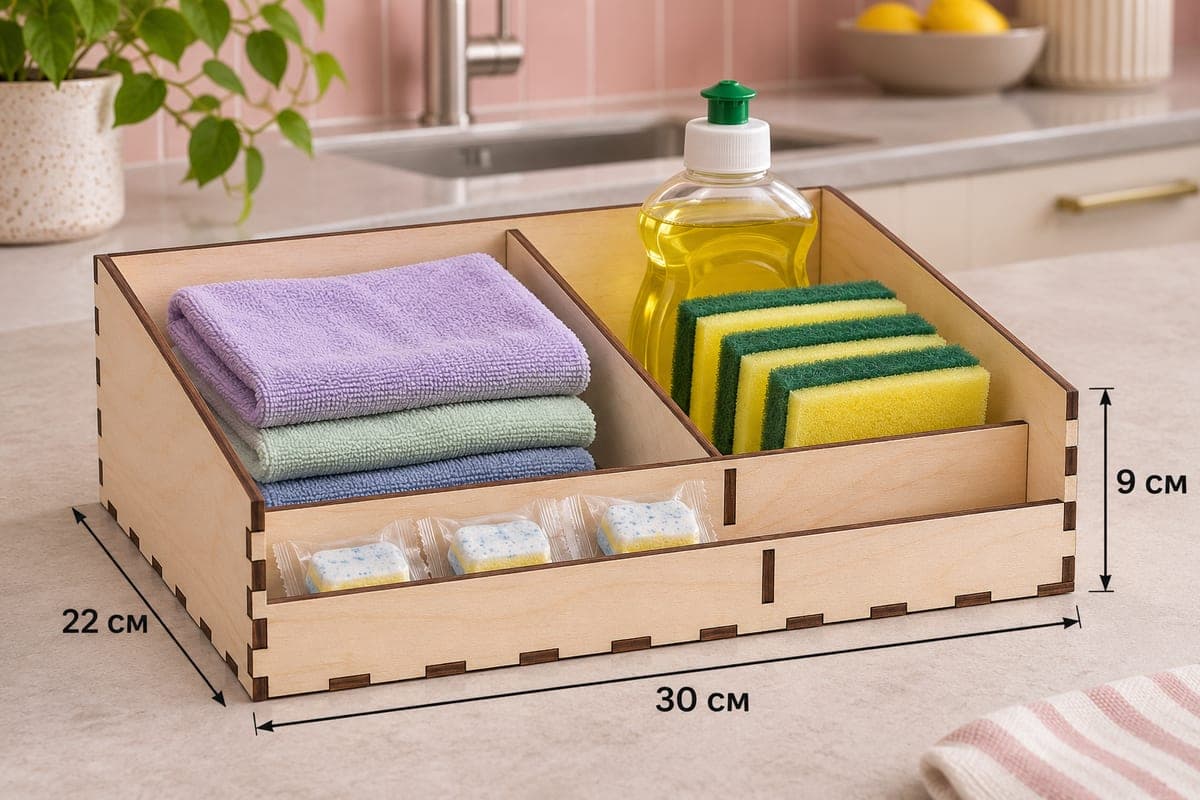
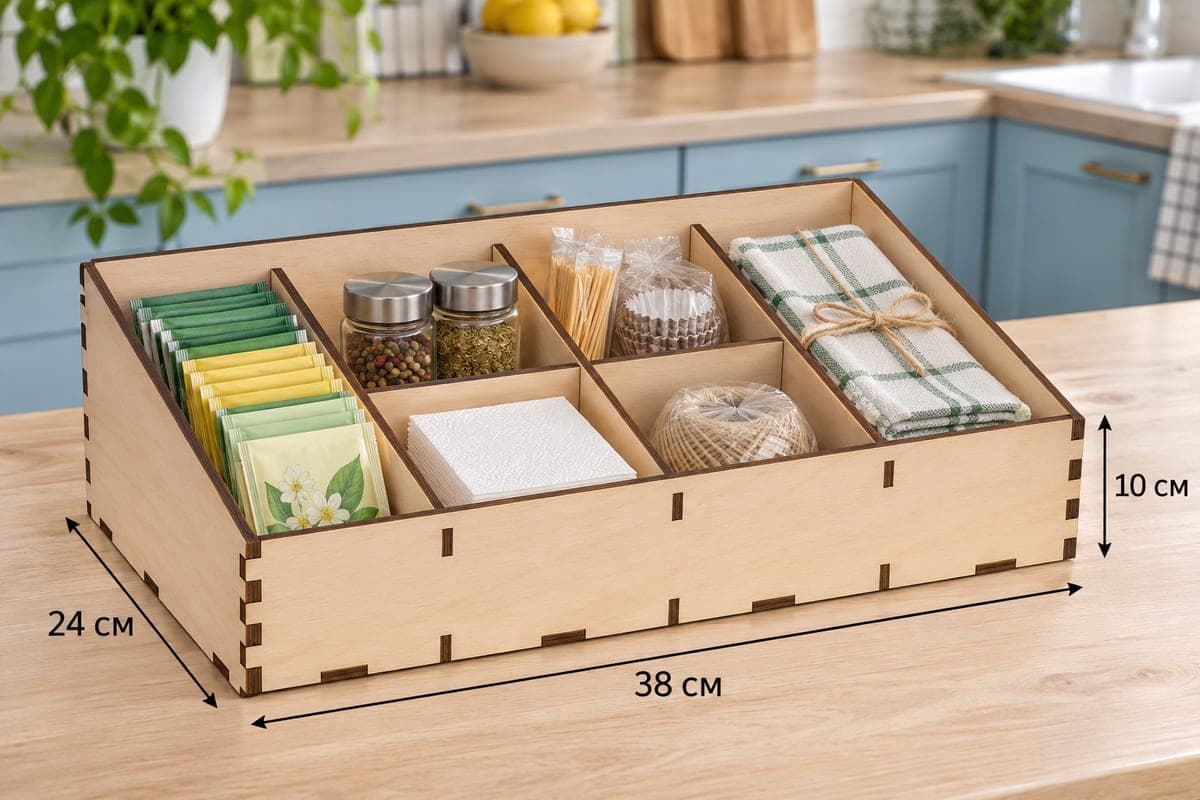
 Visualization
Dish Brush Holder SVG, Sponge and Soap Caddy Laser Cut File, Stepped Sink Organizer DXF, Wooden Cleaning Box
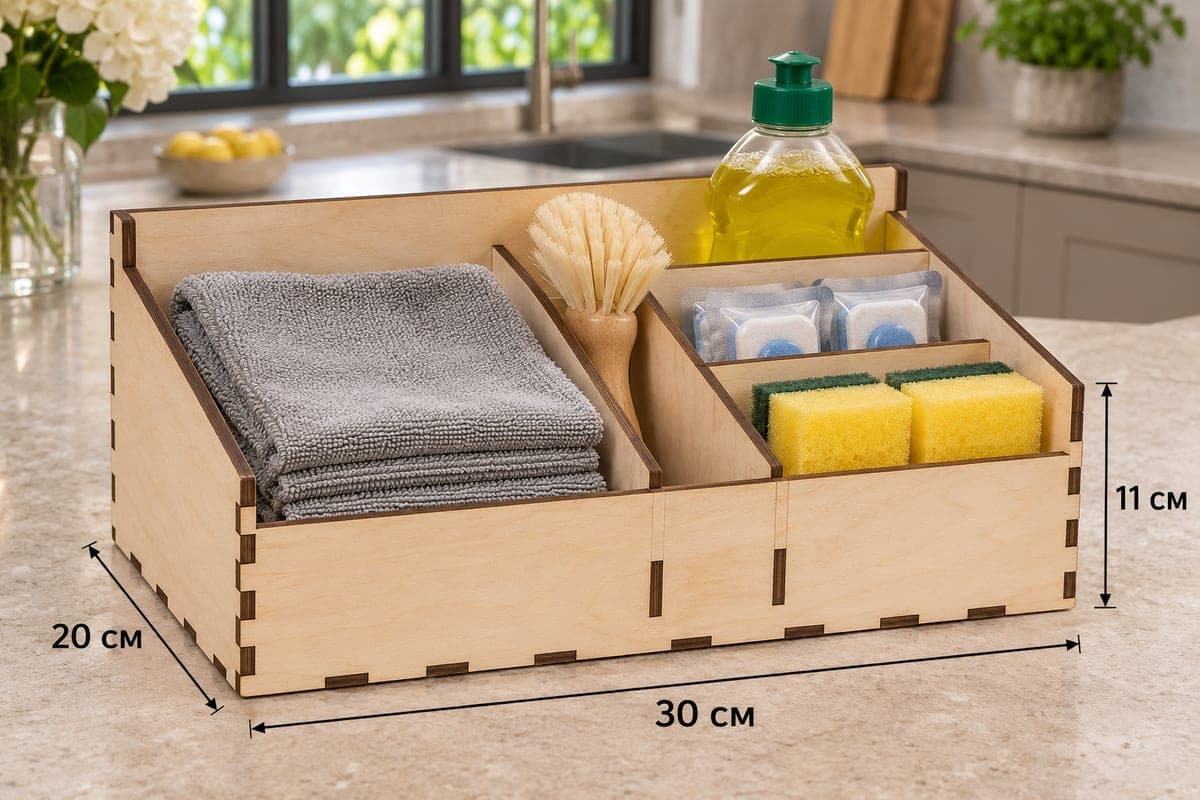
A laser cut file for a dish brush and sponge caddy with a sloped front: a wide bay for cloths, a narrow upright slot for a dish brush, and three stepped bays for soap, tablets and sponges. It comes as SVG and DXF for 3, 4, 5 and 6 mm plywood, measures 300 × 200 × 110 mm (11.81 × 7.87 × 4.33 in) outside, and has 9 pieces with tab-and-slot joints and 5 compartments. The brush caddy files can be downloaded for free.
- Formats
- SVG, DXF
- Outer size (W × D × H)
- 300 × 200 × 110 mm (11.81 × 7.87 × 4.33 in)
- Parts
- 9
- Material thickness
- 3, 4, 5 or 6 mm plywood (a file for each)
- Layout size (3 mm file)
- 1,020 × 322 mm
- Cut length
- 6.49 m
- Est. time, 10 W diode (3 mm)
- 21 min 38 s
- Est. time, 40 W CO2 (3 mm)
- 9 min 01 s
- Layers
- CUT only, no engraving
Free account required to download
How to make it
- 01Open the SVG or DXF for your plywood thickness and cut a test slot to confirm the fit before the full run.
- 02Cut the nine parts: front, back, two sloped sides, base, two long dividers and two cross dividers of different heights.
- 03Build the outer walls on the base, fit both long dividers, then add the taller cross divider at the back of the right column and the lower one in front of it.
- 04Sand, seal against water, then stand the brush in the narrow middle slot and fill the stepped bays with soap, tablets and sponges.
Five compartments, one for the brush
Two long dividers split this caddy into three columns. The left column is the widest and in the photo holds a stack of folded grey cloths. The middle column is narrow, made for a dish brush to stand upright with its head up and dry. The right column is split by two cross dividers of different heights, 95 mm and 80 mm, so its three bays step down from back to front: dish soap at the back, wrapped dishwasher tablets in the middle, and two sponges at the front. The back wall is 110 mm and the front 61 mm.
Thickness and cut time
For the 3 mm file: about 21 min 38 s on a 10 W diode, about 9 min 01 s on a 40 W CO2 and about 4 min 20 s on a 100 W CO2. A 10 W diode needs one or two passes for 3 mm; 5 and 6 mm plywood means more power or extra passes. The 3 mm layout is 1020 × 322 mm, so on a compact machine cut the base and back on one sheet and the walls and dividers on another.
Assembly and finishing
Put in the two long dividers first, then the taller cross divider behind the shorter one in the right column. The joints hold without glue, though wood glue is worth using here because a wet brush leans on the middle slot. Sand the edges and seal the whole caddy with a waterproof finish; plywood next to a sink will swell if left bare.
Ideas: sell it as a dish brush and sponge station, include a wooden brush in a gift version, or offer the caddy in pairs for a kitchen and a utility sink.
Questions about this file
Will my dish brush fit in the middle slot?
The slot suits a standard round-head brush with a straight handle, as in the photo. Check that the head fits the slot width if your brush is extra large.
Why are the two cross dividers different heights?
They follow the sloped sides, so the right column steps down from back to front. Fit the taller one at the back.
Does a wet brush damage the plywood?
It will if the wood is bare. Seal the caddy with polyurethane or hard wax oil on all faces and edges and let the brush drain.
Can I cut it from acrylic?
Yes, use the 3 mm file with 3 mm acrylic and cement the joints. Acrylic is fully water-resistant.
Can I engrave a name on the front?
The file has no engraving, but you can add a name or a word to the front panel in your laser software before cutting.
Similar files