 Visualization
Five Compartment Cutlery Tray SVG, Two Row Flatware Organizer Laser Cut File, Teaspoon Drawer Tray DXF
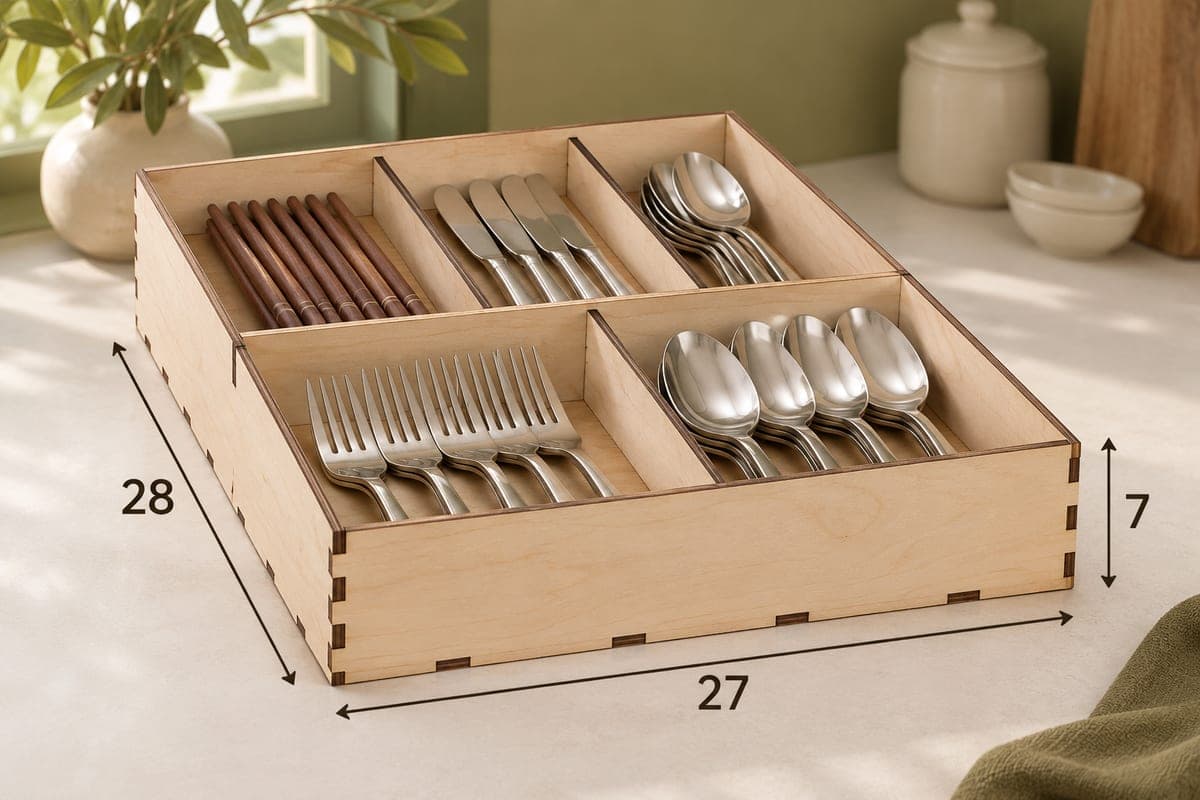
An open cutlery tray split by a cross divider into two rows: two compartments in the front row and three in the back, five in all. It measures 270 × 280 × 70 mm (10.63 × 11.02 × 2.76 in), is made of 9 plywood pieces that fit together with tabs and slots, and is a free SVG and DXF download with separate files for 3, 4, 5 and 6 mm plywood.
- Formats
- SVG, DXF
- Outer size (W × D × H)
- 270 × 280 × 70 mm (10.63 × 11.02 × 2.76 in)
- Parts
- 9
- Material thickness
- 3, 4, 5 or 6 mm plywood (a file for each)
- Layout size (3 mm file)
- 1,120 × 362 mm
- Cut length
- 6.80 m
- Est. time, 10 W diode (3 mm)
- 22 min 40 s
- Est. time, 40 W CO2 (3 mm)
- 9 min 27 s
- Layers
- CUT only, no engraving
Free account required to download
How to make it
- 01Pick the folder for your sheet thickness and test the cross-divider slot on an offcut first.
- 02Cut the base, four 70 mm walls, the cross divider and the three short dividers.
- 03Slot the cross divider into the base, add one short divider in front and two behind, then close the box with the outer walls.
- 04Sand and seal the tray, then sort teaspoons, dessert forks and small knives into the five compartments.
Two rows of short compartments
A single cross divider runs left to right through the tray. In front of it one divider makes two wide compartments; behind it two dividers make three narrower ones. The divider pieces show the depths: about 155 mm for the front row and about 128 mm for the back row, minus the wall thickness. Those are short lanes, so this tray suits teaspoons, coffee spoons, dessert forks, cake forks and butter knives better than full-size dinner cutlery. Measure your longest piece before cutting. In the photo the front row holds forks and spoons, and the back row carries a bundle of chopsticks, knives and teaspoons. At 70 mm the walls are a little taller than a typical tray, so small spoons do not tip over the top.
Cutting and putting it together
For the 3 mm file expect about 22 min 40 s on a 10 W diode, about 9 min 27 s on a 40 W CO2, or about 4 min 32 s on a 100 W CO2. The parts take 1120 × 362 mm in 3 mm, so a compact machine needs the base on one sheet and the remaining eight strips on another. Fit the long cross divider first, then the short dividers that slot against it, then the outer walls. The joints hold without glue; add a drop to each corner if the tray will be lifted out often.
Selling ideas
- A dessert-cutlery tray for cafes and bakeries that set out cake forks and teaspoons.
- A coffee station organizer for spoons, stirrers and sugar sticks.
- Bundle it with a full-size cutlery tray as a two-piece drawer set.
Questions about this file
Are the compartments long enough for dinner knives?
Usually not. The rows are roughly 150 and 120 mm deep inside, which fits teaspoons, dessert forks and butter knives; check your own cutlery first.
Why are the walls 70 mm and not 60 mm?
The extra height keeps short spoons and stirrers from sliding over the top. Check that 70 mm clears the drawer above before cutting.
Can I make the back row longer?
You could move the cross divider in a vector editor, but every divider and slot would need redrawing. Keep slot widths equal to the plywood thickness.
Will it work as a coffee bar organizer?
Yes. The five small bays suit spoons, stirrers, sugar packets and tea bags. Seal it well against spills.
Which plywood thickness is best here?
3 or 4 mm keeps the five compartments roomy. Thicker sheet works but eats into the small lanes.
Similar files