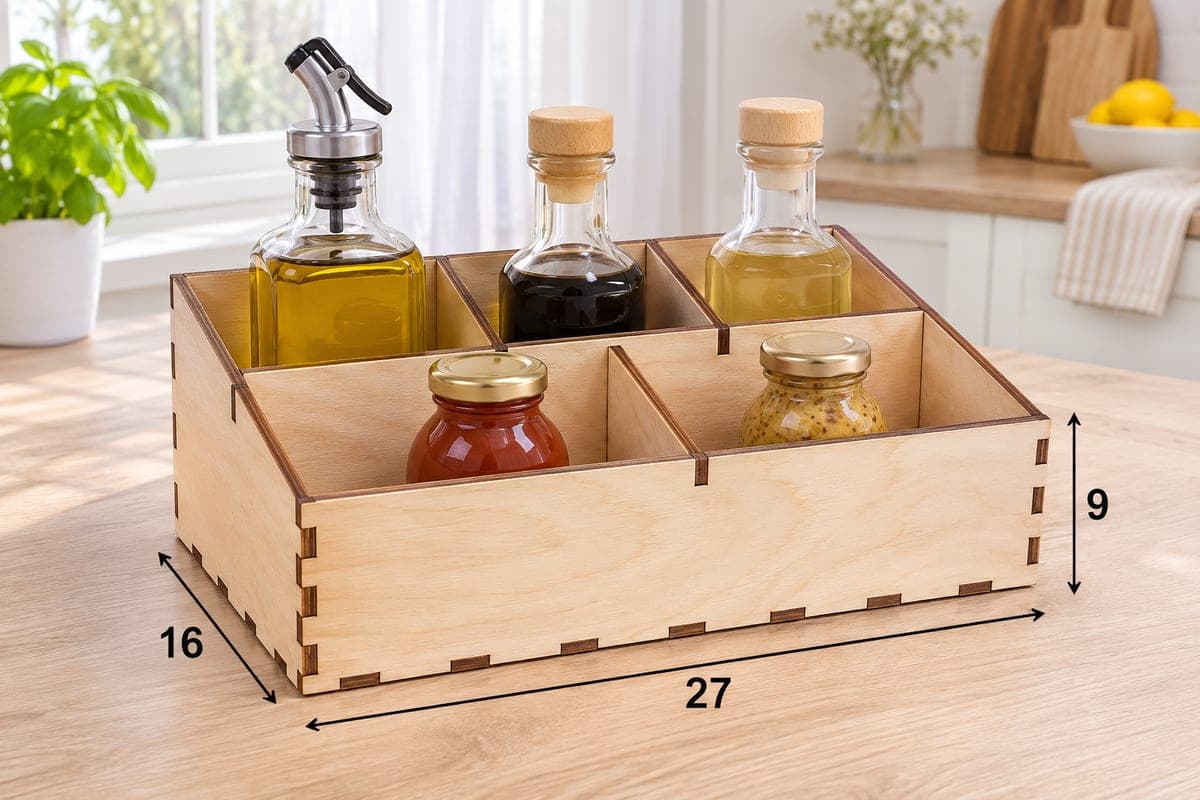
 Visualization
Condiment Organizer SVG, Sloped Oil and Vinegar Tray Laser Cut File, Kitchen Counter Caddy DXF
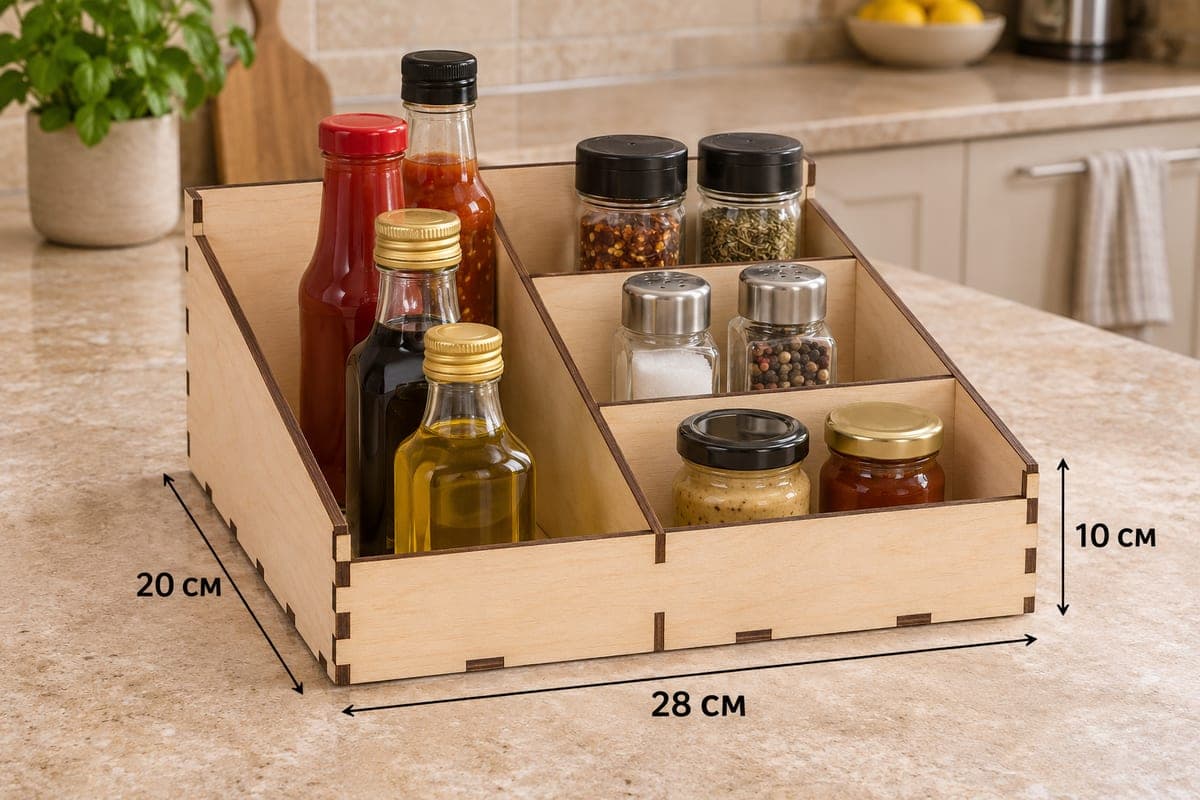
A free laser cut file for an open condiment organizer with five compartments: three tall bays at the back for oil and vinegar bottles and two lower pockets in front for jars, behind a front wall that is lower than the back so the sides slope down. The download has SVG and DXF in separate versions for 3, 4, 5 and 6 mm plywood, and the 9 pieces fit with tabs and slots into a 270 × 160 × 90 mm (10.63 × 6.30 × 3.54 in) organizer.
- Formats
- SVG, DXF
- Outer size (W × D × H)
- 270 × 160 × 90 mm (10.63 × 6.30 × 3.54 in)
- Parts
- 9
- Material thickness
- 3, 4, 5 or 6 mm plywood (a file for each)
- Layout size (3 mm file)
- 880 × 262 mm
- Cut length
- 5.63 m
- Est. time, 10 W diode (3 mm)
- 18 min 46 s
- Est. time, 40 W CO2 (3 mm)
- 7 min 49 s
- Layers
- CUT only, no engraving
Free account required to download
How to make it
- 01Select the thickness folder for your plywood and check the cross divider slot on a scrap before cutting the full sheet.
- 02Cut the 9 parts and sort the three short dividers: the low one belongs to the front row, the two tall ones to the back.
- 03Build from the back forward: base and back wall, back-row dividers, cross divider, front-row divider, then the sloped sides and low front.
- 04Sand the sloped edges, seal against oil and put bottles at the back and jars in the two front pockets.
Two rows, five pockets
A long cross divider splits the tray into a back row and a front row. The back row has three bays behind dividers 90 mm tall, which is where the bottles go: in the photo an olive oil with a steel pourer, a corked balsamic and a lighter oil stand there. The front row is two wider pockets with walls only 71.6 mm high, holding a jar of tomato sauce and a jar of grainy mustard. The outer front wall drops to 54 mm, so from a standing position you see every lid and label at once.
Cut list and assembly order
The 9 parts are front, back, two sloped sides, base, the cross divider and three short dividers (one low for the front row, two full height for the back). Expect about 18 min 46 s on a 10 W diode for the 3 mm file of this condiment tray, about 7 min 49 s on a 40 W CO2, or about 3 min 45 s with a 100 W CO2. Heavier 5 or 6 mm plywood takes a CO2 or several diode passes. The layout is 880 × 262 mm, so smaller beds need two or three sheets. Start with the base and back, add the two back-row dividers, slide the cross divider over them, place the low front-row divider, and finish with the sides and front. Tabs and slots hold it dry, and a little glue in the corners makes it solid.
Ideas for gifts and stalls
Paired with two oils and two homemade preserves it becomes a ready gift hamper. Market sellers can offer it in natural birch and in a dark stain, side by side, so buyers pick the one that matches their kitchen.
Questions about this file
Why are the front pockets lower than the back bays?
Short jars sit in front and tall bottles behind, so lowering the front row lets you see and grab everything without lifting the bottles out. It also gives the tray its stepped look.
How many oil bottles can stand behind the cross divider?
One standard oil or vinegar bottle per bay, three in total. The 160 mm depth is shared between the two rows, so the back bays suit square or round bottles up to about 70 mm across.
Is 6 mm plywood too heavy for this tray?
It works and feels very solid, but the inside shrinks a little and a diode laser needs several passes. For bottles on a counter, 3 or 4 mm is plenty.
Can I seal it so a spilled vinegar does not stain?
Two coats of water-based polyurethane on all inner faces protect it well. Wipe spills promptly; vinegar can still mark raw edges you missed.
Can I swap the five pockets for a different layout?
The dividers are separate pieces, so you can leave out the low front divider for one long front pocket. Fill its slot with a dot of glue or wood filler.
Similar files