 Visualization
Compact Napkin Tray SVG, Five Pocket Kitchen Table Organizer Laser Cut File, Straw and Toothpick Holder DXF
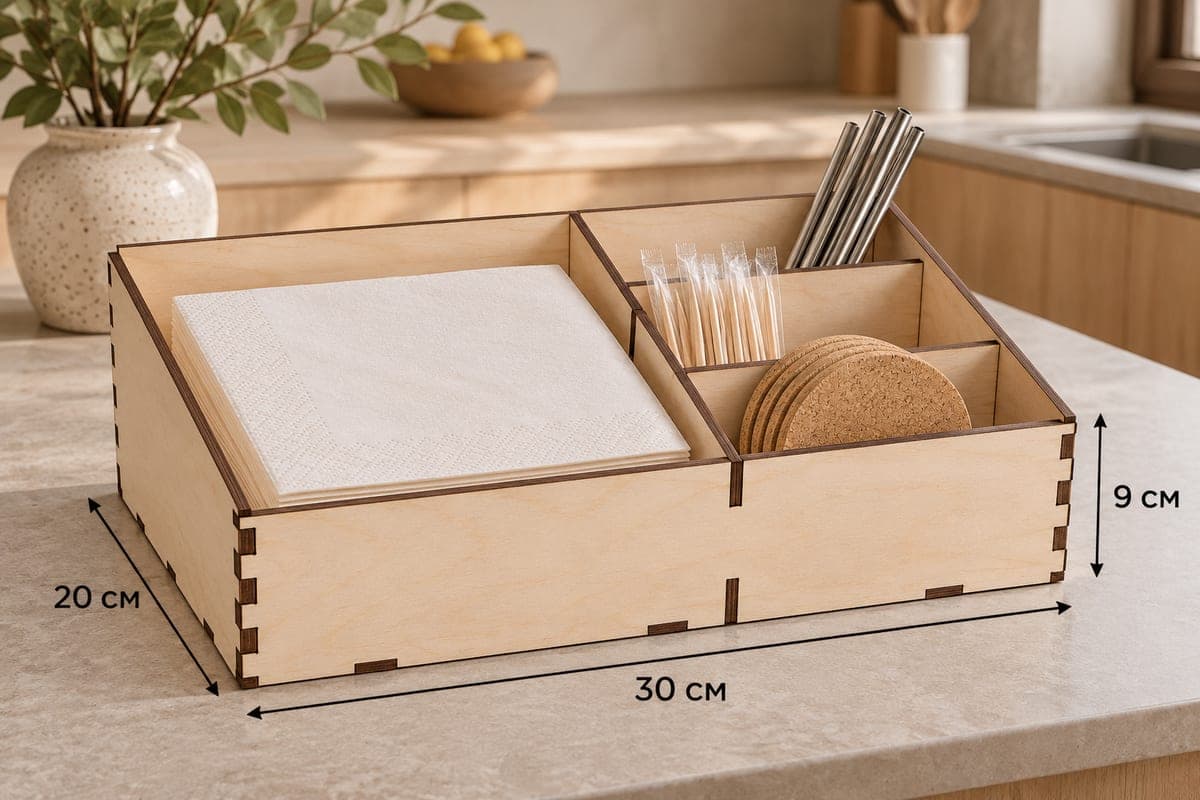
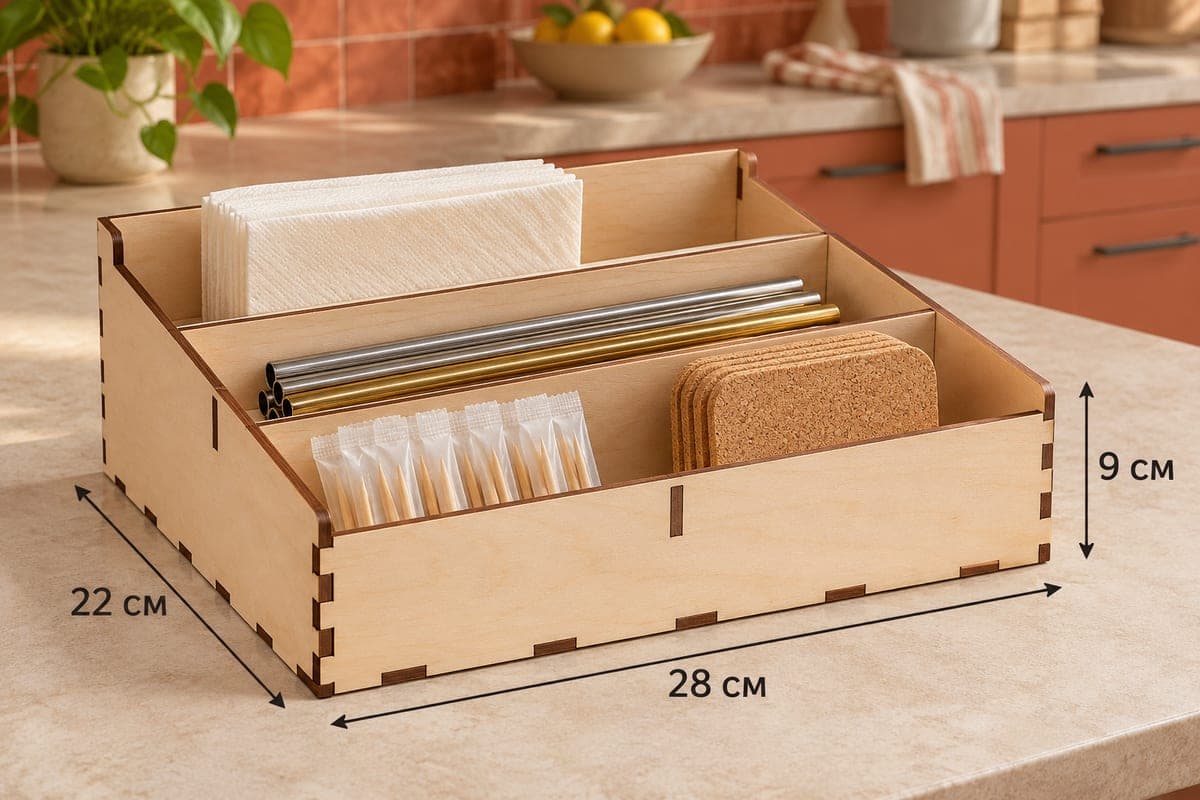
A compact napkin tray with five pockets, two at the back and three in front, for napkins, straws, toothpicks and coasters on a small table. It is offered as SVG and DXF with separate files for 3, 4, 5 and 6 mm plywood, measures 280 × 220 × 90 mm (11.02 × 8.66 × 3.54 in), has 9 pieces, a front lower than the back, and assembles with tabs and slots. Free to download in eight files.
- Formats
- SVG, DXF
- Outer size (W × D × H)
- 280 × 220 × 90 mm (11.02 × 8.66 × 3.54 in)
- Parts
- 9
- Material thickness
- 3, 4, 5 or 6 mm plywood (a file for each)
- Layout size (3 mm file)
- 1,020 × 322 mm
- Cut length
- 6.23 m
- Est. time, 10 W diode (3 mm)
- 20 min 47 s
- Est. time, 40 W CO2 (3 mm)
- 8 min 39 s
- Layers
- CUT only, no engraving
Free account required to download
How to make it
- 01Choose the file that matches your plywood and test one slot on scrap.
- 02Cut the base, back, low front, two sloped sides, the cross divider, the tall back divider and the two front dividers.
- 03Fit the back divider and the two front dividers onto the cross divider, set the frame in the base, then add sides, back and front.
- 04Sand, oil or lacquer, then put napkins and straws at the back and toothpicks and coasters in the three front pockets.
Five pockets in a small footprint
This tray is a little narrower and lower than the tall five-compartment caddy: 280 mm long with a 90 mm back and a 54 mm front. A cross divider runs across the full width; one divider splits the back row into two slots and two more split the front row into three pockets. In the photo it holds a bundle of folded napkins, metal and gold straws, wrapped toothpicks and a stack of square cork coasters.
At 280 by 220 mm it leaves room for plates on a two-person table and sits easily on a narrow kitchen shelf. The lower back means it does not look bulky on a small table.
Cutting and building the frame
The 3 mm layout is 1020 × 322 mm. For the 3 mm file, allow about 20 min 47 s on a 10 W diode, about 8 min 39 s on a 40 W CO2 and about 4 min 09 s on a 100 W CO2. A diode cuts 3 mm in one or two passes; 5 and 6 mm need several, or a CO2 laser. On a 400 mm bed, cut the base alone and gather the rest on a second sheet.
The back divider is the tallest of the three. Slot it behind the cross divider, slide the two front dividers in front, and set the whole frame into the base. Fit the sloped sides, then the back and the low front. Glue is not required.
Finishing and ideas for selling
Sand the top edges until they are smooth to the touch, then seal with clear oil or lacquer. Small cafes with two-seat tables often want several matching trays; quote a price per ten. A family name engraved on the back makes it a personal kitchen gift.
Questions about this file
How is this different from the tall five-compartment caddy?
It has the same two-plus-three pocket layout but is 280 mm long and 90 mm tall at the back, so it suits smaller tables.
Will metal straws stand upright?
Standard 215 mm straws stand in the back slot and lean against the 90 mm back wall.
Which thickness should I cut for a cafe?
4 or 5 mm gives a sturdy tray that survives daily handling; 3 mm is fine for home use.
Can I shrink it further?
Yes, but after scaling set the slot width back to your plywood thickness so the tabs still fit tightly.
Is it OK to cut it in acrylic?
Yes, in a matching thickness; frosted acrylic hides fingerprints better than clear.
Similar files